
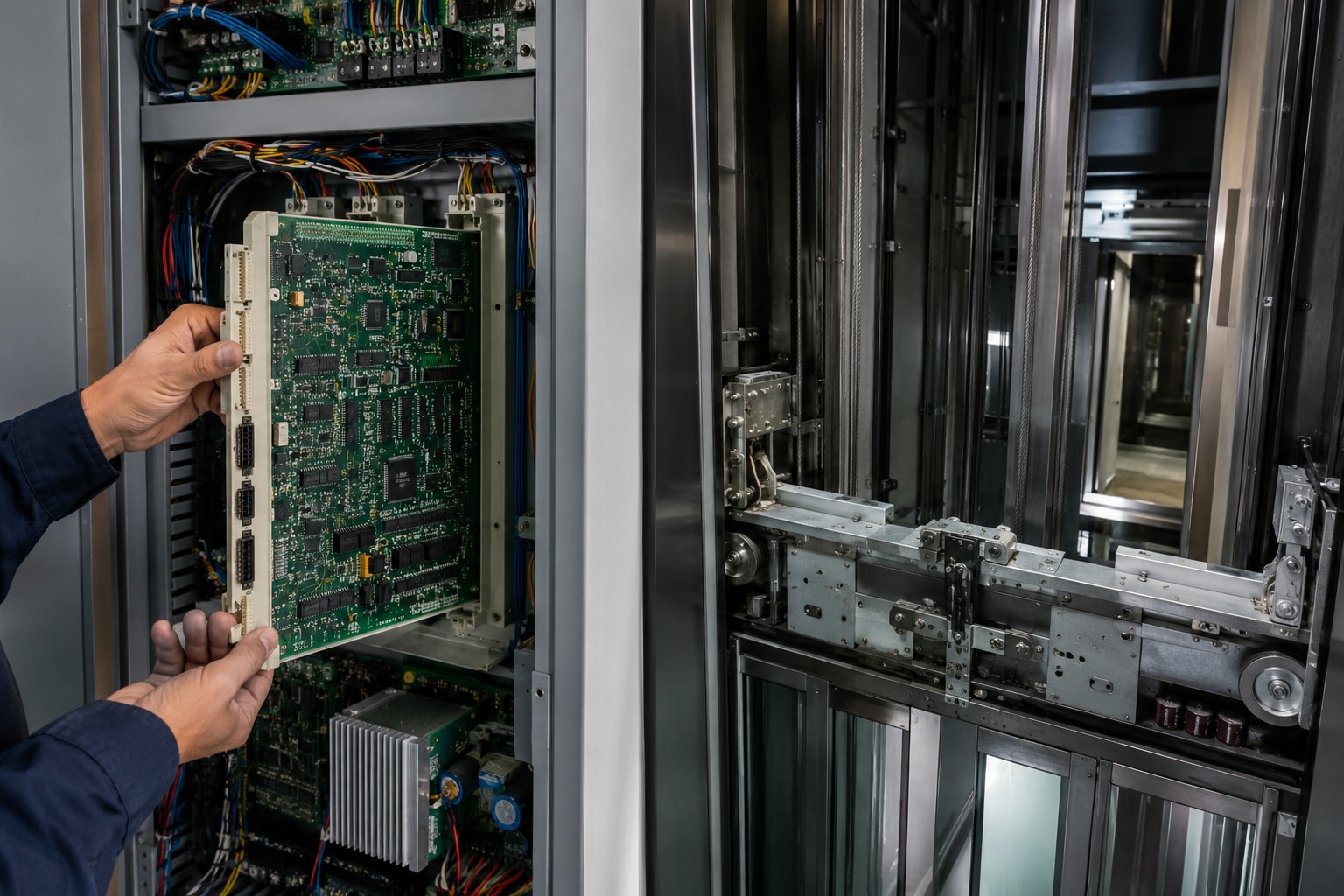
If you need a direct answer, the best way to select a Toshiba elevator board is to match the exact controller family, board code, connector layout, software or firmware requirement, voltage rating, and application position before buying. In the Philippines, where elevators in Metro Manila, Cebu, Davao, Makati, BGC, Pasig, and Quezon City often run under heavy daily traffic and humid conditions, a correct board match is more important than simply finding a part that looks similar. Reliable repair depends on accurate model confirmation, careful inspection of the failed board, safe sourcing, and strong packaging for inter-island or international shipping.
For maintenance companies, modernization contractors, distributors, and building owners, Toshiba elevator boards are not one single product. They include main control boards, inverter boards, inverter driver boards, expansion boards, safety circuit boards, relay boards, car top communication boards, and related interface modules. Each one plays a different role in the elevator control chain. Choosing the wrong one can lead to communication faults, unstable operation, door errors, runaway protection alarms, poor ride quality, or longer downtime.
In practical field work, technicians usually ask the same questions: Is the motherboard really the failed part? Can the driver board be repaired or should it be replaced? Is the expansion board version compatible with the original cabinet? Will the safety board accept the same signal logic? Can a car top communication board from one Toshiba controller generation work with another? These are valid questions, and they matter even more when a site needs a quick restart and the replacement must be shipped fast from a supplier through Manila, Batangas, or Cebu logistics routes.
This guide explains Toshiba elevator board types, when replacement is necessary, how to inspect boards before purchase, what to check for compatibility, how to buy safety-related boards carefully, and how protective packaging reduces shipping risk. It is written for the Philippines market, where service response time, humidity, transport handling, and local building usage patterns all influence repair decisions.
Philippines Elevator Parts Market and Why Correct Board Selection Matters
The elevator service market in the Philippines continues to grow with mixed-use towers, residential high-rises, hospitals, hotels, industrial parks, and transport-linked commercial buildings. Demand is strongest in Metro Manila, but service activity also remains high in Cebu, Davao, Iloilo, Clark, Laguna, Cavite, and Cagayan de Oro. In these locations, maintenance teams often deal with aging controllers, intermittent board faults, and the need for dependable replacement parts with short lead times.
Toshiba elevator systems are found in many commercial and institutional buildings, and reliable controller repair depends on identifying whether the issue comes from the main logic layer, communication layer, drive interface, or safety monitoring path. This is why technicians increasingly prefer suppliers that do more than quote a part number. They need support in model matching, photo verification, connector comparison, and shipping protection.
In the local market, incorrect replacement parts still create avoidable downtime. A board may physically fit the cabinet but fail because of a mismatched firmware variant, terminal assignment, dip-switch setting, communication protocol, or encoder signal requirement. In high-traffic buildings in Ortigas or Makati, even a one-day delay can affect tenants, visitors, and property management operations. In provincial areas, delay can be longer because parts may travel by air cargo, ferry, or trucking before reaching the elevator site.
For this reason, the most dependable sourcing approach combines three factors: technical confirmation before sale, quality inspection before dispatch, and packaging that protects electronic assemblies from moisture, vibration, and impact. That combination is especially important for elevator control boards shipped into the Philippines during monsoon season or routed through busy logistics hubs.
| Market Factor | Philippines Context | Impact on Board Selection | Recommended Action |
|---|---|---|---|
| High-rise residential growth | Strong demand in Metro Manila, Cebu, and Davao | More service calls for aging controllers | Keep fast-moving Toshiba boards identified in advance |
| Heavy daily passenger traffic | Malls, offices, hospitals, and hotels operate long hours | Boards face higher thermal and switching stress | Prioritize tested replacements and stable quality |
| Humidity and coastal exposure | Common near Manila Bay, Cebu port areas, and Batangas | Risk of corrosion and connector oxidation | Inspect terminals, coating condition, and storage quality |
| Inter-island logistics | Shipments may pass through ports or multiple handling points | Electronic boards can be damaged in transport | Use anti-static and shock-protective packaging |
| Mixed controller generations | Older and newer Toshiba systems coexist | Compatibility confusion is common | Verify exact board code, software version, and cabinet type |
| Pressure to reduce downtime | Property managers expect quick restoration | Wrong orders are costly | Confirm with board photos, labels, and site fault symptoms |
The table above shows why board sourcing in the Philippines is not just a pricing exercise. The local operating environment makes technical verification and packaging quality part of the repair strategy.
Toshiba Elevator Board Types Explained
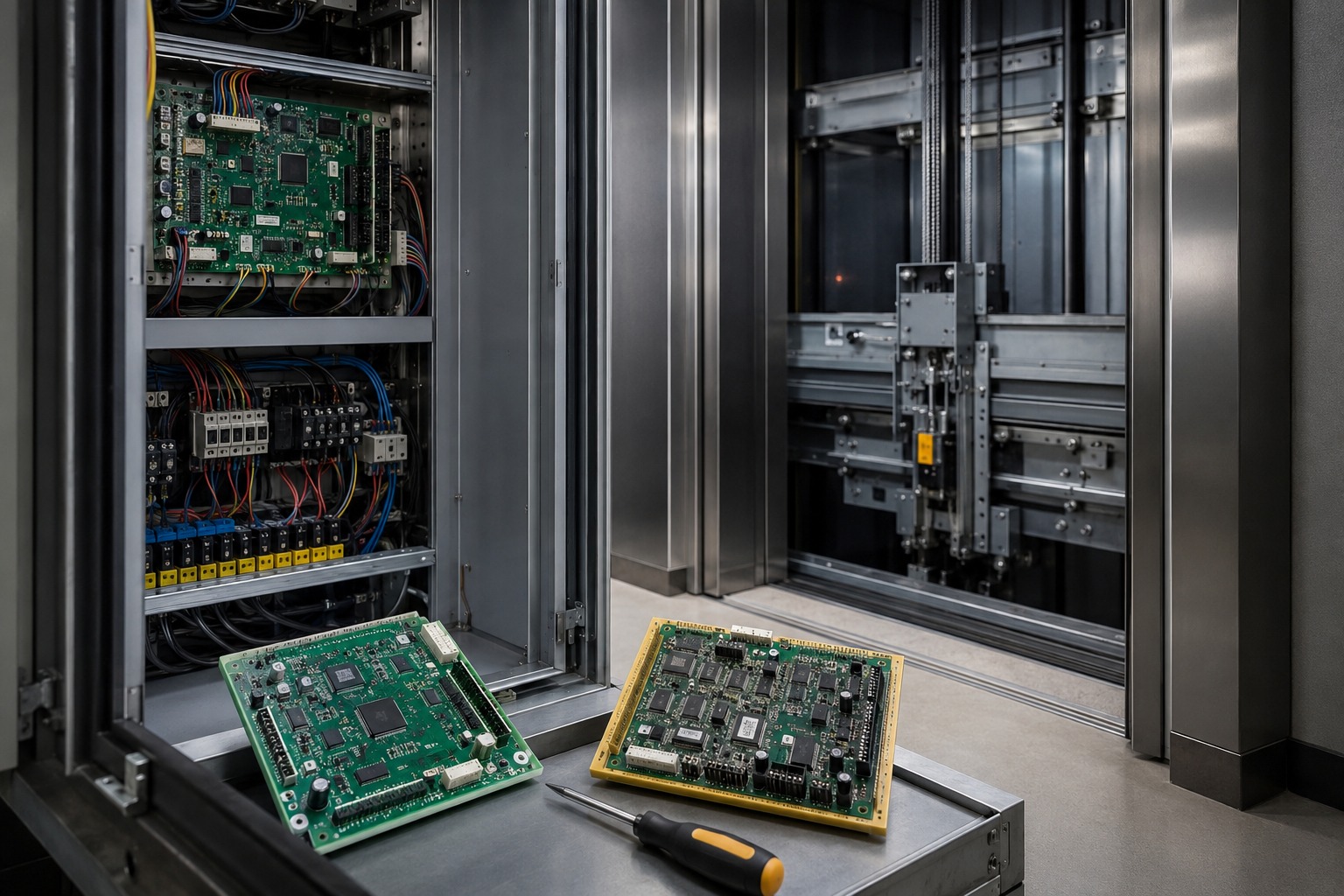
Toshiba elevator boards can be grouped by control function. Understanding these categories helps technicians isolate failures and avoid replacing the wrong assembly. The most common decision starts with whether the fault sits in the main controller logic, the drive interface, the safety chain, or the communication network between car top, car operating panel, and machine room devices.
The motherboard or main control board is the center of elevator decision-making. It processes input and output signals, call registration, door commands, travel logic, and communication with peripheral boards. When it fails, symptoms may include multiple unrelated alarms, no normal startup sequence, or unstable command processing.
Expansion boards add extra inputs, outputs, relays, or interface functions. They are common in systems that need more landing signals, additional device integration, or wider control capability. If you are checking these parts, compare port assignments and board revision carefully. A similar connector layout does not automatically guarantee compatibility.
Inverter boards and inverter driver boards support motor drive control. They are critical to acceleration, deceleration, speed regulation, and smooth ride performance. If a Toshiba elevator shows drive communication errors, irregular motion, or power stage trigger issues, technicians often inspect these boards first. For readers who need specific drive-related replacements, Toshiba-related inverter board options and inverter driver board options are usually evaluated together because the main power and trigger sections must work as a pair.
Safety circuit boards and relay boards monitor critical logic such as door locks, limit chains, emergency stop conditions, and protective interlocks. These boards must be sourced with extra care because the electrical logic and terminal mapping need to align with the original system. If you are reviewing this category, it helps to compare exact models of Toshiba safety circuit relay boards against the site documentation and original board markings.
Car top communication boards are used where signals between the car roof devices and the main controller must be exchanged reliably. These boards often interface with door zone sensors, inspection controls, top-of-car operation devices, and communication loops. They are especially important when fault symptoms appear only during inspection mode or when top-of-car devices fail intermittently.
Expansion functions are also common in modernized systems or buildings with special control logic. Technicians looking for additional signal interface components may review available Toshiba expansion boards and compare them by function rather than appearance alone.
| Board Type | Main Function | Common Fault Symptoms | Typical Inspection Point |
|---|---|---|---|
| Main control board / motherboard | Core logic processing and command management | No boot, random faults, missing outputs | Processor area, power section, communication status LEDs |
| Expansion board | Additional I/O and system interfaces | Missing floor signals, extra functions not responding | Connector mapping, relay action, board revision |
| Inverter board | Drive control interface and motor regulation | Drive trip, speed instability, startup failure | Capacitor condition, signal paths, error history |
| Inverter driver board | Gate drive and trigger control | Power stage fault, uneven output, trigger loss | Optocouplers, driver ICs, solder condition |
| Safety circuit board | Protective logic monitoring and interlocks | Safety chain open, no run permission | Input logic, relay contact integrity, terminal labeling |
| Car top communication board | Signal exchange with top-of-car devices | Inspection mode issues, car top device faults | Bus communication, cable headers, environmental damage |
This table helps separate the boards by job role. In actual service work, many wrong purchases happen because technicians identify only the cabinet location, not the function. The same cabinet can contain several boards with different purposes.
When a Motherboard Should Be Replaced
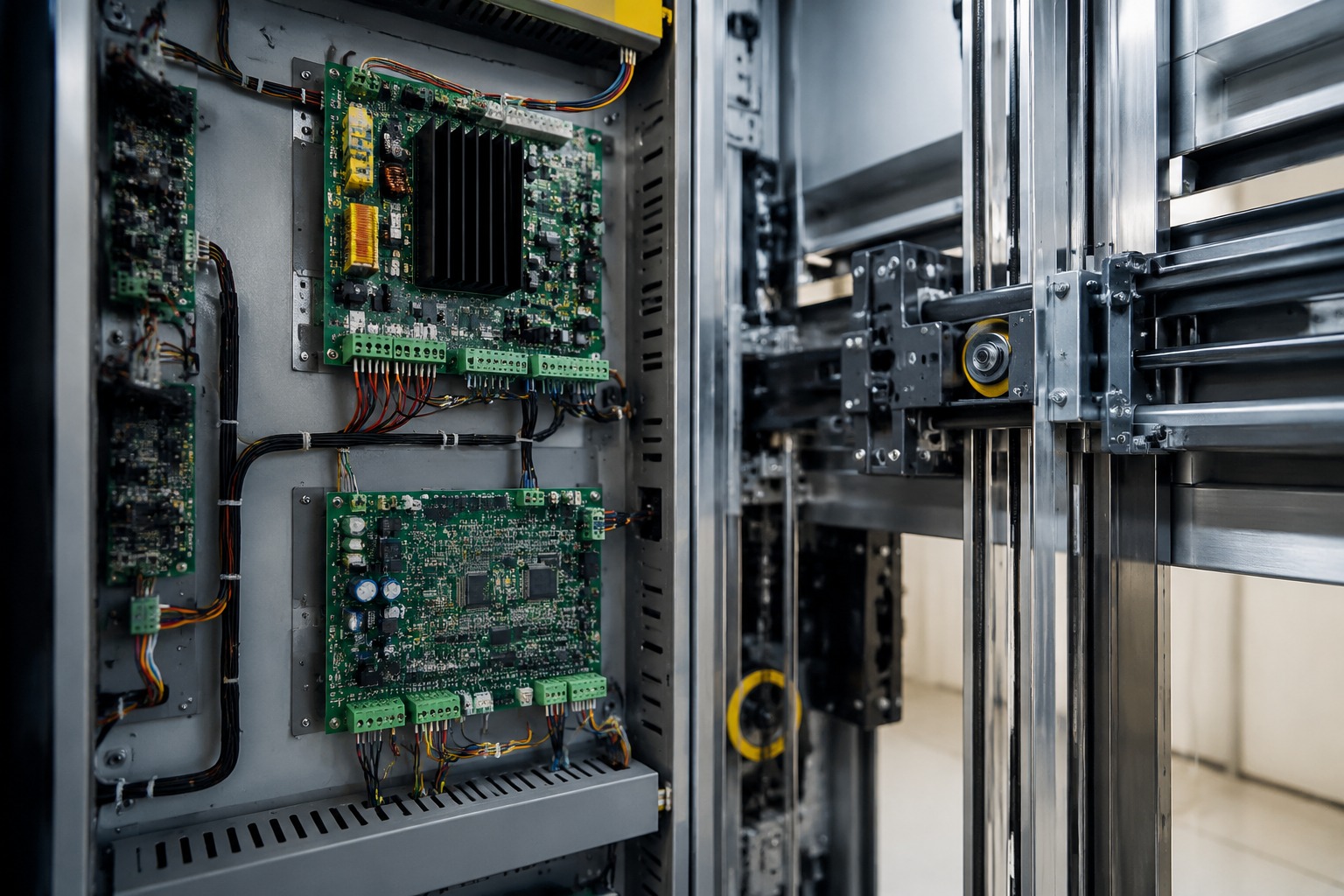
A Toshiba elevator motherboard should be replaced when diagnosis shows that the main board is no longer processing commands reliably, cannot complete startup, has irreparable damage, or continues to generate system-wide faults after power supply, wiring, and peripheral boards have been verified. Replacement should not be the first assumption, because many symptoms that look like motherboard failure actually come from power supply issues, damaged connectors, field wiring problems, or secondary interface boards.
Good technicians usually confirm motherboard replacement by combining visual inspection, fault history, I/O testing, voltage measurement, and substitution logic. For example, if the controller powers normally but some field inputs do not register, the issue may sit in an expansion board rather than the main board. If the car cannot run because safety chain permission is absent, the root cause may be on a safety circuit board or in external wiring. If the drive faults repeatedly during acceleration, the problem could be in the inverter interface rather than the motherboard.
However, there are clear cases where replacement is justified. These include severe burn marks, failed processor startup, missing communication across multiple channels, physically broken connectors, heavy corrosion, and recurring instability that remains after other boards and supply conditions have been checked. In older installations in humid or coastal areas of the Philippines, board replacement may also be chosen when corrosion has progressed under components or through critical traces.
| Symptom | Possible Cause | Check Before Replacement | Replace Motherboard? |
|---|---|---|---|
| Controller does not boot | Main board failure or power supply issue | Verify incoming voltage and board power rails | Yes, if power is correct and boot remains dead |
| Multiple random alarms | Logic instability or communication corruption | Check grounding, connectors, and noise sources | Often yes after external causes are ruled out |
| Missing I/O response | Main board or expansion board issue | Test I/O channels and connected expansion modules | Only if main board channels are confirmed faulty |
| Severe burn marks | Short circuit or surge damage | Inspect related loads and terminal wiring | Yes, with root cause correction |
| Communication loss to several sub-boards | Main communication section failure | Check harnesses and each peripheral board | Likely yes if bus output is absent on main board |
| Corrosion under IC areas | Long-term moisture exposure | Assess whether trace damage is repairable | Yes when corrosion affects critical paths |
The table above is useful because it separates symptoms from confirmed diagnosis. Replacing the motherboard too early can increase repair cost and extend downtime if the real fault lies elsewhere.
How to Inspect Expansion Boards and Driver Boards
Expansion boards and driver boards deserve a disciplined inspection process because they often fail in more subtle ways than a fully burned motherboard. A careful inspection starts with high-resolution photos of both sides, the board label, connector side, and any firmware sticker. Match the part code exactly if possible. Then inspect for physical damage such as cracked solder joints, lifted pads, swollen capacitors, overheated resistors, broken terminal blocks, and contamination from dust, oil, or moisture.
For expansion boards, the most important checks are I/O channel purpose, relay arrangement, jumper settings, terminal numbering, and connector type. Boards that appear mechanically similar can still differ in signal assignment. Replacing an I/O board with a variant designed for another controller generation can cause false signals, missing calls, or door system errors.
For inverter driver boards, focus on trigger components, optocouplers, pulse transmission paths, insulation condition, and signs of heat stress near the gate drive section. In tropical operating environments, repeated thermal cycling can weaken solder joints and create intermittent faults that appear only under load. If the elevator faults only during acceleration or deceleration, the driver board should be inspected together with the drive module and relevant feedback circuits.
In the Philippines, field technicians sometimes receive boards from sites in Manila or Cebu that have already been cleaned. Cleaning can improve appearance, but it may also hide prior overheating. That is why label verification and functional history remain important. Ask whether the fault happened during startup, normal run, door operation, or inspection mode. The sequence tells you which board category to inspect first.
| Inspection Item | Expansion Board Focus | Driver Board Focus | Why It Matters |
|---|---|---|---|
| Part number and revision | Exact I/O variant match | Exact drive interface match | Prevents functional mismatch |
| Connector layout | Signal header positions | Trigger and feedback headers | Avoids wrong harness connection |
| Visible heat damage | Relay or resistor overheating | Gate drive and power trigger hotspots | Indicates stressed circuits |
| Solder condition | I/O relay joints and pins | Driver ICs and optocouplers | Finds intermittent faults |
| Terminal labeling | Input and output mapping | Control and feedback mapping | Confirms functional equivalence |
| Environmental condition | Dust, moisture, corrosion | Insulation, contamination, oxidation | Predicts reliability after installation |
The inspection checklist above helps technicians turn a visual check into a structured verification process. That reduces the risk of ordering by guesswork, especially when a site needs urgent dispatch.
Safety Circuit Board Buying Notes
Safety circuit boards require extra caution because they are involved in protective elevator logic. Buying decisions should never be based only on physical similarity. A safety board may look nearly identical to another unit while using different relay logic, different terminal assignments, or a different controller communication method. In safety-related applications, exact model matching and reliable source inspection are essential.
Before buying, confirm the original Toshiba board code, cabinet type, and application function. Ask whether the board monitors door locks, overspeed-related logic, emergency stop loop, limit switches, or a wider safety chain. Review whether the board is part of a relay-based architecture or integrated with digital control logic. A mismatch in this category can block operation or create unsafe conditions.
Technicians in hospitals, hotels, and government buildings in the Philippines are usually more careful with safety circuit boards because downtime affects public access and compliance expectations. If the building is in a coastal zone or in an older machine room with poor ventilation, pay extra attention to relay contact condition and terminal corrosion. Moisture damage on a safety-related board is a serious warning sign, not just a cosmetic issue.
It is also wise to confirm whether the replacement board is tested, cleaned correctly, protected against electrostatic handling, and packed for long transport. Good suppliers provide photo confirmation, label checks, and a clear compatibility review before shipment.
| Buying Checkpoint | What to Verify | Risk if Ignored | Best Practice |
|---|---|---|---|
| Exact board code | Original label and revision | Functional mismatch | Compare photos and label details |
| Safety function role | Which chain or logic the board handles | No run permission or false faults | Map function before purchase |
| Terminal assignment | Input/output numbering and relay logic | Incorrect field connection | Check terminal legends carefully |
| Electrical condition | Relay wear, burned traces, damaged terminals | Short service life or immediate fault | Require inspected condition report |
| Handling protection | Anti-static and moisture control | Transport-induced damage | Use ESD-safe packaging |
| Application confirmation | Controller family and elevator model | Unsafe or unusable replacement | Submit cabinet and board photos to supplier |
The point of this table is simple: safety-related boards should be purchased like a technical control component, not like a general spare part. The buying standard must be higher.
Car Top Communication Board Use Cases
A car top communication board is used when the elevator needs reliable signal exchange between the car roof equipment and the main control system. Common use cases include top-of-car inspection controls, communication with door devices, sensor feedback from car top components, and signal transfer in systems where the top-of-car layer works as an important field interface.
In service practice, this board becomes a prime suspect when faults appear only during inspection mode, when top-of-car controls respond intermittently, or when door-related signals fail to reach the controller consistently. It can also be involved when technicians see unstable communication between car top devices and the machine room side, especially in elevators that have experienced cable wear, moisture ingress, or repeated vibration.
For older or heavily used buildings in Pasay, Makati, or Cebu City, intermittent faults are common because the car top environment sees dust, movement, and maintenance access. That makes connector integrity and board mounting especially important. A damaged communication board can mimic wiring problems, so diagnosis should include cable harness inspection and signal verification.
In modernization projects, car top communication boards also matter when legacy signal architecture must be preserved while some peripheral devices are updated. In such cases, technicians need to confirm whether the board supports the same communication method, pin assignment, and device interaction expected by the existing Toshiba controller.
Compatibility Questions for Technicians
Compatibility is the most important topic in Toshiba elevator board replacement. Technicians should ask a fixed set of questions before ordering. What is the full board code? What is the controller family? Are the connector count and pin positions identical? Does the board require the same firmware or parameter environment? Is the elevator using the same drive and communication architecture? Is there a hardware revision difference? Was the existing board modified in the field? Are there matching dip-switch or jumper settings that must be preserved?
These questions matter because board compatibility is not only about shape and dimensions. A board can mount correctly and still fail to communicate or process signals as intended. This is particularly true in mixed-generation installations, partial modernization projects, and elevators that have had earlier field changes. The safest process is to share photos of the original board, controller cabinet, stickers, and terminal labels with the supplier.
Experienced parts suppliers usually support this process with three capability areas. First, technological capability: they compare board codes, connector layouts, and application data to reduce mismatch risk. Second, manufacturing capability: they maintain stable sourcing channels, inspection procedures, and controlled handling for electronic assemblies. Third, service capability: they respond quickly with photo review, compatibility checks, and dispatch support for urgent elevator downtime. For Philippine customers working across Luzon, Visayas, and Mindanao, this combination is valuable because it shortens the decision cycle and improves first-time match rates.
| Technician Question | Why Ask It | What to Compare | Decision Effect |
|---|---|---|---|
| What is the exact board code? | Core identification point | Label, sticker, barcode, revision | Confirms correct replacement family |
| Which controller is installed? | Board must match control architecture | Cabinet nameplate and controller type | Avoids cross-series mismatch |
| Do connectors match exactly? | Physical fit alone is not enough | Header count, pin position, keying | Prevents wiring errors |
| Is firmware version relevant? | Some boards require software alignment | EPROM label or software notation | Affects startup and communication |
| Are jumper or dip settings used? | Field settings can alter board behavior | Original board setup photos | Supports proper commissioning |
| Has the site been modernized before? | Mixed hardware is common | Retrofit history and replaced components | Flags compatibility risks early |
The table above provides a practical compatibility checklist. It is especially useful when multiple people are involved in the purchase decision, such as a site technician, purchasing officer, and property manager.
Packaging and Shipping Protection
Packaging is a technical issue, not only a logistics issue. Elevator control boards are vulnerable to static, impact, moisture, and vibration. In the Philippines, shipping conditions may include warehouse transitions, cargo consolidation, ferry movement, air cargo handling, and final-mile delivery to cities or provincial sites. A board that leaves the supplier in good condition can arrive damaged if packaging is weak.
Proper protection begins with anti-static shielding. The board should be placed in an ESD-safe bag, cushioned against movement, and packed in a rigid carton or protective case. Moisture control is also important, especially during rainy season and in coastal routes through Manila, Subic, Batangas, or Cebu. Internal padding should prevent connector damage and edge impact. Labels should mark the parcel as fragile electronic equipment.
For urgent downtime cases, technicians often focus on speed and forget protection. That is a mistake. A fast shipment that arrives with a cracked corner, bent connector, or moisture contamination can create another delay. Reliable suppliers balance dispatch speed with packaging discipline. This is one area where service capability becomes visible: clear packing standards, shipping photo records, and practical advice on how the customer should unpack and inspect the board on arrival.
From a manufacturing and handling perspective, careful packing should be the final step of a controlled process that includes visual inspection, model confirmation, ESD-safe handling, and stable storage before dispatch. That discipline helps maintenance companies reduce disputes and improve installation success rates.
| Protection Element | Purpose | Risk Addressed | Recommended Standard |
|---|---|---|---|
| Anti-static bag | Protects sensitive electronics from ESD | Static damage during handling | Use sealed ESD-safe packaging |
| Foam cushioning | Absorbs impact and vibration | Broken components and cracked boards | Fit board securely with non-abrasive foam |
| Moisture barrier | Reduces humidity exposure | Corrosion and condensation | Add desiccant when needed |
| Rigid outer box | Maintains structural protection | Crushing during transit | Use reinforced carton or hard case |
| Connector shielding | Protects exposed headers and terminals | Bent pins and broken sockets | Stabilize board orientation internally |
| Clear labeling | Improves handling awareness | Rough transport treatment | Mark fragile and electronic equipment |
This packaging table explains why transit protection is part of the product value. It helps reduce the hidden costs of replacement work, especially when the destination is far from the main shipping hub.
Industries, Applications, and Real Service Cases
Toshiba elevator boards are used across many industries in the Philippines. Residential towers need stable main control and door communication because traffic peaks happen in morning and evening clusters. Office buildings need reliable group operation and reduced callback incidents. Hospitals require high confidence in safety-related boards and smooth ride performance for patient movement. Hotels and malls need quick restoration because downtime affects customer experience and building reputation.
Industrial facilities and warehouses may use passenger or freight elevators where motor control and I/O expansion are important. In these applications, inverter boards, driver boards, and expansion boards often receive more attention because operational stress is higher and usage patterns are irregular.
A practical case from Metro Manila might involve a mixed-use tower where intermittent group control faults point to a main board communication section. A case from Cebu could involve a coastal hotel where oxidation affects a safety relay board. A case from Davao might involve repeated drive trips under heavy freight use, leading to replacement of a driver board after confirmation of trigger-stage instability. These examples show that board selection should align with site conditions, not just spare parts availability.
Our role in these situations is not limited to quoting products. The strongest results usually come from combining technical capability, manufacturing discipline, and service responsiveness. On the technology side, board identification, connector comparison, and application matching reduce ordering mistakes. On the manufacturing side, stable sourcing, handling control, and quality inspection support consistency. On the service side, fast response, shipping preparation, and support for maintenance teams help reduce downtime pressure.
Local Supplier Considerations and How to Evaluate a Partner
When choosing a supplier for Toshiba elevator boards in the Philippines, look beyond inventory claims. Ask how the supplier confirms board compatibility. Ask whether they support multiple elevator brands and related parts, because many maintenance companies handle mixed portfolios. A capable supplier can often help customers source not only control boards but also inverter and frequency converter parts, door operator components, door locks, light curtains, guide shoes, oil cups, sensors, encoders, power supplies, buttons, COP panels, intercom parts, and other lift accessories for brands such as Toshiba, Hitachi, KONE, Mitsubishi, and more.
Technological capability means the supplier can review labels, cabinet photos, application position, and control function rather than relying on guesswork. Manufacturing capability means there is a disciplined process for sourcing, inspection, handling, and protection of electronic assemblies. Service capability means quick communication, reliable packing, and practical coordination for urgent shipments into Manila, Cebu, Davao, or provincial service routes.
Local buyers should also consider whether the supplier understands the needs of maintenance companies, distributors, building owners, and modernization contractors. Each buyer group measures value differently. Maintenance companies want reduced callbacks. Distributors want stable product matching. Building owners want less downtime. Modernization contractors want compatible parts that fit into phased upgrade plans.
Future Trends for 2026: Technology, Policy, and Sustainability
Looking ahead to 2026, Toshiba elevator board sourcing and replacement decisions in the Philippines will be influenced by three main trends: smarter diagnostics, tighter compliance expectations, and stronger sustainability pressure.
On the technology side, technicians will increasingly use photo-based matching, digital fault history review, and remote pre-diagnosis before ordering a replacement board. This will improve first-time accuracy and reduce unnecessary motherboard replacement. Communication boards and interface modules are also likely to receive more attention because modern elevator service depends on reliable data exchange across subsystems.
On the policy side, building owners and facility managers are expected to place greater emphasis on documentation, preventive maintenance records, and traceable component sourcing. Safety-related boards will receive closer scrutiny, especially in public-use buildings such as hospitals, transit-linked developments, and government facilities.
On the sustainability side, there will be more demand for repair-versus-replace evaluation, reduced waste in packaging, and sourcing strategies that extend equipment life without compromising safety. The goal is not to reuse damaged boards blindly, but to make smarter decisions about which assemblies can be inspected, tested, and responsibly supplied, and which must be replaced outright due to reliability or safety concerns.
For Philippine building portfolios facing budget pressure and aging equipment, these 2026 trends will favor suppliers who can combine technical accuracy, stable quality control, and practical service speed.
FAQ About Toshiba Elevator Boards
How do I know if a Toshiba board is compatible with my elevator?
Start with the exact board code, controller model, connector layout, terminal markings, and application position. Share clear photos of the original board and cabinet labels for verification.
Should I replace the motherboard immediately if the elevator will not run?
Not always. First check the power supply, safety chain, expansion boards, communication path, and drive-related boards. A no-run condition can come from several sources.
What is the difference between an inverter board and an inverter driver board?
The inverter board generally supports drive control functions, while the driver board focuses more specifically on trigger or gate drive processes within the drive system. Both must match the system correctly.
Why are safety circuit boards more sensitive to compatibility?
Because they are tied to protective logic and run permission. Even a small mismatch in relay logic or terminal assignment can stop the elevator or create unsafe operation.
Can a car top communication board cause door or inspection mode problems?
Yes. If communication between top-of-car devices and the main controller becomes unstable, faults may appear in inspection operation, signal transfer, or door-related functions.
What should I send to a supplier before ordering?
Send board photos from both sides, the label, the controller nameplate, connector views, any alarm codes, and a short description of the fault sequence.
Why does packaging matter so much for elevator boards?
Because these boards are sensitive to static, impact, and moisture. Good packaging protects the board throughout transit, especially for inter-island delivery in the Philippines.
Can one supplier support other elevator brands and parts too?
Yes. Many professional suppliers also support other elevator brands and a broad range of lift accessories, which helps maintenance teams streamline sourcing across different sites.
Choosing the right Toshiba elevator board is ultimately about safe compatibility, reliable inspection, and dependable logistics. For customers in the Philippines, the most successful repairs usually happen when technical review, quality control, and shipping protection are handled as one integrated process rather than separate tasks.