
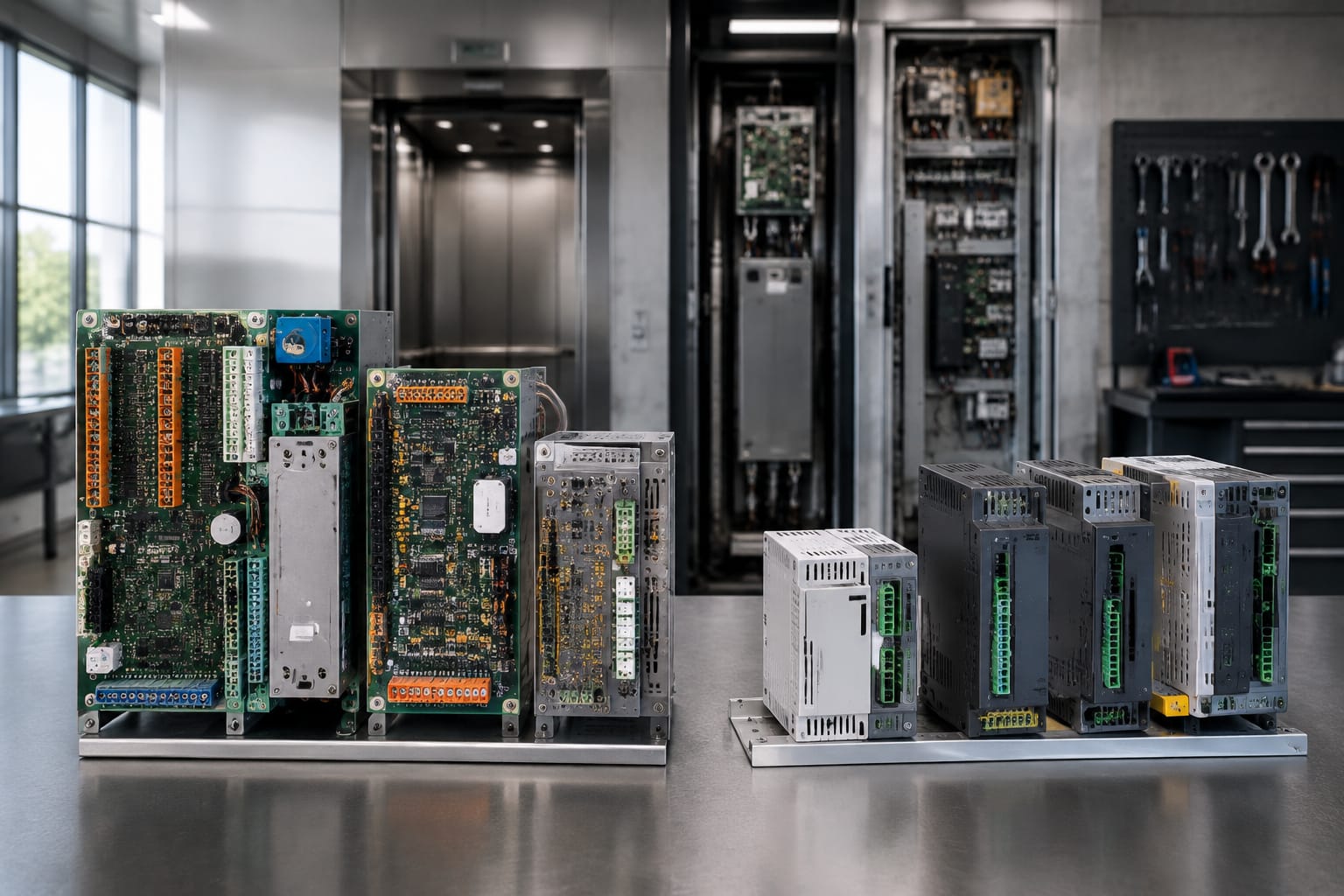
The correct replacement for a ThyssenKrupp elevator part cannot be selected from the brand name alone. You also need the elevator or controller family, the exact board or component code, revision level, connector arrangement, electrical ratings, and the function of the part in the system.
ThyssenKrupp Elevator equipment may appear under legacy ThyssenKrupp labels or current TK Elevator and TKE naming. Before ordering a replacement, record the information on the original component, photograph both sides of the board, and compare the connectors and ratings. This gives a supplier enough information to identify a compatible part or explain what must be checked further.
ThyssenKrupp Elevator and TKE naming
ThyssenKrupp Elevator is a legacy name that remains visible on many installed elevators, spare parts, drawings, controller cabinets, and maintenance records. The elevator business is now commonly identified as TK Elevator, often shortened to TKE. As a result, a replacement part may be described using any of the following:
- ThyssenKrupp Elevator part
- ThyssenKrupp lift spare part
- TK Elevator part
- TKE replacement board
- A component code without either brand name
- A board name based on its function, such as car operating panel board or outbound display board
These names do not automatically indicate that two parts are interchangeable. A part listed as a TKE component may be designed for a newer controller family, while a visually similar ThyssenKrupp-labelled board may belong to an older installation.
When searching for ThyssenKrupp elevator parts, use the original marking as the main identification reference. Include the brand or system name as supporting information, not as the only search term. A useful request might identify the part as a “car communication board” and include the complete board code, revision, connector layout, and elevator details.
The word “replacement” also needs careful interpretation. It may mean:
- An original part with the same code and revision
- A later revision approved for the same application
- A compatible equivalent with matching electrical and communication characteristics
- A substitute requiring a wiring, parameter, or software change
- A part that is only suitable after confirmation from the controller or elevator manufacturer
A supplier should state which of these applies. Do not assume that “equivalent” means plug-and-play.
Identify the elevator and controller family
The controller family is often more useful than the general elevator brand when identifying a spare part. Two elevators with ThyssenKrupp or TKE branding may use different boards because they were installed at different times, configured for different applications, or supplied with different controller architectures.
Start by collecting information from the following locations:
- Controller cabinet nameplates and internal labels
- Main controller board markings
- Drive, inverter, or motor control labels
- Car operating panel and landing display boards
- Inspection station and machine-room documentation
- Electrical drawings and wiring diagrams
- Maintenance records showing earlier board replacements
- The elevator serial, unit, or asset number
- Labels inside the car operating panel or landing fixture
Record the information exactly, including letters, numbers, spaces, hyphens, and suffixes. A single character can distinguish one board version from another.
The elevator identification should ideally include:
| Information | Why it matters |
|---|---|
| Brand and legacy branding | Helps narrow the equipment history |
| Controller family or system designation | Indicates the likely board architecture |
| Installation or upgrade period | Helps distinguish older and newer revisions |
| Elevator unit or serial number | Links the part to a specific installation |
| Component location | Separates car, landing, machine-room, and controller parts |
| Board function | Establishes what the part is expected to do |
| Original part code and revision | Provides the strongest replacement reference |
| Photos of labels and connectors | Allows visual and physical cross-checking |
Do not rely only on the building name, car number, or a general description such as “TKE passenger elevator.” Those details may identify the unit for the site team but usually do not identify a board accurately enough for sourcing.
If the controller family is unknown, photograph the controller nameplate and the complete board assembly. Include the surrounding plugs and mounting position. A close-up of a single chip or logo may not show enough information to distinguish related components.
Common display and communication parts
Display and communication boards are frequently replaced because they are installed in exposed operating areas or connect several user-interface functions. However, the same general description can cover different boards with different roles.
Common categories include:
- Landing or outbound display boards
- Car operating panel display boards
- Car communication boards
- Floor indicator boards
- Button or call station interface boards
- Audio, intercom, or emergency communication interfaces
- Door or car-position indication boards
- Communication interface boards between the car and controller
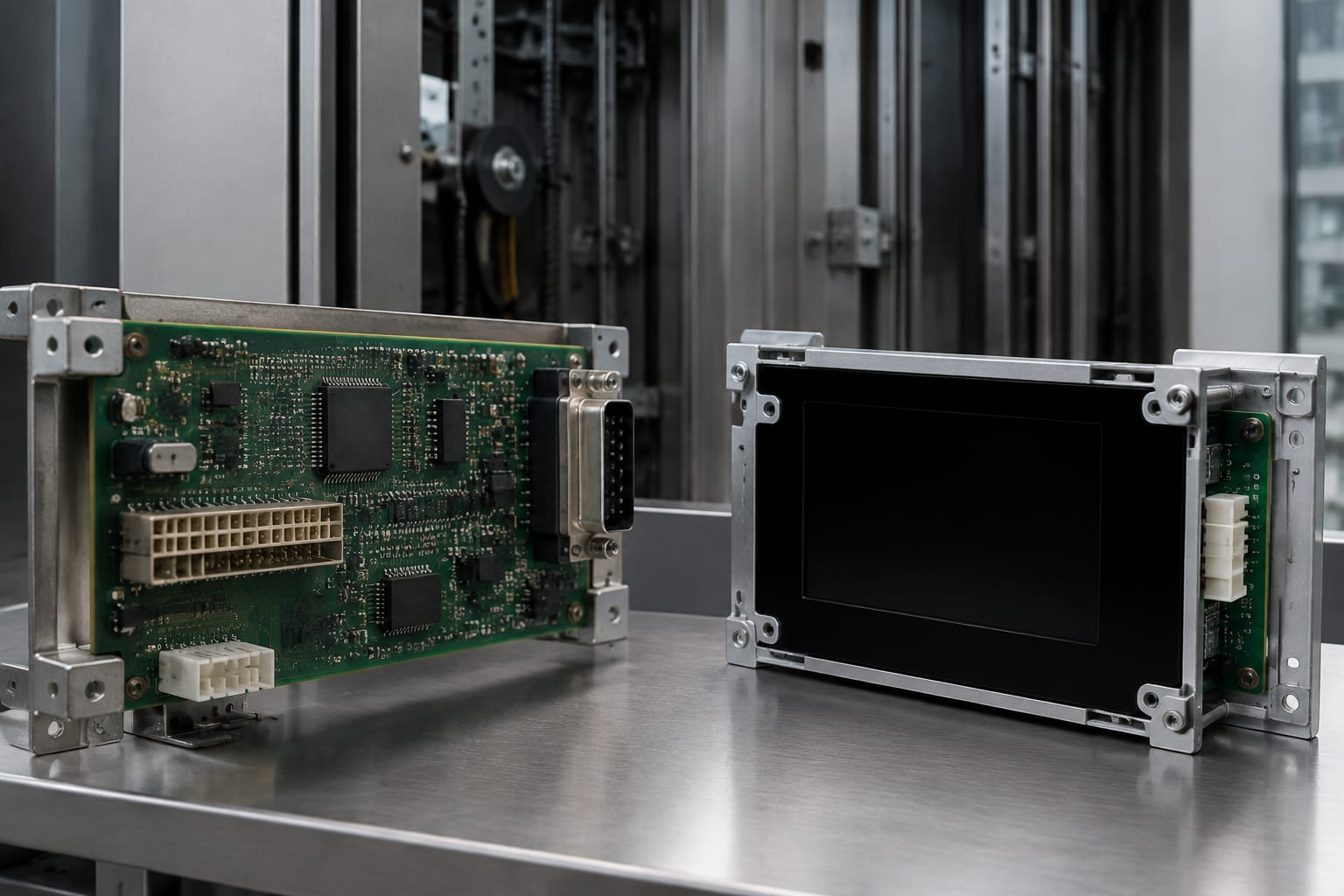
An outbound display board may be associated with the landing-side display or directional indication. A car communication board may transfer information between the car operating panel and another controller or display assembly. A car operating panel display board may handle visual information inside the elevator. These functions can be related, but they are not interchangeable merely because they use similar connectors or display formats.
For an overview of a related ThyssenKrupp outbound display board, compare the function and installation position with the failed part. The product category alone should not replace a code and connector check.
A rectangular-chip board description can also be too broad. The chip package, display technology, communication method, and board revision may differ between installations. If the part is described as a rectangular-chip car communication board, confirm that the description matches the original board and not just the visible chip shape.
When checking a display or communication part, note:
- Where the board is installed.
- What information or signal it handles.
- Whether it is inside the car, at a landing, or in the controller cabinet.
- The number and position of connectors.
- The type and arrangement of display elements.
- Any processor, memory, or communication integrated circuits.
- Whether the board is part of a larger panel assembly.
- Whether the original fault is on the board, wiring, power supply, display, or connected device.
A symptom such as a blank display does not prove that the display board has failed. The problem may also involve a missing supply voltage, a loose plug, a damaged communication line, incorrect configuration, or a fault in another board. Confirming the failure before ordering reduces unnecessary replacement and return issues.
For installations where the car display assembly is being compared with a 3600-series listing, use the 3600 car communication elevator display board as a reference point, then verify the code, application, and physical interface against the installed component.
Read board codes and revision labels
The board code is normally the most important piece of information in a replacement request. It may appear on a printed label, barcode label, silkscreened area, stamped plate, or paper tag attached to the assembly.
Look for several distinct identifiers:
- Assembly or part number
- Board number
- Product or type code
- Revision, version, or issue number
- Serial number
- Manufacturing or date code
- Firmware or software reference
- Connector or harness designation
- Drawing or modification number
Do not combine these identifiers into one assumed part number. For example, a long label may contain a board code, serial number, and production traceability code. A supplier needs to know which portion identifies the orderable assembly.
Record labels in a simple format:
``text Brand: ThyssenKrupp / TKE Location: Car operating panel Function: Display or communication board Part or assembly code: [exact marking] Revision: [exact marking] Serial or date code: [if relevant] Connectors: [number, type, and position] Visible change or fault: [brief description] ``
Photograph the label at an angle that avoids glare. Take one image of the entire board, one of the main label, and one of each connector side. If the board has markings on the reverse, photograph that side as well. Do not remove labels, scrape coating, or clean off markings while trying to make the code more readable.
Revision labels deserve special attention. A later revision may correct a component, alter a connector, change a mounting feature, or require a corresponding software or wiring update. An earlier revision may not perform the same way as a later one, even when the base board number appears similar.
Ask the supplier to clarify whether the proposed part is:
- The same revision
- A later revision replacing the original
- An earlier revision still considered compatible
- A refurbished or repaired unit
- A new equivalent produced under a different code
If the code is incomplete or damaged, provide all surrounding evidence instead of guessing missing characters. The controller family, board function, photos, connector count, and site records may help narrow the identification.
Compare connectors and electrical ratings
Connector compatibility is a necessary check, but it is not sufficient. Two boards can use similar plugs while assigning different signals to the pins. A connector that fits physically can still cause malfunction or damage if the pinout, voltage, polarity, or communication protocol differs.
Compare the following before treating a part as compatible:
| Check | What to compare |
|---|---|
| Connector type | Plug style, socket type, locking method, and keying |
| Connector position | Location and orientation on the board |
| Pin count | Number of populated and unused positions |
| Pin assignment | Power, ground, signal, data, and control pins |
| Harness routing | Which cable connects to each board or device |
| Supply voltage | Required input and permissible range, as documented |
| Polarity | Positive, negative, common, and reference connections |
| Signal type | Digital, serial, display, relay, analogue, or other signal |
| Output capacity | Current or load requirements where applicable |
| Protection and isolation | Fuses, termination, shielding, or isolation features |
| Mounting | Screw holes, spacers, board dimensions, and clearances |
Use the original wiring diagram or technical documentation when available. Colour alone is not a reliable way to identify a conductor, particularly where a harness has been repaired or modified. The safest comparison uses labelled terminals, connector designations, and the documented pinout.
Electrical ratings should come from the board label, manual, schematic, or confirmed technical data. Do not infer a rating from a similar board or from the voltage measured at an empty connector. Measurements taken during a fault can also be misleading, so electrical testing should be performed by a qualified elevator technician using the correct isolation and safety procedures.
Communication boards require additional care. Confirm whether the board communicates directly with the controller, another car board, a display module, or a local interface. A board can have the correct supply voltage and still be unsuitable if its communication format or configuration differs.
Physical fit also matters. Check board dimensions, mounting points, standoffs, edge clearance, heat-producing components, and the direction of cable exits. A board that fits the cabinet but does not support the original mounting or cable routing may create a maintenance or reliability problem.
Handle obsolete or renamed components
Legacy ThyssenKrupp elevator parts may be difficult to source because the original code has been discontinued, renamed, superseded, or replaced by a complete assembly. This does not mean that any board with a similar function is acceptable.
When an original component is obsolete, ask for a documented replacement path. The supplier should identify the relationship between the old and proposed parts as clearly as possible. Useful questions include:
- Is the new code a direct successor to the old code?
- Is the replacement electrically and mechanically compatible?
- Does the revision require a different harness or connector?
- Is software, parameterisation, or commissioning required?
- Must another board be replaced at the same time?
- Is the part supplied as a board only or as a complete assembly?
- Are the original mounting hardware and labels retained?
- What information is needed to confirm the substitution?
A complete assembly may include a display, carrier, cable, interface board, or mounting frame. Confirm what is included before comparing the replacement with the original board. Conversely, a board-only replacement may require the original display or harness to remain serviceable.
Avoid these common assumptions:
- The newest-looking board is automatically the correct successor.
- A part with the same connector must have the same pinout.
- A board from the same building can be transferred to another elevator.
- A compatible display module will work with every controller.
- A used board has the same revision or condition as the removed board.
- A code found in an online image is sufficient identification.
- A failed board is the only possible cause of the reported symptom.
For older equipment, retain the removed part until the replacement has been checked and the fault has been confirmed. The old board may contain useful labels, jumpers, connector references, or configuration information. Follow the site’s safety and disposal procedures, especially if the component has been exposed to moisture, heat, or electrical damage.
Supplier documentation to request
A replacement request should produce more than a product name and a price. For B2B sourcing, the documentation should allow the maintenance, engineering, and purchasing teams to verify what is being offered.
Request the following where applicable:
- Exact proposed part number
- Original or cross-reference part number
- Revision or version
- Clear photos of the actual board label
- Board-only or complete-assembly description
- Connector and pinout information
- Electrical rating information
- Compatibility statement and its basis
- Required wiring, parameter, or software changes
- Installation or commissioning requirements
- Condition, such as new, repaired, refurbished, or used
- Items included with the part
- Any limitations or unresolved identification points
- Packing and identification details for the shipment
The supplier may not be able to confirm final compatibility without controller documentation or a complete site inspection. That limitation should be stated clearly rather than replaced with a broad assurance.
A good request for quotation includes the evidence in one message or attachment. Include the original code, revision, photos, controller family, elevator unit number, installation location, failure symptoms, and whether the request is for an original part, a compatible equivalent, or an obsolete-part alternative.
Kelevator supplies multi-brand elevator spare parts for B2B importers, distributors, maintenance contractors, sourcing teams, modernization companies, and OEM buyers. Whether the request is sent to Kelevator or another supplier, the same technical evidence helps reduce errors when the installed equipment carries a legacy brand name.
Replacement verification checklist
Use this checklist before approving a ThyssenKrupp or TKE elevator part for purchase:
Equipment identification
- [ ] Brand and legacy brand name recorded
- [ ] Elevator unit or asset number recorded
- [ ] Controller family identified or clearly marked unknown
- [ ] Installation location recorded
- [ ] Original maintenance or wiring documentation checked
Part identification
- [ ] Board function described
- [ ] Complete part or assembly code copied exactly
- [ ] Revision or version recorded
- [ ] Serial, date, or traceability code retained where relevant
- [ ] Front and rear photos taken
- [ ] Board-only versus complete assembly confirmed
Compatibility
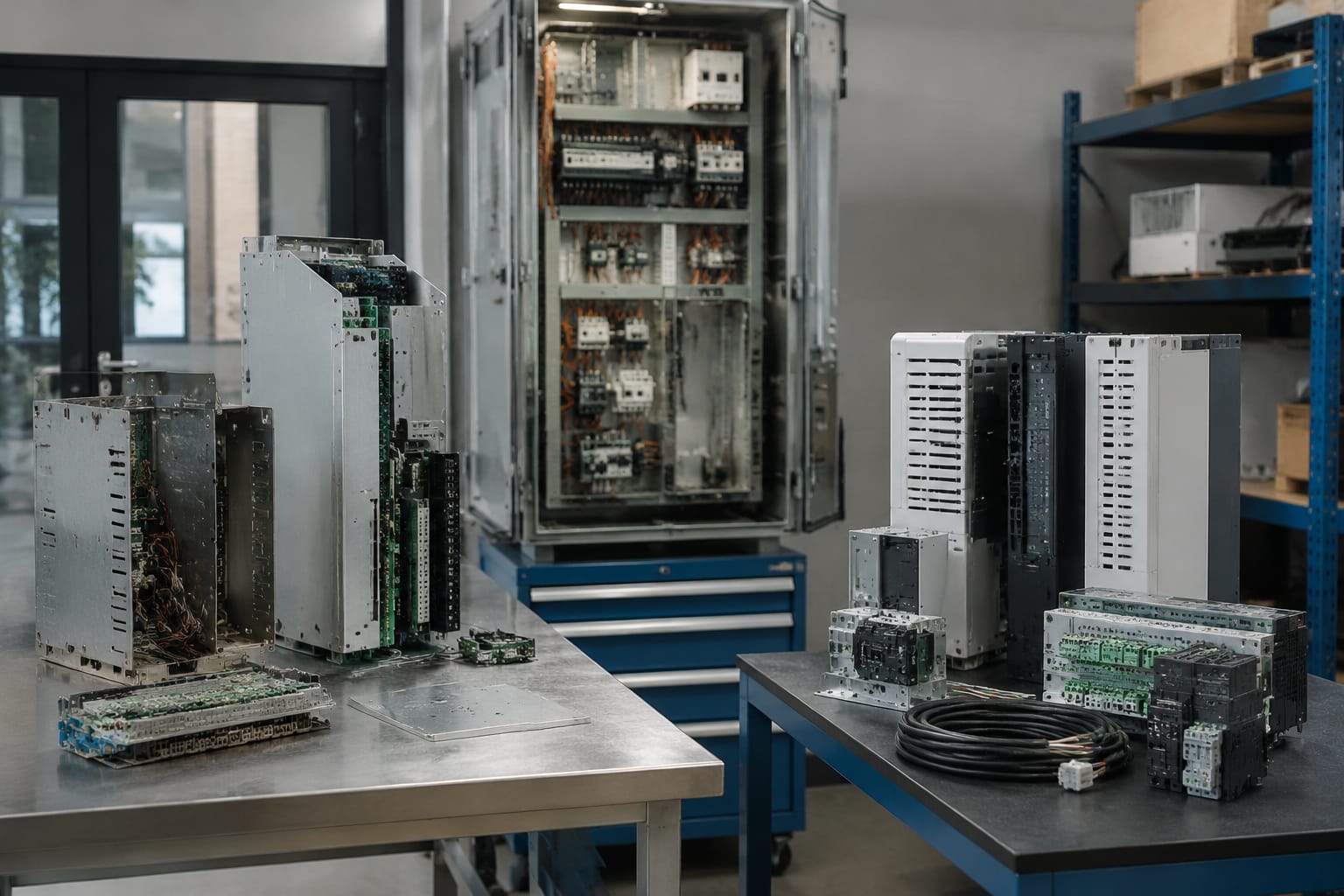
- [ ] Connector type and pin count compared
- [ ] Connector position and orientation compared
- [ ] Pinout verified from documentation
- [ ] Electrical supply and ratings confirmed
- [ ] Communication interface or signal type confirmed
- [ ] Mounting dimensions and fixing points checked
- [ ] Harness and cable routing checked
- [ ] Software, parameters, or commissioning requirements identified
Supplier response
- [ ] Proposed code provided in writing
- [ ] Original-to-replacement relationship explained
- [ ] Revision compatibility addressed
- [ ] Included items listed
- [ ] Condition of the part stated
- [ ] Known limitations disclosed
- [ ] Any required site verification or technical approval identified
The most reliable replacement request is specific enough that another engineer can review it without seeing the elevator in person. If key information is missing, mark it as unknown and request confirmation rather than filling the gap with an assumption.
For a maintenance contractor or sourcing team in the Philippines, this approach is especially useful when the installed lift has older documentation, mixed replacement history, or components sourced through different channels. Accurate identification at the start helps the buyer compare like-for-like options and prevents delays caused by an incorrectly ordered board.
Once the code, revision, connectors, ratings, and application have been checked, submit the complete part details to a multi-brand elevator parts supplier for confirmation. Kelevator can use that information to review a sourcing request, while the final installation and commissioning decisions should remain with the responsible elevator technician or engineering team.
Related product references
For practical catalog examples related to this topic, review [Outbound Display Board Thyssen elevator parts lift accessories](/products/outbound-display-board-thyssen-elevator-parts-lift-accessories/), [Car Communication Board Rectangular Chip Thyssen elevator parts lift accessories](/products/car-communication-board-rectangular-chip-thyssen-elevator-parts-lift-accessories/), and [3600 Car Communication Elevator Display Board COP lift parts](/products/3600-car-communication-elevator-display-board-cop-lift-parts/). Confirm the exact model, dimensions, ratings, and connectors before ordering.