
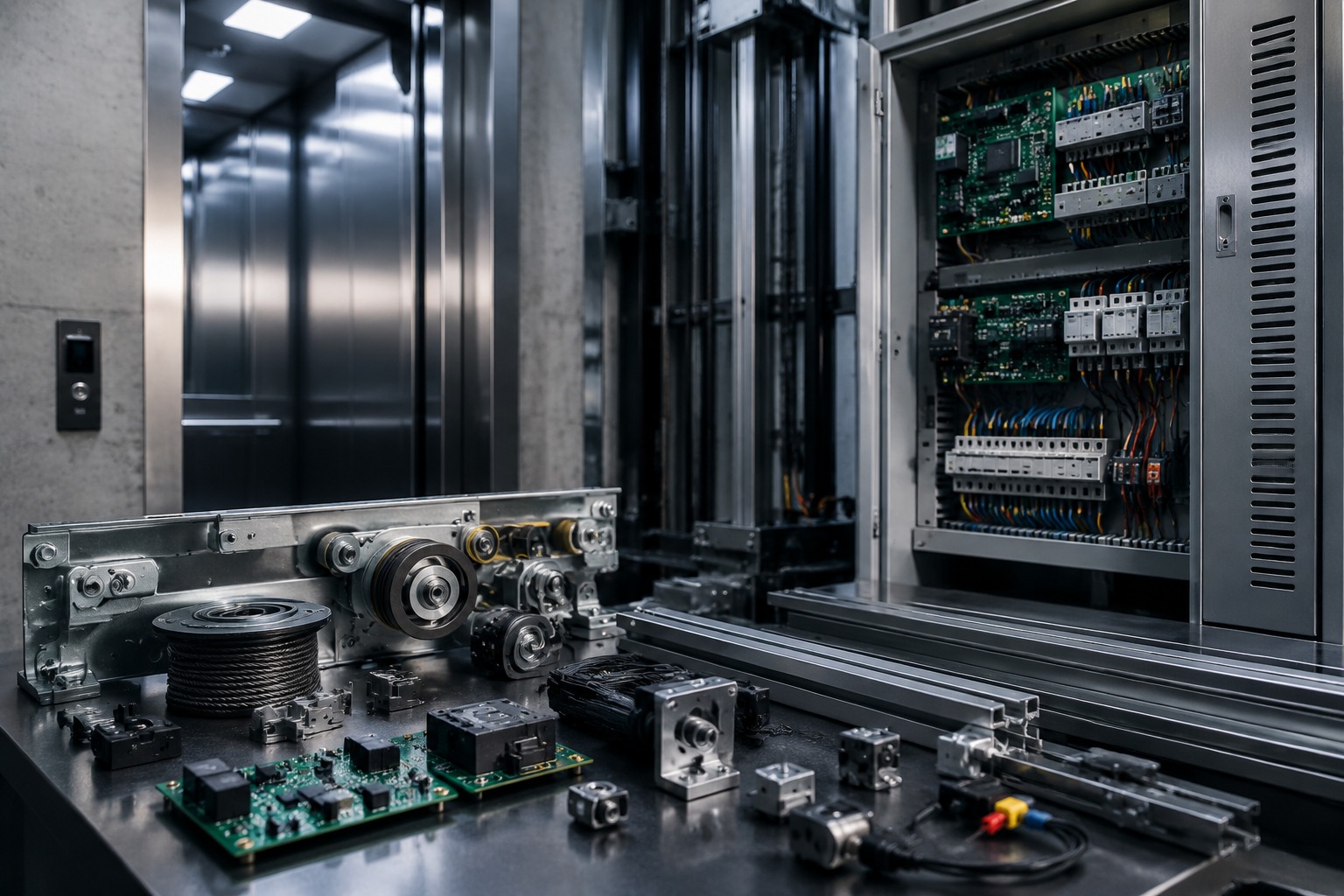
For repair teams, purchasing staff, and building operators in the Philippines, the fastest way to reduce elevator downtime is to match the correct Hitachi lift part before ordering, verify supplier quality before shipment, and plan replacements around actual fault history rather than guesswork. In practice, the most requested items are control boards, encoders, sensors, door operator parts, emergency power supplies, guide shoes, buttons, light curtains, and brake-related components. These parts are especially important in Metro Manila office towers, Cebu mixed-use projects, Davao hospitals, and tourism-driven properties across Makati, Bonifacio Global City, Pasay, Iloilo, and Cagayan de Oro where passenger flow is high and service interruptions quickly become a building management issue.
The Philippine market is also shaped by long lead times, variable port clearance schedules, and the need for exact model matching when elevators have been in service for many years or partially modernized. A wrong board revision, unmatched encoder signal, or incompatible door motor can create extra site visits, passenger complaints, and safety risks. That is why buyers increasingly prefer suppliers that can support serial verification, photo-based cross-checking, stable packaging for sea and air freight, and responsive technical communication before dispatch.
We serve maintenance companies, distributors, building owners, and modernization contractors with a focused approach: correct model matching, careful quality inspection, protective export packing, and practical communication that helps customers in the Philippines source compatible elevator spare parts with less uncertainty. Our supply scope covers Hitachi and other major brands, but this guide focuses on how to buy Hitachi elevator components more accurately for repair, maintenance, and retrofit work.
In many local projects, procurement is no longer just about buying the cheapest spare. It is about balancing downtime, safety, compatibility, and service life. A condominium in Quezon City may prioritize rapid delivery of a door lock and COP button set, while a hospital in Manila may need higher scrutiny for a control board, encoder, and emergency power backup due to continuous usage requirements. A logistics-minded contractor in Batangas or Subic may also consider whether parts can be consolidated into one shipment to reduce handling delays.
The chart above reflects a realistic upward demand trend driven by aging installations, modernization activity, tighter maintenance expectations, and the growing preference for preventive replacement instead of waiting for full failure. Demand in the Philippines is supported by commercial redevelopment in Metro Manila, continued residential construction in Cebu, and infrastructure-linked urban growth in secondary cities.
Popular Hitachi Elevator Replacement Parts
Not all parts fail at the same rate. The highest-turnover Hitachi lift parts usually come from the door system, control system, safety interface, and landing/cabin user interface. Buyers should classify parts by failure frequency, criticality, and compatibility sensitivity. This helps teams decide which items to stock locally and which items can be sourced on demand.
| Part Category | Typical Function | Common Failure Symptoms | Priority Level | Stock Advice | Philippines Use Case |
|---|---|---|---|---|---|
| Control board | Handles logic, commands, and communication | Random shutdown, fault codes, unstable operation | Very high | Keep verified backups for key sites | Office towers in Makati and Ortigas |
| Encoder | Provides position and speed feedback | Leveling error, jerky travel, stopping faults | High | Order with exact signal and connector match | High-rise residential towers in Manila |
| Door motor | Drives opening and closing cycle | Slow doors, repeated reopening, door faults | Very high | Plan as a critical spare for busy buildings | Malls and hotels in Cebu and Pasay |
| Power supply | Supports stable electrical output to circuits | No power to modules, intermittent reset | High | Check voltage, output, and mounting type | Hospitals and BPO buildings |
| Guide shoe | Guides cabin or counterweight along rails | Noise, vibration, uneven ride quality | Medium | Inspect during preventive maintenance | Older residential buildings in Quezon City |
| Brake parts | Assist safe stopping and holding | Abnormal noise, delayed release, wear signs | Very high | Replace according to wear condition and inspection | Sites with heavy daily traffic |
| Light curtain and door sensors | Detect obstructions for safe door movement | Door reopening, false detection, no detection | High | Check alignment and connector condition | Condominiums with frequent passenger flow |
Among these, control boards and door system parts usually create the most procurement pressure because they can stop service completely. For teams that are replacing a main board, it is wise to compare board photos, software labels, terminal layout, revision numbers, and any handwritten field tags before confirming the order. Where available, a dedicated Hitachi control board replacement solution should be checked against the original board code, cabinet application, and machine room configuration.
Encoders are another frequently misunderstood item. A small mismatch in pulse count, shaft type, plug orientation, or electrical interface can lead to repeat visits and persistent faults. If the lift shows leveling drift or travel instability, many teams now request an encoder for Hitachi elevator systems only after verifying the exact label data and related drive information.
In the Philippines, high humidity, voltage fluctuation, and frequent use patterns can also accelerate failure in power modules, door controllers, relays, and cabin interface parts. This is why high-demand spare planning should not be based on generic brand lists alone. It should be based on the installed model, traffic load, age of equipment, and maintenance records from each property.
This industry comparison shows why buyers in retail, office, and residential sectors often need quicker spare turnover. In dense urban locations such as Makati, BGC, Alabang, and Cebu IT Park, passenger expectations are high and downtime becomes visible immediately.
How to Identify Model Series and Part Numbers
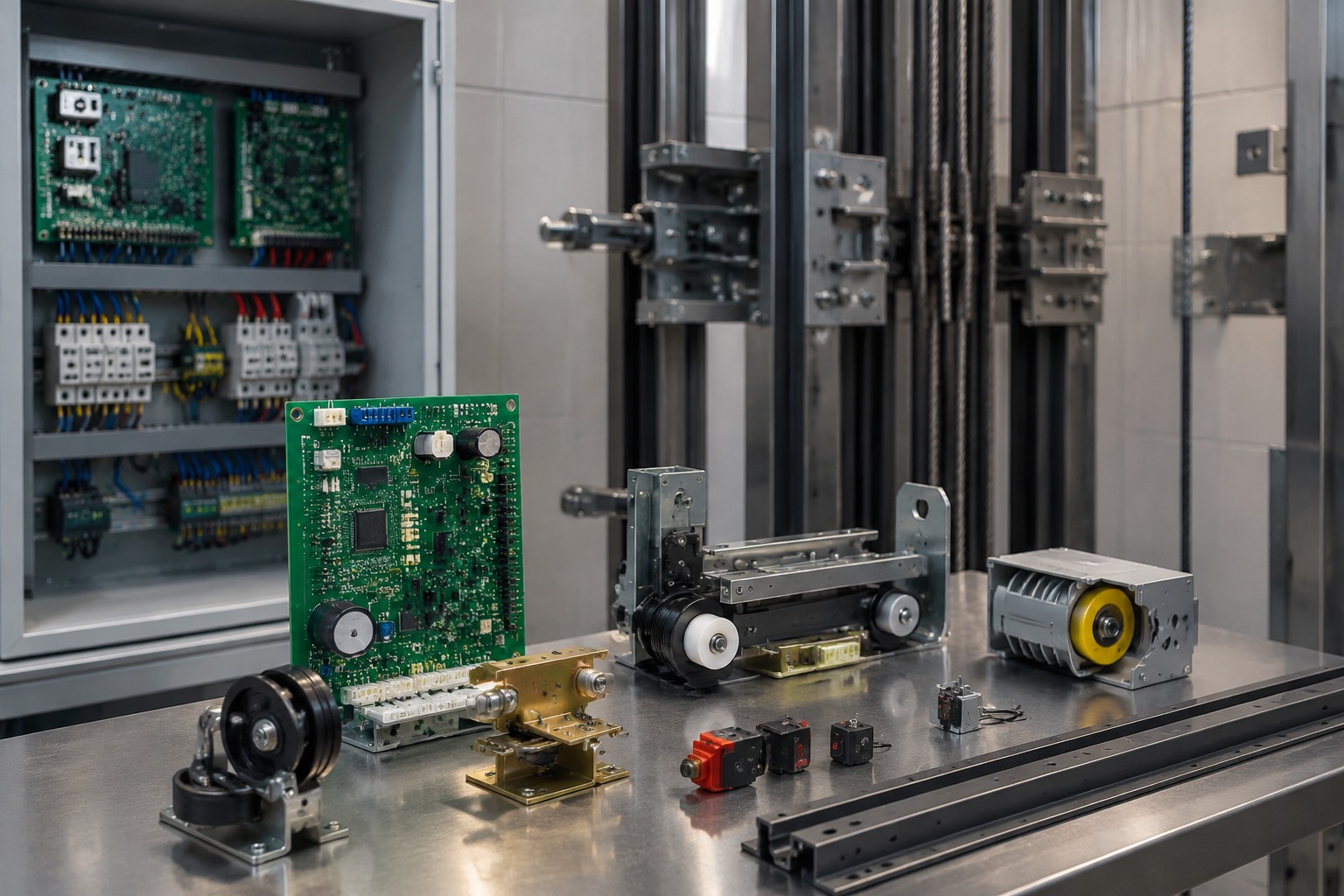
Correct identification is the foundation of successful Hitachi elevator parts procurement. Many ordering mistakes happen because buyers send only a broad description such as “Hitachi door board” or “lift sensor for condo unit.” That is rarely enough. Model series, part code, revision, connector format, and application position must be confirmed whenever possible.
Start with the elevator nameplate, controller cabinet label, machine label, and defective part sticker. Then compare photos of the front and back of the part, especially terminal blocks, pin layout, barcode stickers, firmware labels, and any etched code on the housing. If the part has been replaced before, do not assume the currently installed item matches the original specification. Past repairs may have introduced a different revision.
| Identification Step | What to Check | Why It Matters | Common Buyer Mistake | Best Practice | Field Example |
|---|---|---|---|---|---|
| Nameplate review | Lift model, capacity, speed, year | Confirms system family | Ignoring older serial tags | Photograph entire plate clearly | Older Manila apartment tower |
| Part label capture | Part number, revision, barcode | Enables exact or compatible match | Sending blurred photos | Share close and wide shots | Cebu hotel controller room |
| Connector verification | Pin count and socket orientation | Avoids installation mismatch | Ordering by appearance only | Include rear-side image | Davao mall door board case |
| Application position | Door operator, main controller, COP, LOP | Distinguishes similar-looking parts | Using generic item names | State exact installed position | Pasig mixed-use tower |
| Fault history review | Error code and recurring symptoms | Improves diagnosis before buying | Replacing parts without troubleshooting | Share maintenance log extract | Hospital service elevator |
| Previous repair check | Signs of retrofit or rewiring | Reveals non-original replacement history | Assuming all parts are factory original | Inspect harness and mounting changes | Modernized Quezon City property |
| Voltage and signal review | Input/output, pulse, communication type | Critical for boards and sensors | Skipping electrical data | Request technical cross-check | Subic commercial building |
For Philippine buyers handling older properties, documentation gaps are common. Some building owners have partial records only, while maintenance contracts may have changed hands several times. In those cases, structured evidence becomes even more important: cabinet photos, controller layout, fault logs, motor labels, and on-site video clips of symptoms can all help narrow the correct match.
A strong supplier should be able to review these details and tell you whether the requested item is an exact match, a compatible alternative, or a part that requires further engineering confirmation. This reduces the risk of ordering something that fits physically but fails electrically or functionally.
Control Board and Sensor Replacement Planning
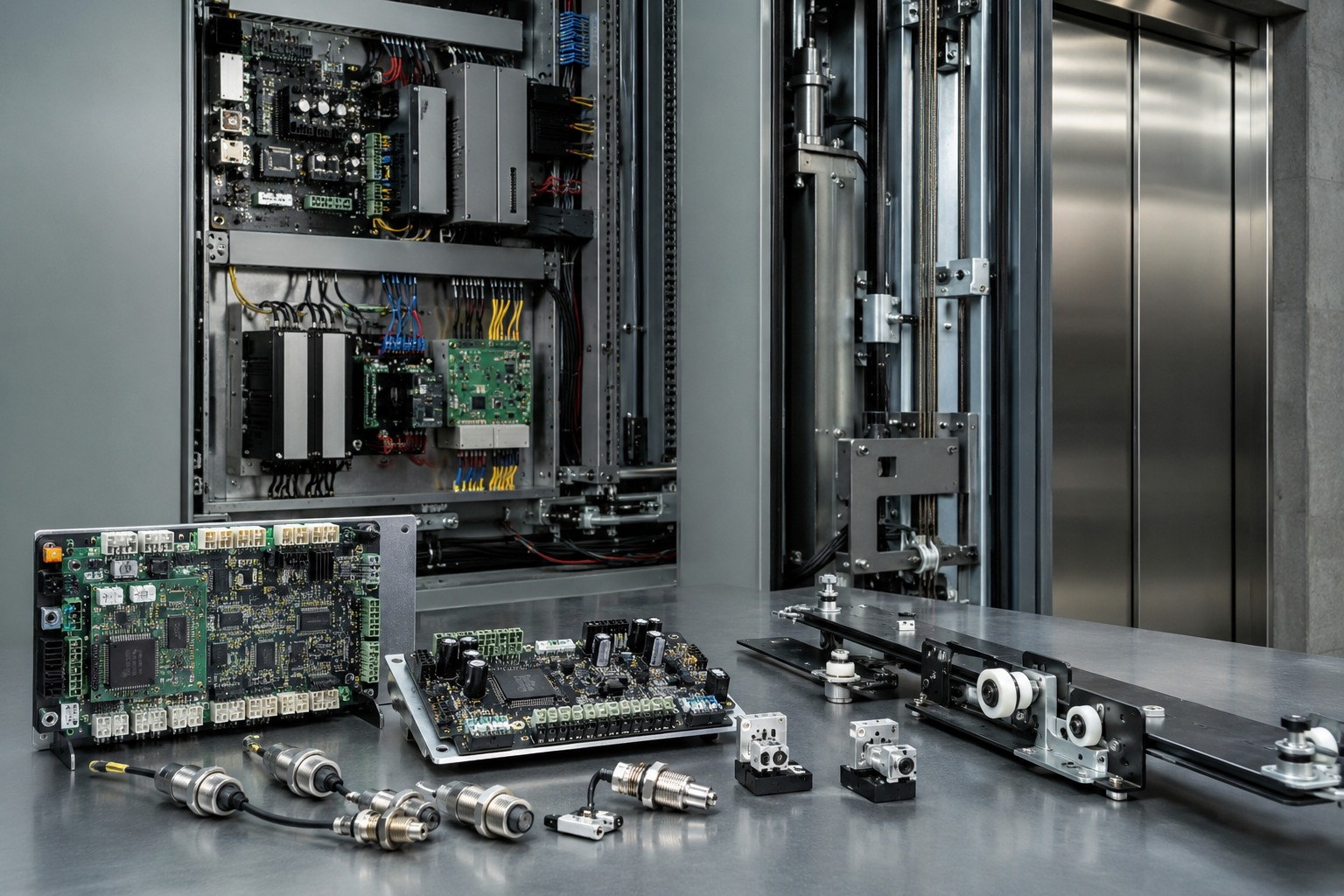
Control boards and sensors should never be treated as simple swap items without a replacement plan. These parts affect motion logic, floor detection, door protection, and communication within the elevator system. When a building in the Philippines has only one or two passenger lifts, poor planning can extend downtime from hours to days.
The first planning step is to distinguish between emergency replacement and preventive replacement. Emergency replacement is driven by hard failure, burnt components, communication loss, or repeat fault lockout. Preventive replacement is justified when a part shows unstable behavior, age-related deterioration, or a known history of recurring failure across the same installation family.
Control boards often require more than part matching. Teams should check whether parameter transfer, firmware version, chip set, or external module interaction will affect commissioning. Sensors require a similar level of care because the wrong sensing range, signal output, or mounting type can lead to false door detection, car position issues, or travel instability.
| Replacement Item | Planning Focus | Pre-Order Data Needed | On-Site Risk | Recommended Action | Downtime Impact |
|---|---|---|---|---|---|
| Main control board | Software and terminal compatibility | Part code, revision, cabinet photos | Non-start or communication failure | Confirm code and connector layout | Very high |
| Door control board | Door operator matching | Operator model, error logs | Door malfunction persists after install | Check paired motor and sensor status | High |
| Encoder | Pulse and shaft compatibility | Label photo, drive data | Misleveling and speed feedback faults | Cross-check signal specification | High |
| Light curtain | Beam count and size | Opening width and harness type | Door reopens repeatedly | Verify dimensions and connector | Medium |
| Limit sensor | Mounting and electrical type | Sensor body and bracket images | False position reading | Match mounting exactly | Medium |
| Leveling sensor | Detection range and output | Controller relation and placement | Poor floor accuracy | Test old wiring before replacement | High |
As a practical rule, if you are replacing a board because of a recurring sensor fault, make sure the sensor and wiring are also checked. Otherwise, the new board may be blamed for the same symptom. Likewise, a failing power supply can create unstable board behavior that looks like a controller defect. Good planning looks at the system chain, not one part in isolation.
For teams preparing a major repair, it is useful to pre-arrange both the board and its likely supporting components. This may include a compatible sensor set, communication cable, terminal markings, and an installation checklist. On urgent cases, a verified control board for Hitachi lifts can be sourced together with related inspection steps to reduce repeat shutdowns.
From a technical capability perspective, our work centers on model verification, part-code comparison, and compatibility review for key electronic components. This is especially important for boards, inverters, sensor interfaces, encoders, and communication-related accessories where visual similarity does not guarantee functional equivalence.
The trend toward planned replacement is becoming stronger in the Philippines as building operators recognize that reactive emergency buying usually costs more than preventive sourcing. By 2026, this shift is expected to accelerate further due to modernization demand, stricter uptime expectations, and greater use of digital maintenance records.
Door Motor and Power Supply Considerations
Door motor and power supply issues deserve special attention because they are frequent causes of service interruption and passenger complaints. Door performance problems are often the most visible defect in any building. Slow opening, repeated reopening, abnormal noise, or failure to fully close can quickly affect tenant confidence, especially in offices, hotels, and medical facilities.
When evaluating a door motor, confirm the operator model, voltage, mounting structure, shaft and pulley arrangement, and whether the replacement is direct-fit or requires tuning. Buyers should also ask whether the old problem may actually come from mechanical drag, worn rollers, incorrect belt tension, door vane alignment, or a weak drive command from the controller.
A suitable permanent magnet synchronous door motor for Hitachi elevators can improve stability and responsiveness, but only when the door operator and associated controller are properly matched. Installing a correct motor into a poorly aligned door mechanism will not solve the underlying fault.
Power supplies are equally important and often underestimated. Voltage instability, aged capacitors, heat exposure, and improper output ratings can trigger controller resets, sensor communication loss, or unreliable door operation. In areas with power quality variations, such as older commercial districts or remote islands with less stable electrical conditions, power-related faults deserve more scrutiny.
| Component | Key Checks | Typical Warning Sign | Procurement Note | Installation Concern | Suggested Support Item |
|---|---|---|---|---|---|
| Door motor | Voltage, model, mounting, torque | Weak opening force | Match operator system exactly | Requires mechanical alignment | Door belt or roller inspection |
| Door controller | Board code and parameter relation | Door cycle errors | Verify paired motor compatibility | May need tuning after install | Error log review |
| Power supply unit | Input/output rating, dimensions | Random reset or no output | Check heat and load history | Terminal correctness critical | Fuse and wiring check |
| Emergency power supply | Backup capacity and connection type | No rescue operation during outage | Confirm system application | Battery and interface testing needed | Battery condition record |
| Door sensor | Beam function and connector type | False obstruction signal | Match length and mounting | Alignment impacts performance | Bracket review |
| Transformer or auxiliary module | Output stability and load | Intermittent control issues | Do not order by size only | Heat dissipation matters | Panel ventilation check |
In outages and emergency readiness planning, many buyers also pay more attention to rescue-related power support. For suitable applications, an emergency power supply for Hitachi elevators can be a critical part of continuity planning, particularly in hospitals, hotels, and high-rise residences where passenger safety and managed evacuation matter.
Our manufacturing capability is reflected in stable sourcing channels, inspection procedures for core components, and protective packing designed for long-distance shipment. For Philippine customers receiving cargo through Manila, Batangas, Cebu, or Davao, durable packing reduces the risk of transit-related damage to boards, sensors, and other precision parts.
Guide Shoe and Brake Component Checks
Guide shoes and brake components may not receive as much attention as boards or door motors, but they are essential for ride quality and safe operation. Worn guide shoes can produce vibration, scraping noise, uneven running, and faster wear on related components. Brake components demand even closer attention because they directly affect stopping and holding performance.
For guide shoes, maintenance teams should inspect liner wear, fastening condition, lubrication support where applicable, rail contact pattern, and whether unusual vibration points to a deeper alignment problem. Simply replacing the shoe without investigating rail condition or cabin balance can shorten the life of the new part.
Brake checks should include lining wear, coil condition, release response, spring action, mounting integrity, heat effects, and any sign of contamination. Philippine coastal environments, including areas near Manila Bay, Batangas port zones, and Cebu port operations, may expose equipment to humidity and airborne contaminants that accelerate deterioration if machine rooms are not well protected.
| Inspection Item | What to Look For | Likely Cause | Action Needed | Urgency | Notes for Buyers |
|---|---|---|---|---|---|
| Guide shoe liner | Uneven wear or cracking | High friction or misalignment | Replace and inspect rails | Medium | Confirm dimensions carefully |
| Guide shoe body | Loose or damaged housing | Vibration and impact stress | Check mounting hardware | Medium | Order by assembly type |
| Oil cup or lubrication part | Low oil or leakage | Poor maintenance or seal wear | Restore lubrication path | Medium | Useful as routine spare |
| Brake lining | Thinning or glazing | Normal wear or heat | Replace before unsafe condition | High | Ask for material details |
| Brake coil | Weak release or overheating | Electrical fault or age | Electrical test and replacement | High | Voltage match is critical |
| Brake spring and linkage | Slow response or uneven action | Fatigue or contamination | Clean, inspect, replace as needed | High | Photograph assembly before order |
| Mounting hardware | Corrosion or looseness | Moisture and vibration | Re-secure or renew hardware | Medium | Include hardware request if needed |
For modernization contractors, these components are often part of a broader performance improvement plan. Replacing a control board without addressing worn guide shoes or brake assemblies can leave the building with better logic but poor mechanical performance. A complete repair strategy improves reliability more than isolated part changes.
How to Inspect Supplier Quality
Supplier evaluation is where many procurement savings are either protected or lost. Low upfront pricing means little if the part arrives damaged, mismatched, or unsupported. For Hitachi elevator parts, quality inspection should begin before production release or dispatch, not after cargo reaches the Philippines.
Buyers should ask suppliers for part-label photos, front and back product images, dimensional confirmation where relevant, packaging standards, and a clear statement on whether the part is exact-match, equivalent, or application-confirmed based on customer data. For electronic items, anti-static handling and moisture-resistant packaging are important. For mechanical parts, finish quality, machining accuracy, and protective packing matter just as much.
Another good practice is to assess response quality, not only product quality. A reliable supplier asks for the right technical data, points out inconsistencies, and warns you when information is incomplete. A weak supplier simply accepts the order without verification, which increases the chance of mismatch.
| Supplier Checkpoint | What Good Looks Like | Warning Sign | Why It Matters | Buyer Question | Expected Result |
|---|---|---|---|---|---|
| Model verification | Supplier reviews labels and photos | Accepts vague item description | Prevents mismatch | Can you confirm by part code and image? | Higher order accuracy |
| Inspection process | Photos and checks before shipment | No evidence of inspection | Reduces defects on arrival | What is inspected before dispatch? | Better confidence |
| Packaging quality | Protected board and shock-safe carton | Loose packing | Transit safety | How do you pack sensitive parts? | Lower freight damage risk |
| Technical response | Clear and specific answers | Generic replies only | Supports complex orders | Can you review our fault data? | Better diagnosis support |
| Lead time reliability | Realistic shipping estimate | Unclear promises | Important for downtime planning | What is actual ready time? | More predictable repair schedule |
| After-sales communication | Responsive if issue arises | Disappears after payment | Critical for installation stage | How do you support post-delivery issues? | Reduced project risk |
| Export experience | Knows documents and routing needs | Inexperienced with overseas handling | Prevents delay to Manila or Cebu | Do you ship regularly to the Philippines? | Smoother logistics |
Our service capability is built around prompt communication, organized verification, and shipment support that helps local buyers manage downtime risk. This matters for customers coordinating deliveries into Metro Manila, Cebu, Davao, and other regional hubs where site schedules, customs timing, and maintenance windows need better predictability.
This comparison highlights an important point: procurement success is rarely determined by price alone. Verification discipline and technical response usually save more time and money than a small discount on the unit price.
Common Procurement Mistakes
The most common buying errors in Hitachi elevator parts sourcing are preventable. In the Philippines, where imported spare lead times can affect building operations quickly, these mistakes are especially costly.
The first mistake is ordering from a broad part description without confirming part number and revision. The second is replacing the “suspected” part without checking related causes such as sensor wiring, unstable power supply, or worn mechanical assemblies. The third is choosing a supplier based only on the lowest quote. The fourth is failing to prepare site data in advance, which delays troubleshooting and ordering.
Another frequent issue is underestimating logistics. If a building in Cebu or Davao needs an urgent spare, the buyer should consider whether air shipment is necessary, whether fragile electronics need reinforced packaging, and whether customs documents are complete. A cheap part that arrives late can cost more than a slightly higher-priced item that restores service quickly.
| Mistake | What Happens | Operational Impact | Better Approach | Who Should Act | Outcome Improvement |
|---|---|---|---|---|---|
| Ordering by appearance only | Wrong part received | Extra downtime | Use code, label, and connector check | Buyer and technician | Higher match accuracy |
| Ignoring revision number | Board does not work properly | Repeat service call | Confirm full part designation | Technical purchaser | Lower install risk |
| No fault history shared | Root cause remains unresolved | Same issue returns | Provide logs and symptoms | Maintenance team | Better diagnosis |
| Lowest-price-only buying | Poor quality or no support | False savings | Balance price, quality, and service | Procurement manager | More reliable supply |
| Weak packaging requirement | Transit damage | Delayed repair | Request protected packing standard | Buyer and supplier | Safer arrival |
| No spare planning | Emergency sourcing pressure | Long service outage | Stock high-risk items strategically | Building owner and contractor | Faster recovery |
| Skipping installation review | New part fails due to old fault source | Extra cost and confusion | Inspect related system components | Site technician | More complete repair |
For local suppliers and contractors, a practical lesson from real projects is that successful sourcing starts with information discipline. The more precise the site data, the faster a reliable supplier can support a correct order. This matters for property managers in Makati, Mandaluyong, Pasay, Cebu City, and Davao where elevator uptime is tied directly to tenant satisfaction and building reputation.
Looking toward 2026, three trends will shape Hitachi elevator parts procurement in the Philippines. First, modernization demand will rise as more installed units reach the stage where control and door system upgrades become more economical than repeated reactive repairs. Second, policy and safety expectations will support better documentation, more traceable maintenance records, and stronger emphasis on reliable replacement parts. Third, sustainability will influence buying decisions through longer-life components, reduced waste from wrong orders, better packing efficiency, and more selective preventive replacement rather than emergency scrapping of related assemblies.
FAQ About Hitachi Elevator Parts
1. What are the most commonly purchased Hitachi elevator spare parts in the Philippines?
The most commonly purchased parts are control boards, door motors, encoders, sensors, power supplies, light curtains, buttons, guide shoes, door locks, and brake-related components. Buildings with heavy traffic often need faster turnaround for door system and controller items.
2. How can I identify the correct Hitachi part number if records are incomplete?
Collect the elevator nameplate, cabinet photos, defective part label, connector images, and fault code history. If the site has undergone previous repairs or modernization, note any rewiring or non-original modules. A supplier can often help confirm the match from this information.
3. Can I replace only the control board when the lift has a sensor fault?
Sometimes yes, but not always. Sensor faults may be caused by wiring, connector oxidation, unstable power supply, or an actual sensor failure. Replacing the board alone without checking the full chain may not solve the issue.
4. Why is door motor matching so important?
A door motor must match the operator system, controller relationship, voltage, and mechanical configuration. A near-looking alternative can still cause poor opening force, repeated faults, or commissioning problems.
5. Should building owners in the Philippines keep certain Hitachi lift parts in stock?
Yes, especially for busy properties or buildings with limited lift redundancy. Typical stock candidates include door sensors, buttons, selected relays, guide shoe consumables, and in some cases a verified board or encoder for critical units.
6. How do I judge whether a supplier is reliable?
Look for technical verification, clear communication, inspection evidence, secure packaging, realistic lead times, and after-sales responsiveness. A reliable supplier asks good questions before shipping.
7. Are emergency power supply parts worth planning in advance?
For hospitals, hotels, high-rise residences, and premium commercial buildings, yes. Backup-related parts can be important during outages or rescue situations and are easier to manage when planned before failure.
8. What is the biggest procurement mistake buyers make?
The biggest mistake is ordering by generic description without verifying the full code, revision, and application. This causes mismatches, delayed restoration, and unnecessary cost.
9. How do local logistics affect lift parts sourcing in the Philippines?
Delivery planning can be affected by customs timing, port handling, domestic forwarding, and urgency level. Buyers serving Manila, Cebu, Davao, Batangas, and Subic often benefit from suppliers who understand export packing and realistic shipment schedules.
10. What should maintenance teams prepare before requesting a quote?
Prepare part photos, labels, elevator model details, fault codes, installation position, quantity required, and destination city. The better the information, the faster and more accurate the quotation and matching process.
For buyers and repair teams in the Philippines, the best sourcing result comes from combining three things: exact identification, practical replacement planning, and supplier verification. Whether you are handling a control board fault in Makati, a door motor issue in Cebu, a guide shoe order for Davao, or an emergency power inquiry for a hospital in Manila, accuracy at the start saves time, money, and downtime later. With structured technical review, careful inspection, and responsive support, Hitachi elevator spare procurement becomes more predictable and more effective for both short-term repairs and long-term modernization planning.