
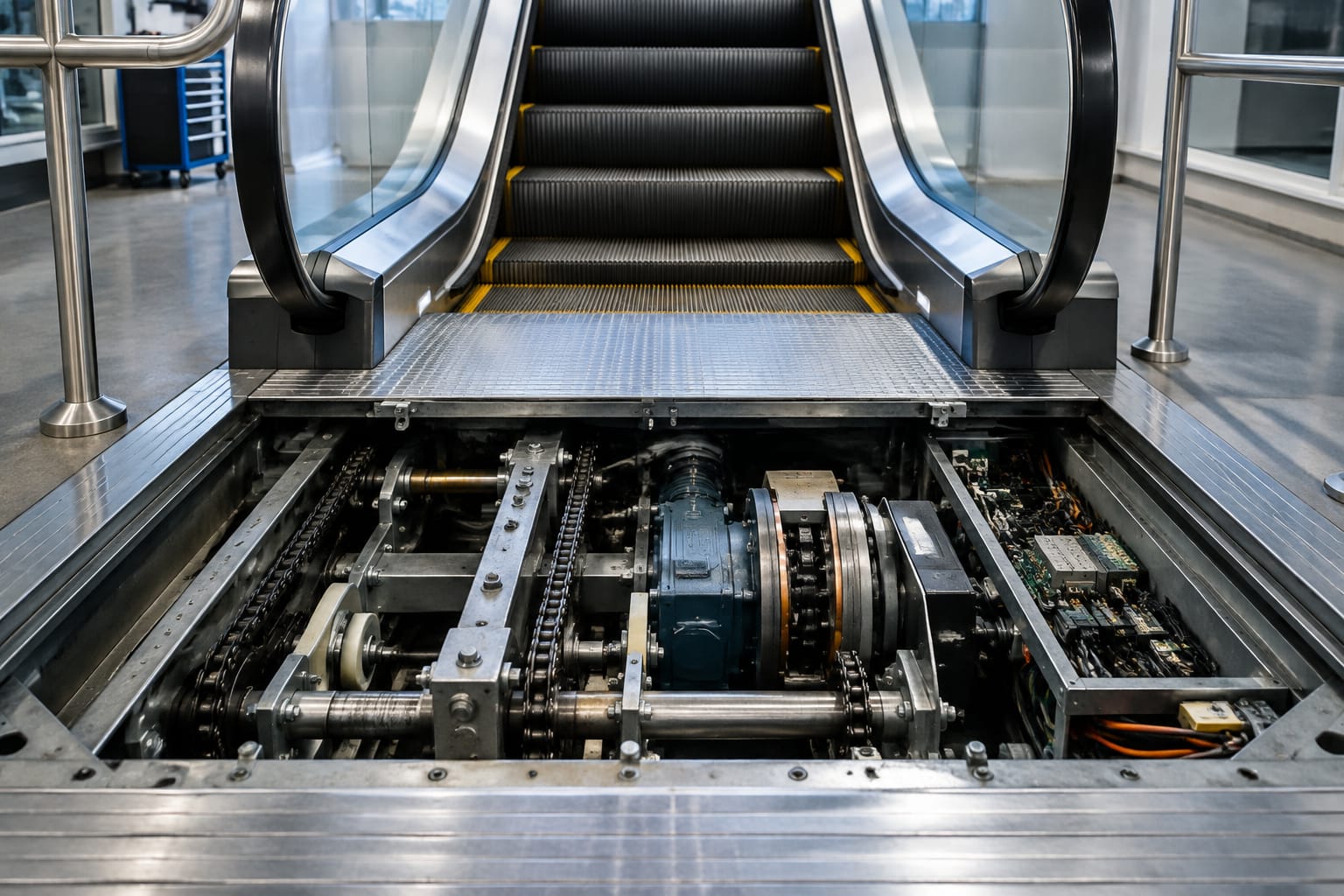
Escalator equipment is a connected group of mechanical, electrical, and safety systems that move passengers safely between floors. The most important systems are the step band, drive train, handrail mechanism, braking arrangement, controller, and safety devices. A fault in any one of these areas can lead to erratic operation, nuisance shutdowns, excessive wear, or an unsafe condition.
For maintenance contractors, building operators, and parts buyers in the Philippines, the practical priority is not simply identifying a failed part. It is confirming the exact equipment configuration, understanding why the part failed, and replacing it with a component that matches the escalator's original design and safety circuit requirements.
Main Escalator Systems at a Glance
An escalator is often described as a moving stairway, but its equipment is closer to a coordinated conveyor and safety system. The truss houses the main working parts, while the visible steps, handrails, balustrades, comb plates, and landing sections form the passenger interface.
| System | Main function | Typical parts | Maintenance concern |
|---|---|---|---|
| Step band | Carries passengers between landings | Steps, step chains, axles, rollers, tracks | Chain wear, roller damage, step alignment |
| Main drive | Moves the step band | Motor, gearbox, drive chain or belt, sprockets | Lubrication, alignment, vibration, overheating |
| Handrail system | Moves handrails in line with steps | Handrail drive, rollers, tension carriage, guide rails | Slippage, tracking, uneven speed |
| Braking system | Stops and holds the escalator | Main brake, auxiliary brake, coils, brake controller | Brake clearance, stopping performance, switching faults |
| Electrical control | Starts, stops, monitors, and protects operation | Controller, contactors, relays, inverter, terminals | Loose wiring, heat damage, incorrect settings |
| Safety circuit | Stops operation when unsafe conditions occur | Switches, sensors, emergency stops, comb-impact devices | Bypassed switches, damaged actuators, intermittent contacts |
Most escalator maintenance work begins with an observed symptom, such as a handrail running slower than the steps, a repeated safety shutdown, brake-related fault indication, abnormal noise, or a step that does not sit correctly at the landing. The symptom is only the starting point. A proper inspection must identify the underlying mechanical, electrical, or adjustment issue.
Steps, Chains, Tracks, and Comb Plates
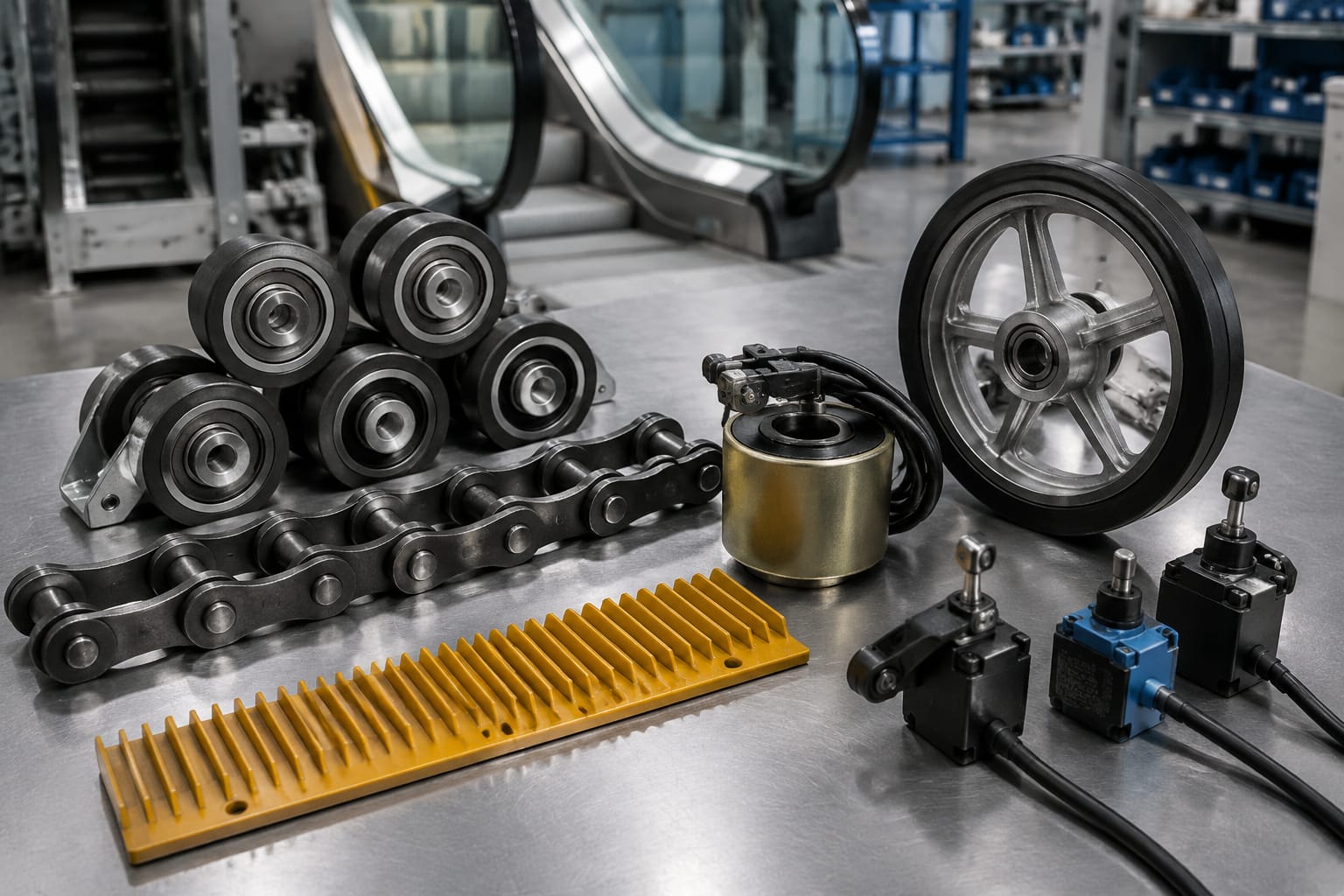
The step band is the core passenger-carrying system. Each escalator step is connected to adjoining steps through the step chain, while rollers guide the step along tracks inside the truss. As the steps travel around the curved landing sections, the track profile changes their position from a flat step into the staircase formation and back again.
Steps and step axles
Steps must remain stable, level where required, and correctly spaced. A cracked tread, damaged demarcation line, bent axle, or worn roller can affect step movement and passenger safety.
Inspect for:
- Broken or worn step tread surfaces
- Missing or damaged yellow demarcation inserts
- Loose, cracked, or distorted step components
- Abnormal step-to-step clearance
- Rubbing, knocking, or vibration during travel
- Step movement that differs from neighbouring steps
Do not assume that a noisy step needs only replacement. Noise may originate from a worn step roller, track damage, chain condition, axle wear, or debris lodged in the truss.
Step chains and sprockets
Step chains transfer movement from the drive sprocket to the step band. Their condition directly affects smooth travel, synchronisation, and chain tension. Over time, pins, bushings, rollers, and links wear. Sprocket teeth may also wear or become damaged.
A maintenance team should monitor chain elongation using the manufacturer's specified measurement method. Chain stretch must not be judged by appearance alone. Incorrect tension can accelerate wear, affect step alignment, and place unnecessary load on the drive.
When assessing step-chain replacement, confirm:
- Escalator make, model, and serial or equipment identification
- Chain pitch and link arrangement
- Number of links and required length
- Attachment and axle configuration
- Sprocket compatibility
- Whether both chains should be evaluated as a set
- Original manufacturer instructions for tensioning and lubrication
Replacing one visibly damaged chain component without evaluating the full chain and sprocket condition can create uneven wear or premature repeat failure.
Tracks and comb plates
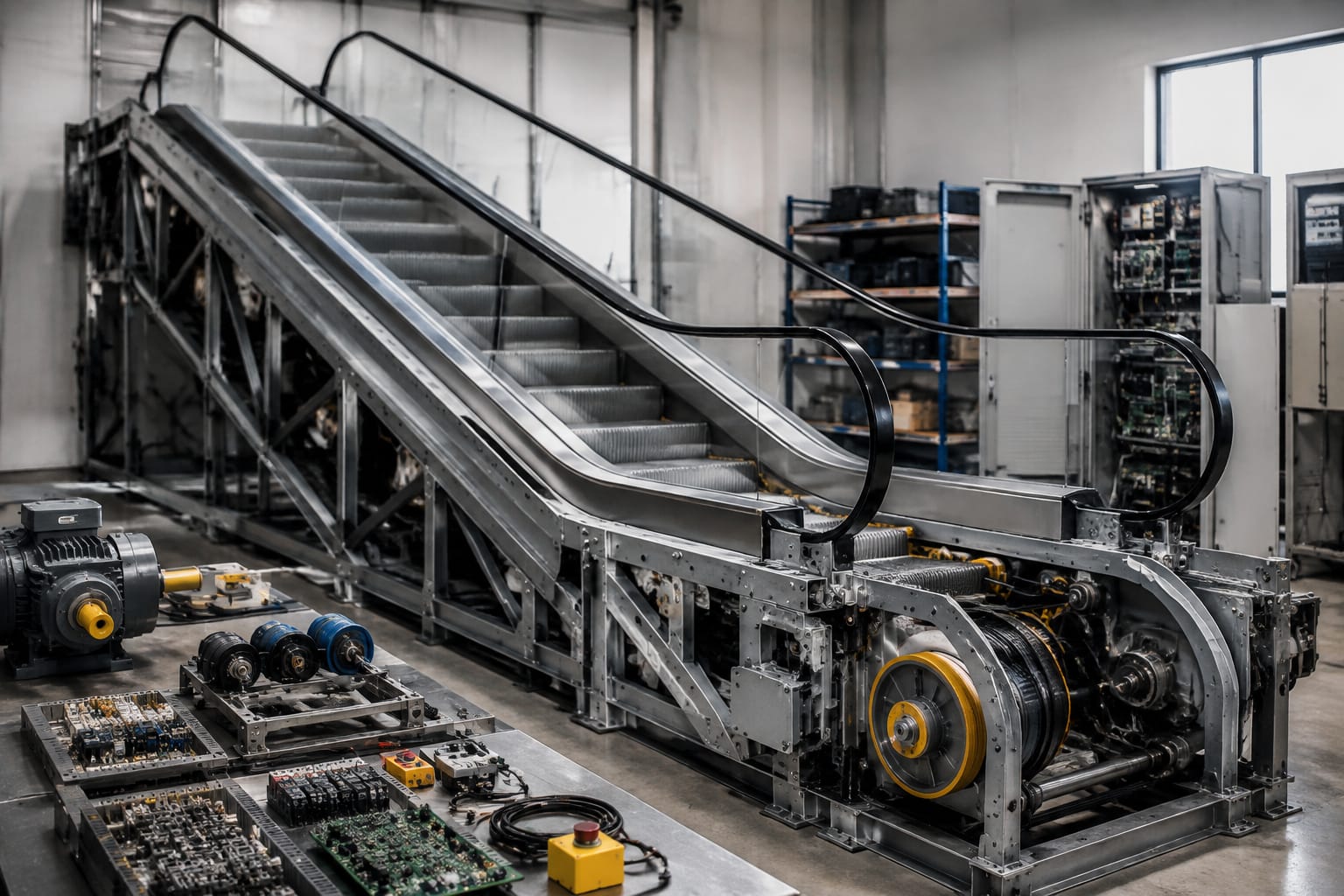
Step rollers run inside guide tracks, so track condition is essential for smooth movement. Bent sections, loose fasteners, foreign objects, or worn track surfaces can cause vibration, roller damage, and poor step positioning.
At the top and bottom landings, the comb plate teeth mesh with grooves in the step tread. This helps reduce the gap where steps enter and leave the floor plate. Damaged comb teeth, incorrect adjustment, or a displaced comb plate can create a trapping risk and may activate the comb-impact safety device.
Routine checks should include:
- Comb tooth condition and engagement with step grooves
- Secure floor plate and comb plate fasteners
- Correct operation of comb-impact switches
- Removal of debris beneath landing plates
- Step clearance and alignment at each landing
- Track cleanliness and roller running condition
Comb plates and step treads should be inspected together. A replacement part that appears physically similar may not match the correct tooth spacing, tread profile, or mounting arrangement.
Handrail Drive and Tensioning Parts
Handrails need to travel at a speed that remains suitably coordinated with the steps. The handrail system generally includes the handrail belt, drive wheel or friction drive, guide rollers, tension carriage, tension springs or weights, and entry devices at the newel ends.
A handrail that is slow, slipping, wandering, or intermittently stopping is not only a comfort issue. It can indicate contamination, poor tension, worn friction surfaces, damaged guide rollers, or an issue with the handrail drive system.
Common handrail faults
Typical warning signs include:
- Handrail speed visibly different from step speed
- Handrail slipping at the drive wheel
- Handrail drifting to one side
- Excessive squealing, rubbing, or vibration
- Cracks, hardening, or damage on the handrail surface
- Difficulty moving the handrail by hand during isolated inspection
- Frequent activation of a handrail-entry or speed-monitoring device
Cleaning may help where contamination is the cause, but it will not correct worn rollers, a damaged belt, or a tensioning mechanism that cannot maintain the required force.
Handrail tension and alignment
Handrail tension must be set according to the escalator manufacturer's procedure. Excessive tension increases load on the drive and guide components. Insufficient tension can cause slip and poor speed matching. There is no universal adjustment setting suitable for every escalator model.
Before ordering a handrail drive or tensioning component, document the handrail width, profile, drive arrangement, roller dimensions, mounting points, and equipment model. For complete handrail replacement, verify the required finished length and joining method where applicable. Field measurement should follow the original equipment procedure because an incorrect length can make correct tensioning impossible.
Main and Auxiliary Brakes
Escalator braking equipment is a critical safety system. The main brake normally acts on the drive machinery to stop the escalator when power is removed or a stop command is issued. An auxiliary brake, sometimes called an additional brake, provides an extra protective braking function under specified fault conditions, depending on the escalator design.
Brake systems vary significantly by manufacturer, model, duty rating, and controller design. For this reason, brake parts should never be selected from a photograph or a broad description alone.
Main brake function
The main brake is usually spring-applied and electrically released. During normal running, an electromagnetic coil or actuator releases the brake. When the escalator stops, the release power is removed and spring force applies the brake.
Maintenance attention commonly includes:
- Brake lining or friction-surface condition
- Brake shoe and drum or disc condition
- Air gap and clearance adjustment
- Spring condition and linkage movement
- Coil condition and electrical connections
- Evidence of oil, grease, corrosion, or heat damage
- Secure mounting and correct release operation
Brake adjustments affect stopping behaviour. They must be completed only by competent personnel using the relevant manufacturer procedure and applicable safety requirements. Over-tightening, under-tightening, or using an incorrect friction material can change braking performance.
Auxiliary brake and its controls
An auxiliary brake may be triggered by conditions such as unintended movement, excessive speed, drive-chain failure, or another defined mechanical fault. The exact trigger logic depends on the escalator design and controller.
When troubleshooting an auxiliary-brake fault, inspect both the brake mechanism and its electrical control path. A fault may originate from the brake coil, monitoring contacts, controller input, wiring, mechanical release linkage, or the safety device that commands activation.
For systems using a dedicated control board, compare the required part number, board revision, input and output arrangement, supply requirements, and connector layout. An [escalator 508 brake board for Otis equipment](/products/escalator-508-brake-board-otis-elevator-parts-lift-accessories/) is relevant only where its identification and electrical compatibility have been confirmed for the installed system.
Likewise, an [additional brake electromagnetic coil](/products/escalator-additional-brake-electromagnetic-coil-lift-accessories-elevator-spare-parts/) must match the specified voltage, coil type, mounting arrangement, and associated brake assembly. A coil with a similar shape but different electrical characteristics can overheat, fail to release correctly, or damage the control circuit.
Motors, Drives, and Controllers
The main drive system supplies the torque that moves the step band. It commonly consists of an electric motor, gearbox, drive chain or belt, sprockets or pulleys, and associated bearings. The controller coordinates starting, stopping, direction, monitoring, and safety-circuit response.
Motor and gearbox checks
A gradual rise in drive noise, vibration, temperature, or current draw can indicate developing mechanical resistance or drive wear. Possible causes include bearing deterioration, gearbox issues, insufficient or unsuitable lubricant, misalignment, worn drive chain, or resistance in the step band.
Inspect and record:
- Motor mounting and terminal condition
- Abnormal vibration or bearing noise
- Gearbox oil condition and signs of leakage
- Drive chain or belt wear, tension, and alignment
- Sprocket or pulley wear
- Coupling condition, where fitted
- Signs of overheating or discoloured insulation
- Drive-machine brake operation
Do not replace a motor before checking whether the escalator has an upstream mechanical loading problem. A new motor operating against a seized roller, misaligned chain, or failing gearbox will not solve the underlying cause.
Controllers and electrical components
Escalator controllers contain components such as contactors, relays, power supplies, terminal blocks, protective devices, variable-frequency drives where fitted, and logic boards. Electrical faults may be intermittent, especially where terminals are loose, components are heat-stressed, or moisture and dust affect the panel.
Before replacing a controller component, verify:
- Controller model and original component part number
- Supply voltage and frequency
- Terminal markings and connector type
- Input and output requirements
- Firmware, parameter, or revision compatibility where relevant
- Fault history and the state of the safety circuit
- Whether the failed item caused damage elsewhere in the circuit
A brake controller must be considered part of the wider safety design. For example, this [escalator auxiliary brake controller](/products/escalator-auxiliary-brake-controller-lift-parts-elevator-accessories/) should be matched against the installed unit's part number, wiring arrangement, and control requirements before procurement.
Safety Switches and Sensors
Safety switches and sensors monitor conditions that could make continued escalator operation unsafe. When a device detects a problem, it opens or changes the safety circuit so the controller can stop the escalator.
Common devices include:
- Emergency-stop switches at landing areas
- Comb-impact switches
- Step-chain tension or breakage switches
- Drive-chain monitoring switches
- Handrail-entry switches
- Skirt obstruction switches, where fitted
- Missing-step or step-level monitoring devices
- Overspeed or unintended-movement devices
- Access-panel and machinery-space safety switches
- Motor thermal protection and phase-monitoring devices
A repeated safety shutdown should be investigated systematically. Resetting the equipment without identifying the cause can return an escalator to service with an unresolved mechanical or electrical defect.
A practical fault-finding sequence
- Record the controller indication and operating conditions at the time of shutdown.
- Isolate the escalator following the site's safe work procedure.
- Inspect the relevant switch, actuator, wiring, and mechanical condition.
- Check for dirt, misalignment, loose mounting, damaged cable, or intermittent contacts.
- Confirm the switch operates at the correct mechanical point.
- Restore and test only under the approved maintenance procedure.
- Record the corrective action and any parts replaced.
Safety switches must not be bypassed to keep an escalator running. A temporary jumper may conceal a fault and remove a required protection from service.
Common Wear and Inspection Points
Preventive maintenance is most effective when inspections focus on parts that experience friction, load cycles, movement, heat, or environmental exposure. In high-traffic settings, wear can develop faster, so maintenance frequency and inspection scope should follow the equipment manufacturer's instructions, site usage, and observed condition.
High-priority mechanical inspection points
Pay particular attention to:
- Step-chain pins, rollers, links, and tension
- Step rollers and track condition
- Drive chain, sprockets, bearings, and gearbox
- Brake linings, springs, coils, and linkage
- Handrail drive surfaces, rollers, guides, and tension mechanism
- Comb plates, step treads, and landing clearances
- Fasteners on moving or safety-related assemblies
- Signs of rubbing, corrosion, oil leakage, or foreign material
High-priority electrical inspection points
Electrical inspections should cover:
- Controller terminals and earthing connections
- Contactors and relays for wear or heat damage
- Brake coil connections and release circuit operation
- Safety-switch actuation and wiring condition
- Power-supply condition and protective devices
- Heat, moisture, dust, or pest-related panel contamination
- Fault logs and recurring trip patterns
Visual inspections are useful, but measurement and functional testing are also necessary. For example, chain wear requires an approved measurement method, electrical condition may require proper test instruments, and brake performance must be checked according to the applicable equipment procedure.
Common maintenance mistakes
Several avoidable errors can increase downtime or create safety risks:
- Replacing parts based only on appearance
- Fitting a generic electrical component without confirming ratings and terminal logic
- Adjusting brake settings without the manufacturer's procedure
- Treating a safety trip as a reset issue rather than a fault condition
- Ignoring related wear on mating parts, such as a chain and sprocket
- Failing to record measurements, adjustments, and recurring faults
- Using unsuitable lubricant or applying lubricant where friction is required
- Ordering a part before confirming model, serial information, and revision details
Sourcing Escalator Replacement Parts
Escalator replacement parts should be sourced against a clear technical identification record. This reduces the risk of receiving a component that fits physically but does not meet the required electrical, mechanical, or safety function.
For each request, prepare the following information where available:
| Information to provide | Why it matters |
|---|---|
| Escalator brand, model, and serial number | Identifies the equipment family and original configuration |
| Original part number | The most reliable starting point for matching |
| Clear photos of the installed part and labels | Helps verify physical configuration and markings |
| Electrical nameplate details | Confirms voltage, current, frequency, and coil ratings |
| Dimensions and mounting details | Important for mechanical parts without clear part numbers |
| Board revision and connector layout | Necessary for controller boards and electronic modules |
| Fault description and affected system | Helps avoid replacing the wrong component |
| Quantity and whether the part is safety-related | Supports correct purchasing and inspection planning |
OEM, equivalent, and used parts
Buyers may encounter original manufacturer parts, compatible replacement parts, refurbished items, and used components. These options should not be treated as interchangeable.
Original manufacturer parts may provide the clearest fitment path when the exact number is available. Compatible replacement parts require careful confirmation of dimensions, ratings, materials, function, and interface requirements. Refurbished or used electronic and brake-related safety components deserve particular caution because condition, repair history, and test status may be difficult to verify.
For safety-critical equipment, purchasing decisions should account for more than initial cost. Consider the consequences of incorrect fitment, repeat site visits, equipment downtime, and the need to preserve the intended safety function.
Kelevator supplies multi-brand elevator spare parts for B2B importers, distributors, maintenance contractors, modernization companies, and OEM buyers. For a practical sourcing enquiry, provide the equipment details and original part identification first, then confirm compatibility before placing an order.
FAQ
What is the most important escalator equipment to inspect regularly?
The step band, drive system, handrail system, brakes, comb plates, and safety circuit all require regular inspection. The priority depends on the equipment condition and fault history, but brakes, safety switches, step chains, and comb plates are especially important because they affect passenger protection and safe stopping.
Can an escalator run with an auxiliary brake fault?
It should not be returned to normal operation until the fault has been assessed and corrected under the relevant maintenance procedure. An auxiliary-brake fault may involve the brake itself, its coil, wiring, safety device, or control circuit.
How do I know whether an escalator part is compatible?
Confirm the original part number first. Then compare the equipment model, serial information, electrical ratings, physical dimensions, mounting, connector arrangement, and component revision where relevant. For safety-related parts, confirm the complete functional requirement rather than relying on shape alone.
Should step chains and sprockets be replaced together?
They should be assessed together. A worn chain operating on worn sprockets can accelerate wear and affect engagement. The replacement decision should follow measured wear, visual condition, manufacturer guidance, and the condition of associated components.
A reliable escalator maintenance programme combines routine inspection, measured wear assessment, proper fault investigation, and accurate parts identification. Before sourcing a replacement, collect the original part number, equipment details, photos, and relevant electrical or mechanical measurements so the proposed component can be checked against the installed escalator.