
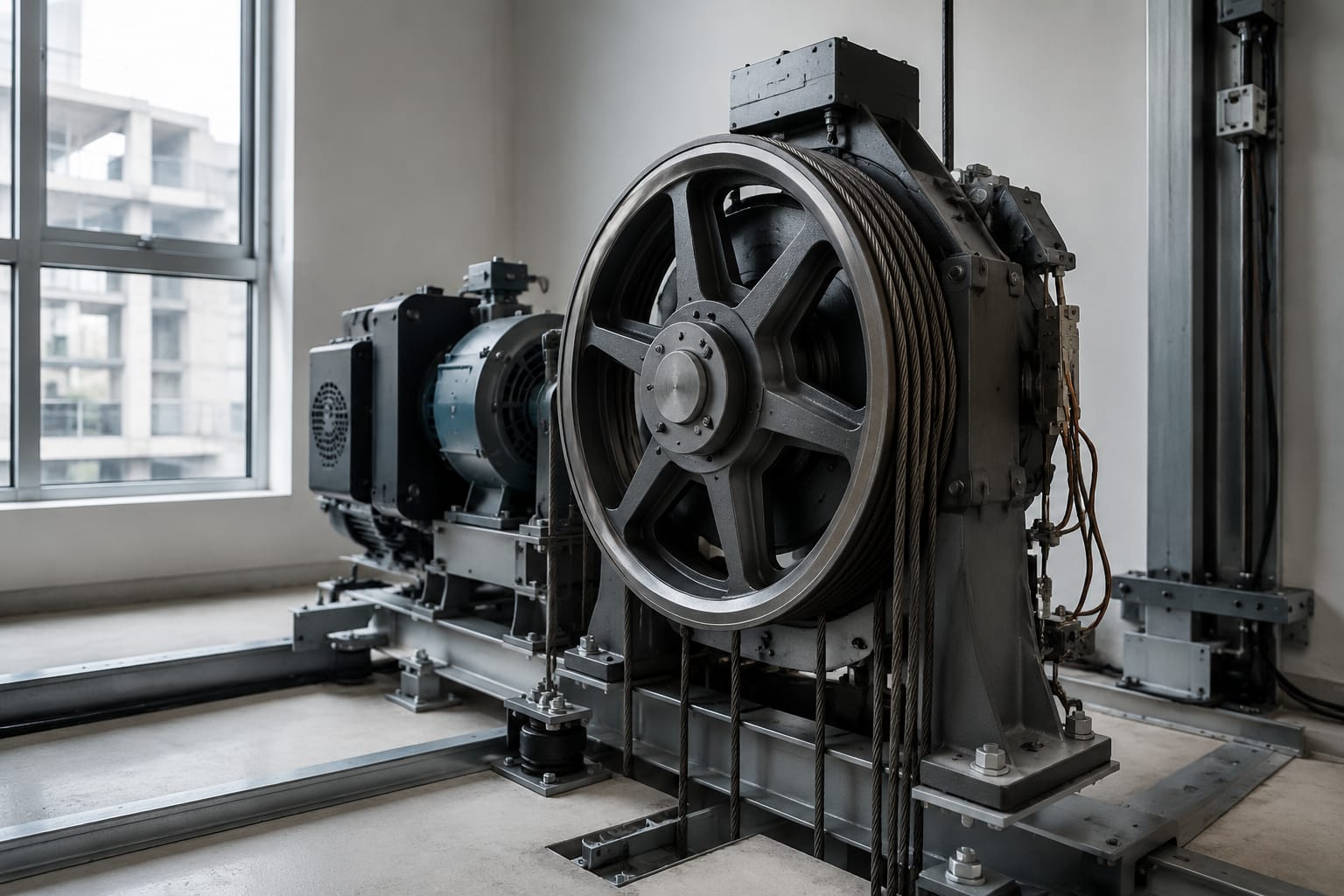
An elevator traction sheave transfers the machine's torque to the suspension ropes or steel belts through carefully matched grooves. Its condition directly affects traction, ride quality, levelling, and the service life of the suspension system. A replacement sheave cannot be selected by outside diameter alone: the groove geometry, shaft interface, suspension type, and machine compatibility must all match the existing application.
For maintenance contractors and sourcing teams in the Philippines, the practical approach is to inspect the complete traction system, record measured dimensions and machine data, then compare these against the equipment manufacturer's requirements. Replacing a worn sheave without addressing worn ropes, belts, bearings, or incorrect tension can quickly repeat the problem.
How a traction sheave works
The traction sheave is the grooved wheel mounted on the elevator machine shaft. As the motor turns the sheave, friction between the grooves and the suspension members moves the car and counterweight in opposite directions.
Traction depends on several conditions working together:
- The sheave groove profile must suit the installed wire ropes or coated steel belts.
- Groove surfaces must provide consistent contact and friction.
- The suspension members must have acceptable condition and tension balance.
- The car-side and counterweight-side loads must remain within the machine design.
- The sheave must run true on the shaft, without excessive runout or bearing-related movement.
A sheave does not pull the ropes by clamping them. Instead, it uses friction created by wrap angle, groove shape, load difference, and the material condition of the groove and suspension member. If the grooves become polished, enlarged, uneven, or contaminated, the traction relationship changes. The result may be slip, rough travel, accelerated rope or belt wear, or inconsistent floor levelling.
On geared machines, the traction sheave is usually driven through a gearbox. On gearless machines, it is typically mounted directly to the motor rotor or shaft. This distinction matters during replacement because the shaft connection, fixing method, and load arrangement can differ significantly.
Steel-rope and steel-belt applications
Steel wire ropes and coated steel belts both perform the suspension function, but they require different sheave designs. They should never be treated as interchangeable simply because their nominal load capacity appears similar.
Steel-rope traction sheaves
Conventional traction elevators commonly use several round steel wire ropes. The sheave has a matching number of round grooves, and each groove must support its rope evenly.
Key considerations include:
- Rope diameter and construction
- Number of ropes
- Groove profile and undercut, where specified
- Groove pitch or centre-to-centre spacing
- Sheave diameter
- Rope wrap and reeving arrangement
- Rope lubrication condition
- Equal tension across all ropes
A worn groove can cause one rope to sit lower or deeper than the others. That rope may carry a greater share of the load, leading to unequal stretch and faster wear. A tension check is therefore important when groove wear is suspected.
Steel-belt traction sheaves
Some modern elevator systems use flat, coated steel belts rather than round ropes. Their sheaves have shaped channels that support the belt width and profile. Belt applications rely heavily on the correct interface between the belt coating and sheave groove.
For a steel-belt sheave, confirm:
- Exact belt type and width
- Number of belts and channel count
- Channel geometry and pitch
- Belt-facing surface condition
- Machine model and suspension layout
- Approved belt and sheave pairing from the original equipment documentation
A belt channel with damaged edges, embedded debris, coating transfer, or abnormal polishing can affect belt tracking and traction. Do not use a rope sheave for a belt system or attempt to modify round grooves to accept flat belts.
For example, sourcing should identify whether the required part is a [steel-belt traction sheave for a 3300 elevator system](/products/id-steel-belt-traction-sheave-3300-elevator-parts/) rather than relying on a generic description such as “traction pulley”.
Groove profiles and traction conditions
Groove shape determines how the suspension member sits in the sheave and how much traction it develops. A profile that looks broadly similar may still be unsuitable if its depth, flank angle, undercut, or contact surface differs from the original design.
Common groove arrangements include round grooves, V-type grooves, U-grooves, and undercut variants for wire ropes. Steel belts use proprietary or application-specific channel profiles. The correct profile is set by the elevator system design, not chosen only by a preference for higher friction.
| Groove condition | Likely effect | Practical concern |
|---|---|---|
| Correct, even profile | Consistent support and traction | Normal inspection remains necessary |
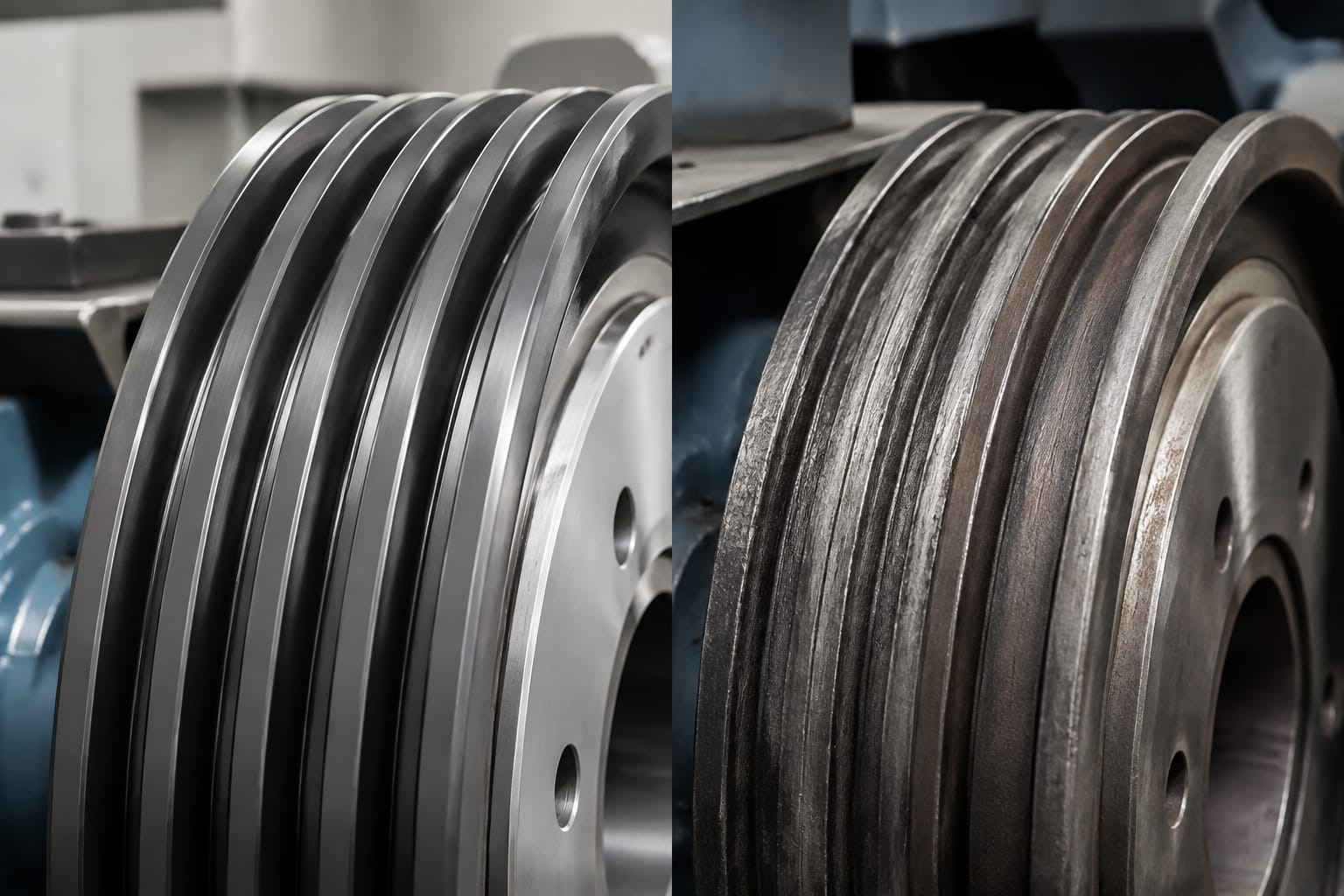
| Polished or glazed surface | Reduced or variable friction | May contribute to slip, especially with contamination |
| Grooves worn deeper | Ropes sit at different depths | Unequal rope loading and accelerated wear |
| Uneven groove wear | Different traction from one rope to another | Can affect ride quality and rope tension balance |
| Sharp edges or pitting | Abrasive contact | Can damage rope wires or belt coating |
| Wrong groove profile | Unpredictable traction and contact stress | May create slip or excessive suspension-member wear |
Groove wear is not always obvious from a visual inspection. Compare each groove using the correct profile gauge, measure groove depth where applicable, and inspect how evenly ropes or belts sit across the sheave. A rope that sits noticeably deeper than adjacent ropes is a warning sign, but it is not a substitute for measurement.
Traction problems can also come from oil, grease, moisture, dust, rust particles, or unsuitable cleaning products on the groove or suspension members. Correcting contamination is necessary, but it does not restore a groove that has already worn out of profile.
Signs of sheave and belt wear
Elevator symptoms often point to a traction-system issue, but they do not prove that the sheave alone is at fault. Inspect the sheave, suspension members, machine, and tension condition as one system.
Common signs of traction sheave wear include:
- Ropes seated at visibly different depths in adjacent grooves
- Grooves with a mirror-like, polished appearance
- Sharp groove edges, pitting, cracks, or material loss
- Metallic dust or unusual debris around the sheave
- Uneven rope wear or broken wires concentrated in one location
- Repeated rope-tension imbalance after adjustment
- Slip symptoms, such as poor levelling or movement irregularities under load
- Vibration, noise, or abnormal rope movement through the grooves
- Evidence that the sheave is wobbling or running out of true
For steel belts, inspect for coating damage, edge wear, local flattening, cracks, exposed cords, debris embedded in the belt surface, and abnormal marks that repeat at the same sheave position. Follow the system-specific inspection criteria because belt rejection limits and acceptable surface appearance vary by manufacturer.
A worn belt or rope can damage a replacement sheave. Equally, a new suspension member can wear quickly when installed over a sheave with incorrect or deteriorated grooves. Plan the inspection and replacement scope together.
Measure diameter, grooves, and shaft interface
Accurate measurements prevent the common mistake of ordering a sheave that fits physically but does not perform correctly. Record measurements from the existing component only after confirming that the reference surfaces are clean and accessible. When wear is significant, compare against approved drawings, machine records, or the original part identification rather than assuming the worn dimension represents the original size.
Essential sheave measurements
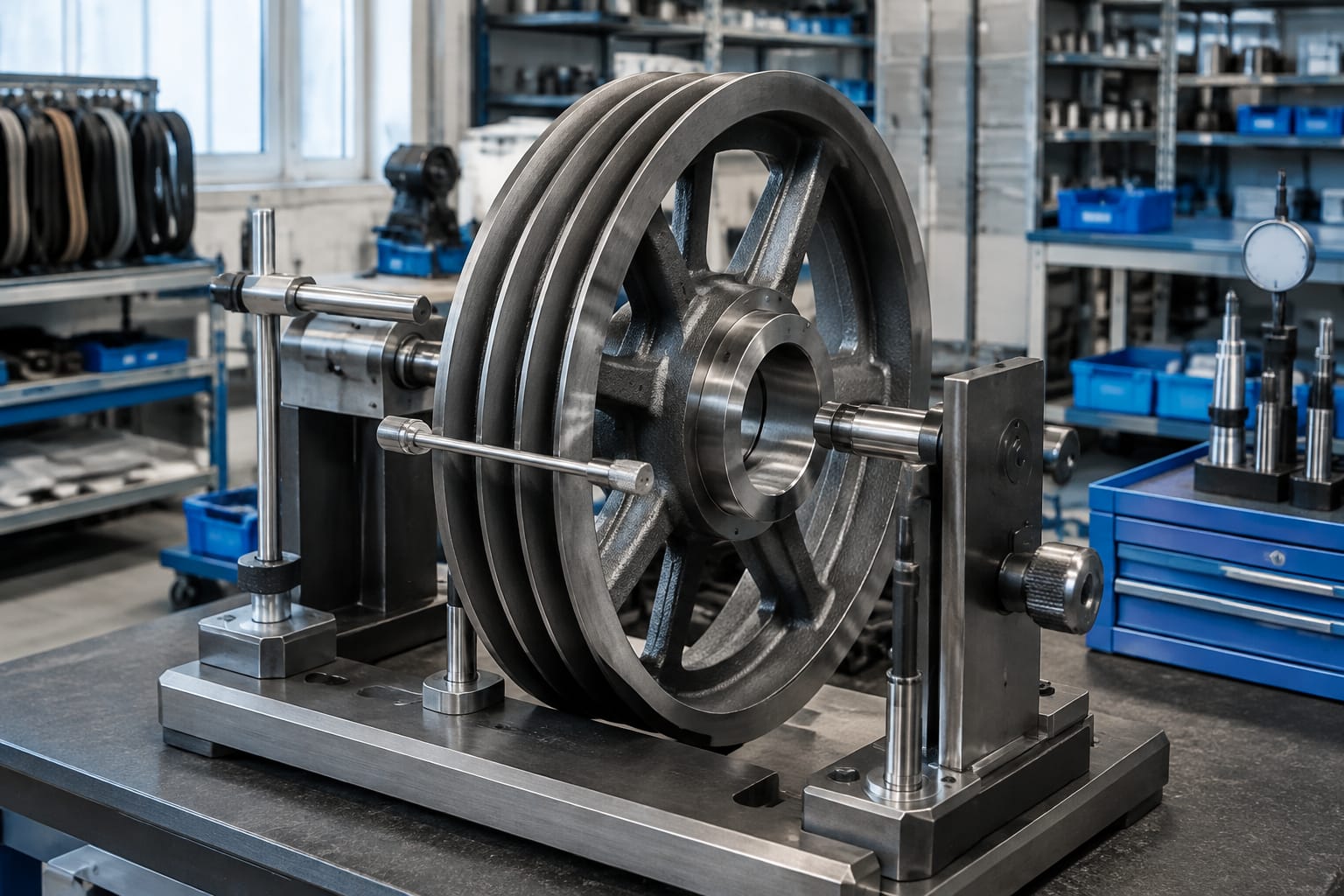
At minimum, collect the following information:
| Measurement or detail | What to record | Why it matters |
|---|---|---|
| Outside diameter | Diameter across the sheave rim | Affects traction geometry and rope or belt bending |
| Groove or channel count | Total working grooves/channels | Must match the suspension-member arrangement |
| Groove pitch | Centre-to-centre spacing between grooves | Keeps ropes or belts aligned with their paths |
| Groove profile | Shape, width, depth, angle, and undercut where relevant | Determines contact and traction |
| Rope diameter or belt dimensions | Nominal size plus actual measured condition | Confirms groove suitability |
| Bore diameter | Shaft-hole size | Must fit the machine shaft correctly |
| Keyway or spline details | Width, depth, location, and form | Ensures torque transfer and correct orientation |
| Hub dimensions | Hub length and outside diameter | Affects mounting clearance and retention |
| Fixing arrangement | Bolts, locking device, taper fit, or other method | Must match the machine design |
| Overall width | Width across the sheave and hub | Confirms clearances and rope or belt alignment |
Use calibrated measuring tools suited to the tolerance required. A tape measure is useful for an initial estimate but is not sufficient for bore, keyway, groove, or pitch verification. Vernier callipers, micrometers, inside measuring tools, a groove gauge, and a dial indicator may be needed depending on the job.
Take clear photographs of the sheave face, grooves, hub, keyway, identification markings, and mounting arrangement. Include a scale in photographs when practical. For a multi-groove sheave, document whether all grooves show the same wear pattern.
Do not assume a nominal size is enough
A listing such as “550 mm traction sheave” can leave out critical information. Two sheaves of the same diameter may have different groove counts, rope sizes, bore details, keyways, hub lengths, and groove profiles.
When evaluating a [5500 elevator traction steel pulley](/products/id-traction-steel-pulley-5500-elevator-parts/), confirm the actual dimensional drawing and application data before treating it as a replacement option. “Pulley” and “sheave” are sometimes used loosely in purchasing descriptions, but the interface and intended suspension system must be verified.
Check machine and suspension compatibility
Compatibility is a technical check, not a visual match. The replacement traction sheave should match the machine and suspension arrangement approved for the lift.
Confirm these points before ordering:
- Machine identification: Record the manufacturer, model, serial information, and existing part number where available.
- Drive configuration: Establish whether the machine is geared or gearless and how the sheave attaches to the shaft or rotor.
- Suspension type: Confirm steel rope or steel belt, including exact size, construction, and number of members.
- Reeving ratio: Verify the existing roping or belt arrangement. A change in sheave diameter or arrangement can affect travel, load behaviour, and clearances.
- Groove specification: Match the original groove profile, count, pitch, and traction design.
- Shaft connection: Verify bore, keyway, spline, taper, locking method, and hub position.
- Space and alignment: Check guards, encoder components, brake clearance, rope guards, deflector sheaves, and suspension paths.
- Associated components: Inspect bearings, mounting parts, rope retainers, deflector sheaves, and suspension members.
The correct sheave diameter is particularly important. A smaller diameter increases bending stress on ropes or belts; a larger diameter can create clearance or alignment problems and may alter the intended traction behaviour. Use the machine and elevator-system documentation as the governing reference.
For proprietary steel-belt systems, it is prudent to source by confirmed system information rather than dimensions alone. A [traction steel belt component for Otis elevator applications](/products/traction-steel-belt-otis-elevator-parts-lift-parts/) may be relevant only where the verified belt system, machine arrangement, and part details correspond to the item.
Replacement planning and handling
Traction sheave replacement is a controlled maintenance activity that affects a primary load-bearing and motion-transmitting system. It should be planned and performed by qualified personnel under the applicable site procedures and equipment documentation.
Before work begins, establish the lifting method, access route, isolation process, car and counterweight securing method, and required inspection scope. A traction sheave can be heavy, and the machine-room or overhead working space may be constrained.
Replacement planning checklist
- Confirm the replacement part against machine records and measured dimensions.
- Determine whether ropes or belts also require replacement based on their condition and manufacturer criteria.
- Obtain any required shaft, key, fastener, locking, or retaining components.
- Inspect the shaft, hub seating surfaces, and keyway for damage or fretting.
- Review the required tightening method and torque values from the equipment documentation.
- Plan rope or belt handling to avoid twisting, kinking, contamination, or uncontrolled movement.
- Prepare suitable lifting equipment and guarding arrangements.
- Record pre-replacement rope tension, alignment observations, and wear findings.
Do not machine, weld, build up, or re-groove a traction sheave unless this is specifically supported by the original equipment requirements and evaluated by an appropriately qualified party. Material removal or profile alteration can change traction and reduce the component's suitability even if the sheave appears serviceable afterwards.
Another common mistake is replacing only the visibly damaged item while ignoring the root cause. Misalignment, inadequate rope tension equalisation, bearing wear, incorrect lubrication, contamination, or a brake-related issue can all contribute to abnormal sheave wear.
Kelevator supplies multi-brand elevator spare parts for B2B importers, distributors, maintenance contractors, modernization companies, and OEM buyers. For a sourcing enquiry, the most useful package is the machine identification, original part number where available, measured drawing, groove profile details, and photographs of the shaft interface.
Inspection after installation
Installation is not complete when the new sheave is mounted. The suspension system must be checked under controlled operating conditions, following the relevant elevator documentation and site procedures.
Inspect the following after installation:
- Correct sheave seating, retention, and locking arrangement
- Alignment of ropes or belts across the traction sheave and deflector sheaves
- Proper seating in every groove or channel
- Clearance to guards, covers, and nearby machine components
- Rope tension balance or belt tension condition as required by the system
- Smooth movement through a full travel cycle
- Abnormal sound, vibration, or visible lateral movement
- Levelling and traction behaviour during operational checks
- New marks, debris, coating transfer, or rubbing after initial running
Recheck fasteners and tension only according to the machine manufacturer's procedure. Unauthorised adjustment can create a different traction problem or damage the suspension members.
Document the replacement date, part identification, inspection findings, measurements, and any accompanying rope or belt work. This record gives the maintenance team a useful baseline for later condition checks and helps identify whether wear is recurring.
FAQ
Can a traction sheave be replaced without replacing the ropes or belts?
Sometimes, but only after a full condition assessment. If the ropes or belts are within their applicable service criteria and the wear cause has been addressed, separate replacement may be possible. When suspension members show damage, abnormal wear, or tension-related problems, replacing the sheave alone may not solve the issue.
How do I know whether the grooves are worn beyond acceptable condition?
Use the equipment manufacturer's inspection limits, correct groove gauges, and the specified profile dimensions. Uneven rope seating, polished grooves, sharp edges, and measurable loss of profile are indicators that further evaluation is needed. Visual inspection alone is not enough for a replacement decision.
Is the sheave diameter measured at the grooves?
Specify how the diameter was measured and use the dimension called for on the applicable drawing. Outside diameter, pitch diameter, and diameter at the groove base are different references. A supplier needs the correct reference dimension, not an unlabelled measurement.
Can I use a similar traction sheave from another elevator model?
Only where all relevant compatibility details have been confirmed. Similar diameter or appearance does not establish compatibility with the shaft, groove design, suspension type, loading, or machine arrangement.
For replacement sourcing, prepare a measured dimension sheet, clear component photographs, machine identification, and the verified rope or belt specification. This allows the traction sheave to be assessed on the details that actually determine fit and performance.