
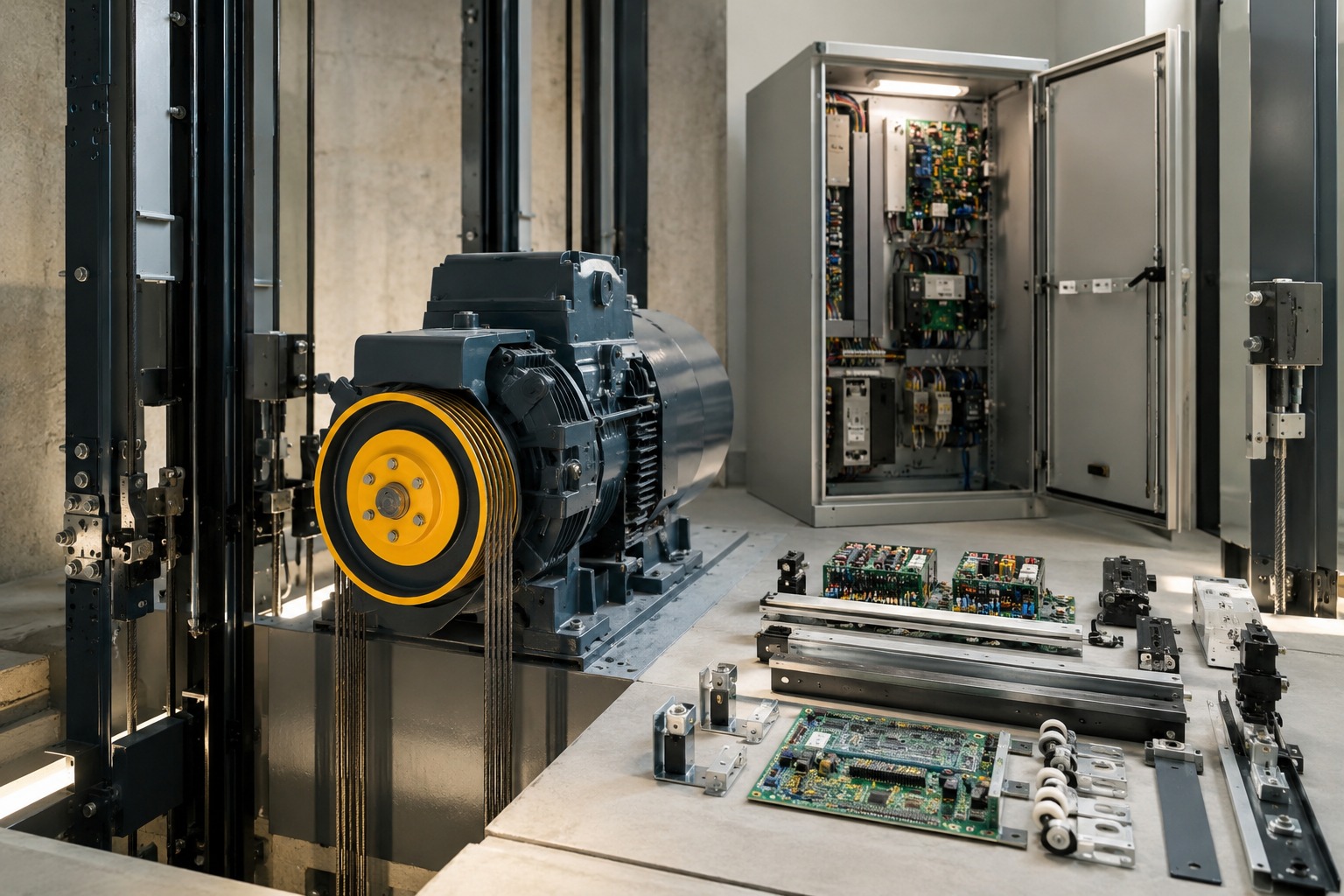
For building owners, maintenance contractors, and modernization teams in the Philippines, the traction motor is one of the most important components in the overall performance of a lift. It directly affects acceleration, levelling accuracy, travel smoothness, machine room conditions, power consumption, and long-term maintenance cost. When a motor is undersized, poorly matched, worn, or installed with alignment errors, the result is often obvious to passengers: noisy starts, vibration, inconsistent speed, overheating, nuisance shutdowns, and premature wear on related parts. When the correct traction motor is selected and matched properly to the controller, drive, sheave, and load profile, the elevator operates more quietly, more efficiently, and more reliably.
In the Philippines, replacement and modernization decisions are often shaped by tropical heat, humidity, coastal corrosion exposure, unstable power quality in some locations, and the need to keep buildings operating with minimal downtime. High-rise offices in Makati and Bonifacio Global City, mixed-use projects in Cebu, hotels in Pasay, hospitals in Quezon City, logistics facilities near Cavite and Laguna, and residential towers in Davao all depend on practical sourcing and model matching rather than generic assumptions. A traction motor is never just a power rating on a nameplate; it is part of a system that must fit the application, duty cycle, controller logic, brake arrangement, and site conditions.
This guide explains the main traction motor options, the advantages of permanent magnet synchronous motor designs, key points on Hitachi HGP motor sourcing, controller compatibility, installation checks, warning signs before failure, and modernization planning. It is written for the Philippines market and focuses on safe, informed procurement for elevator maintenance companies, distributors, building owners, and modernization contractors.
In practical terms, if you are planning to replace an aging unit or upgrade an existing system, the best approach is to confirm the original model data, examine the controller and inverter parameters, review the load and travel requirements, inspect the mounting and brake interfaces, and source from a supplier that can support careful cross-checking. That process reduces risk, helps shorten downtime, and avoids costly mismatch problems after delivery.
Understanding the Main Types of Traction Motors
Elevator traction motors can be grouped by electrical design, speed control method, and mechanical arrangement. In the Philippines, the most common decisions in replacement and modernization involve whether to stay with a like-for-like motor or move toward a more efficient permanent magnet synchronous motor solution. Each type has different strengths in terms of efficiency, torque behavior, maintenance demand, and compatibility.
Traditional geared traction motors have long been used in mid-rise and older commercial buildings. They are robust and familiar to many field technicians, but they generally produce more noise, require more mechanical maintenance, and often consume more energy than modern gearless alternatives. Gearless systems, particularly those using permanent magnet synchronous motors, are now widely preferred where ride quality, energy savings, and compact machine-room or machine-room-less configurations are important.
Some installations still use induction motor arrangements depending on the age and brand of the system. These can remain serviceable when the drive and mechanical components are in good condition, but modernization contractors increasingly evaluate whether a PMSM upgrade will deliver better lifecycle value. For buildings experiencing rising electricity costs, passenger complaints about vibration, or parts obsolescence, that shift can be justified even before total failure occurs.
| Motor Type | Typical Use | Main Strength | Main Limitation | Noise Profile | Modernization Suitability |
|---|---|---|---|---|---|
| Geared AC traction motor | Older mid-rise commercial lifts | Familiar design and serviceability | Higher mechanical wear and energy use | Moderate to high | Often replaced during major upgrade |
| Gearless induction motor | Higher-capacity or smoother-running systems | Good ride quality | Can be less efficient than PMSM | Moderate | Suitable where compatible parts remain available |
| Permanent magnet synchronous motor | MRL and modern gearless lifts | High efficiency and compact size | Needs accurate controller matching | Low | Excellent for modernization |
| Machine-room traction motor | Conventional lift layouts | Accessible maintenance area | Requires dedicated space | Depends on motor design | Good for planned replacement |
| Machine-room-less traction motor | Space-saving building designs | Compact installation | More access planning needed | Low to moderate | Common in new upgrades |
| Brand-specific OEM pattern motor | Exact model-based replacement | Better fit for existing systems | Requires strict verification | Varies by design | Ideal when minimizing redesign |
The table above shows why the motor choice cannot be separated from the installation context. For example, a replacement in a hotel in Manila Bay focused on guest comfort may prioritize low noise and smooth starts, while a freight-oriented application in an industrial area near Batangas may emphasize torque reserve and dependable duty performance. In both cases, however, the right decision depends on data rather than assumption.
Why Permanent Magnet Synchronous Motors Are Increasingly Preferred
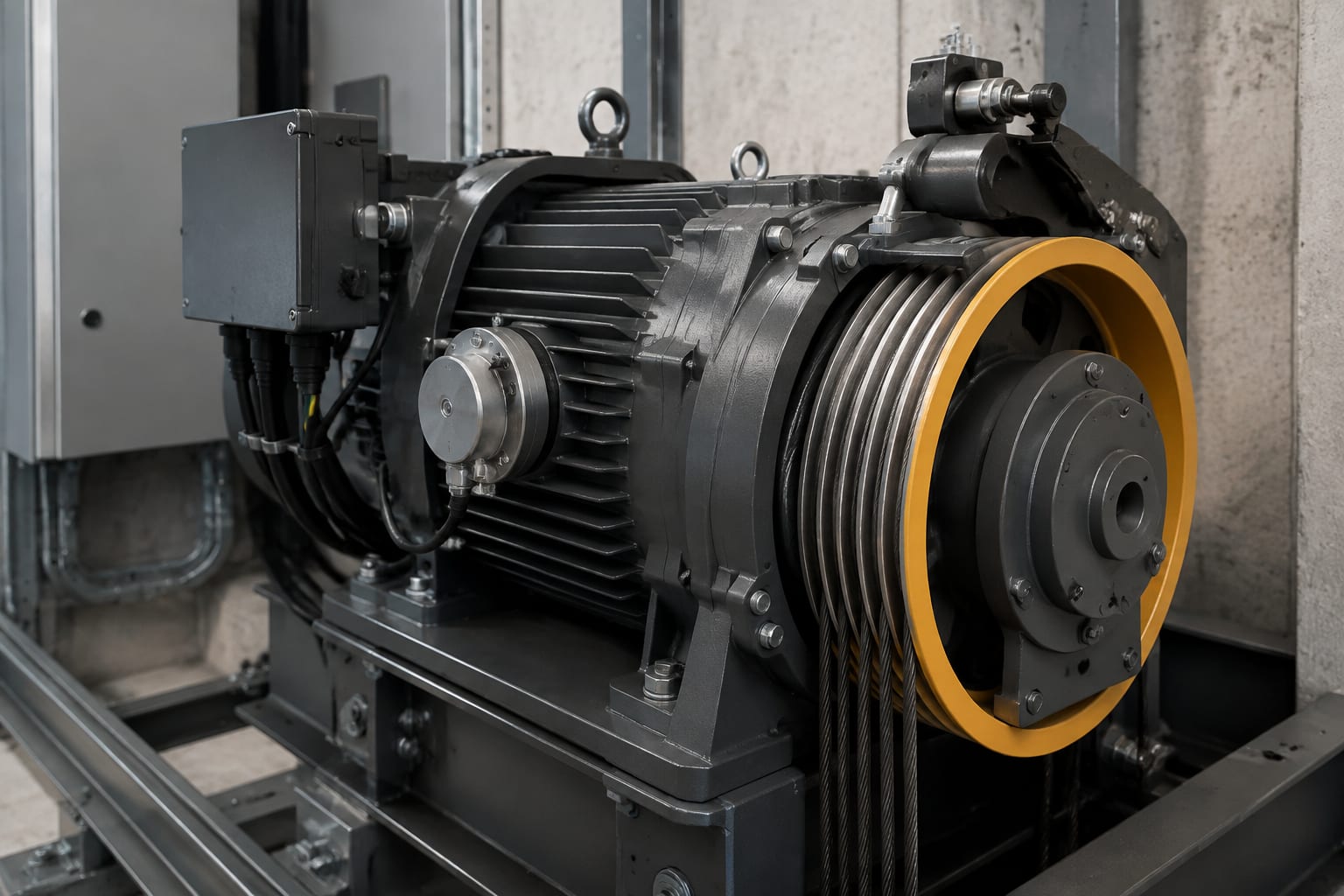
Permanent magnet synchronous motors, often shortened to PMSM, are widely selected in elevator modernization because they combine high torque density, compact form factor, and lower energy consumption. In simple terms, they can deliver strong and controlled performance without the larger footprint and higher losses often associated with older motor technologies. For building owners in the Philippines facing higher utility costs and tighter equipment space, these benefits are significant.
One of the main advantages of a PMSM traction motor is efficiency across typical operating conditions. Elevators rarely run at one constant full load all day. They handle variable passenger loads, frequent starts and stops, and changing traffic patterns. PMSM systems perform well under this type of duty cycle, especially when paired with a correctly configured inverter. That can reduce wasted energy and support more stable temperature behavior in machine spaces exposed to tropical ambient conditions.
Another major benefit is ride quality. Because a PMSM can provide precise speed control and smooth torque delivery, passengers experience cleaner starts, reduced jerk, and more accurate floor levelling. In premium residential towers, hospitals, and office buildings, this matters not only for comfort but also for accessibility, trolley movement, and reputation. Quieter operation is another strong selling point, especially in buildings where machine noise can affect nearby occupied spaces.
For modernization contractors, PMSM designs also help in projects where space is limited. Compact gearless arrangements can simplify adaptation in certain upgrade scenarios. That said, the benefits are only realized when the motor is matched carefully to the drive, encoder feedback, brake system, suspension ratio, and actual load profile.
| Benefit | Operational Effect | Impact on Building Owner | Impact on Maintenance Team | Best-Fit Sites in Philippines | Notes |
|---|---|---|---|---|---|
| Higher efficiency | Lower energy draw | Reduced operating cost | Less heat-related stress | Office towers, condos, malls | Most visible on high-use lifts |
| Compact design | Saves installation space | Supports modernization layouts | Easier integration in some retrofits | MRL projects, dense urban buildings | Requires detailed dimension checks |
| Low noise | Quieter travel and machine area | Better occupant experience | Fewer comfort complaints | Hotels, hospitals, residences | Alignment still matters |
| Smooth torque control | Gentler acceleration and deceleration | Improved ride quality | Supports better levelling tuning | Premium and public-use sites | Controller tuning is critical |
| Reduced mechanical complexity | Fewer gear-related issues | Potentially lower lifecycle cost | Different maintenance focus | Modernized aging systems | Brake and bearing checks remain essential |
| Better modernization value | Supports longer-term upgrade plans | Extends service life of lift | Improves parts standardization | Legacy branded elevators | Requires system-level planning |
If you are comparing replacement options, it is worth reviewing dedicated product specifications for a permanent magnet synchronous motor for elevator use and checking whether the existing system can support the required control strategy. A PMSM is not simply a drop-in efficiency upgrade in every case, but when matched correctly it often delivers the strongest balance of performance, comfort, and energy savings.
What to Check When Sourcing Hitachi HGP Motors
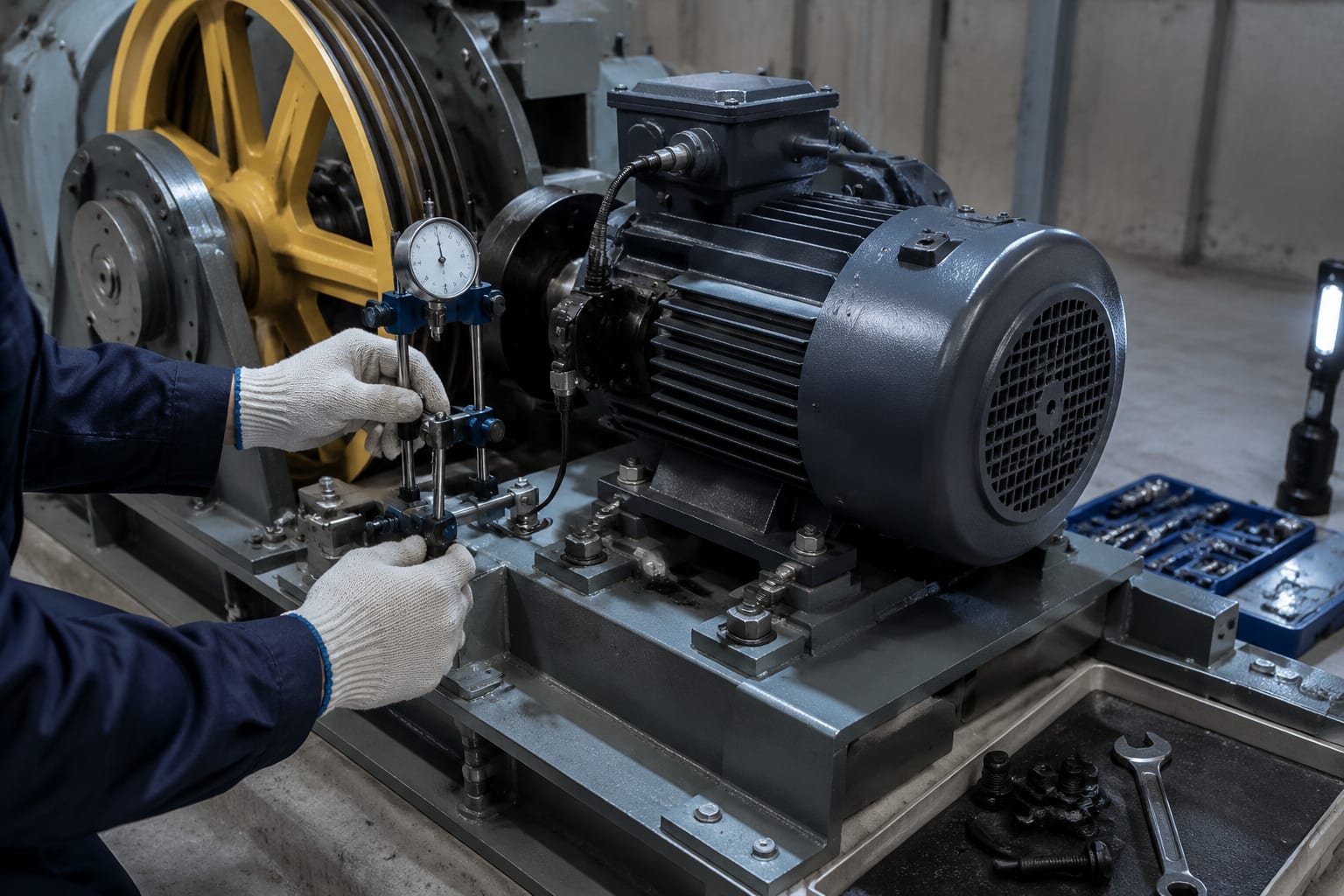
Hitachi HGP motor sourcing requires more than matching the brand name. In field practice, many issues come from incomplete nameplate records, mixed revisions, unclear serial references, or assumptions that visually similar units are electrically interchangeable. For buildings in the Philippines where downtime directly affects tenants, shoppers, hospital operations, or hotel guests, a sourcing error can become expensive very quickly.
When reviewing a Hitachi HGP motor replacement, start with the original motor data plate and all available controller details. Confirm model number, rated power, rated torque where available, voltage, current, speed, brake data, encoder specification, mounting dimensions, shaft or sheave interface, and application details such as car capacity and speed. Also confirm whether the replacement is intended as an exact model match, a compatible equivalent, or part of a broader modernization package.
It is equally important to verify the surrounding equipment. A motor that appears correct on basic power data may still have feedback or brake characteristics that do not match the existing drive. In older buildings in Metro Manila or Cebu, previous repairs may have changed inverters, encoders, wiring methods, or braking components, so current site condition matters as much as original design documentation.
For projects involving Hitachi-related applications, buyers often review both traction and door-side PMSM parts because modernization can involve multiple performance bottlenecks. In some cases, teams evaluating a traction motor replacement also check complementary parts such as a Hitachi-compatible permanent magnet synchronous door motor if landing performance complaints are happening at the same time.
| Sourcing Checkpoint | Why It Matters | Common Risk if Missed | Who Should Verify | Recommended Evidence | Field Comment |
|---|---|---|---|---|---|
| Motor model and revision | Ensures true compatibility | Wrong fit or incorrect control behavior | Purchasing and engineering | Nameplate photo and old records | Do not rely on verbal identification |
| Rated power and speed | Matches duty requirement | Overload, poor acceleration, overheating | Engineer or supervisor | Motor data and traffic profile | Check peak load conditions |
| Brake voltage and torque | Safe holding and release function | Brake faults and safety issues | Technician and supplier | Brake label and wiring diagram | Critical in modernization work |
| Encoder or feedback type | Drive must read feedback correctly | Speed errors and shutdowns | Drive specialist | Encoder code and controller data | Often overlooked in urgent orders |
| Mechanical dimensions | Prevents mounting mismatch | Installation delays and rework | Site team | Measurements and photos | Include bolt pattern and clearances |
| Packaging and transport protection | Protects sensitive parts in transit | Damage before installation | Supplier and receiver | Packing report and inspection photos | Important for inter-island shipment |
The Philippines supply chain adds another layer of planning. Equipment may move through Manila, Subic, Batangas, or Cebu logistics routes before reaching local project sites. Protective packaging, humidity control, shock protection, and documentation quality all matter, especially for motors, encoders, and brake assemblies. A professional supplier helps reduce this risk by supporting model verification before shipment and by preparing goods properly for export, warehousing, and last-mile delivery.
Matching Motor Power with the Controller and Drive
One of the most frequent causes of performance issues after replacement is incomplete motor-to-controller matching. A traction motor does not work in isolation. It depends on the inverter or frequency converter, control board logic, feedback device, brake command timing, and tuning parameters. Even when rated kilowatt values look similar, an elevator may run poorly if the full control relationship is not checked.
Motor power matching involves several layers. First, the nominal power and speed must align with the duty requirement of the elevator. Second, the inverter must be able to supply the necessary current and support the correct motor control method. Third, encoder feedback and control signals must be recognized properly. Fourth, acceleration and deceleration settings, levelling performance, and brake release timing should be adjusted to the new or replacement motor characteristics.
In practice, modernization teams in the Philippines often face mixed-brand situations. A building may retain certain legacy components while replacing the traction machine or drive. This can work, but only if the interface is reviewed carefully. A mismatch can create motor hum, torque ripple, rollback at start, stopping errors, or repeated fault trips. These symptoms are often blamed on the motor alone even when the root cause lies in the drive setup.
| Matching Item | Question to Ask | Possible Problem | Result for Passengers | How to Check | Priority Level |
|---|---|---|---|---|---|
| Rated power | Is the kW suitable for load and duty? | Overload or sluggish travel | Slow response, heat, faults | Compare duty data and nameplate | High |
| Rated current | Can the inverter supply required current? | Trips during acceleration | Unexpected stoppages | Review inverter specifications | High |
| Control mode | Does the drive support the motor type? | Unstable running | Rough starts and stops | Check drive parameters | High |
| Encoder compatibility | Is feedback signal type correct? | Speed or positioning errors | Bad levelling, unsafe feel | Compare encoder protocol and wiring | High |
| Brake timing | Is release timing coordinated? | Rollback or jerking | Passenger discomfort | Commissioning test | Medium |
| Thermal management | Will the system run within safe temperature? | Insulation stress and shorter life | More outages in hot weather | Monitor temperature under load | Medium |
A good supplier should support this matching process with stable model identification, quality checks, and responsive communication. This is especially useful when local teams need fast answers during shutdown events or modernization planning. For maintenance contractors managing multiple brands across Metro Manila, Iloilo, Bacolod, Cagayan de Oro, and Davao, this type of support can make the difference between a smooth restart and repeated callbacks.
The line chart above illustrates the rising demand for modernization-related sourcing in the Philippines. Growth is driven by aging installed bases, energy efficiency goals, and increasing passenger expectations in residential and commercial towers. This trend supports more proactive replacement of traction motors before catastrophic failure.
Installation, Alignment, and Commissioning Checks That Matter
Even a correct motor can perform badly if installation quality is poor. Alignment, mounting, electrical termination, brake adjustment, and commissioning discipline all affect final ride quality and service life. In tropical environments such as the Philippines, dust, humidity, temperature swings in machine spaces, and transport handling can all influence installation outcomes.
Start with a mechanical inspection before lifting the new motor into place. Verify the mounting base condition, bolt integrity, anti-vibration elements if used, sheave condition, rope alignment, and available clearance for servicing. Check whether previous wear patterns suggest misalignment or uneven loading. If a failed motor showed abnormal bearing damage, do not assume the root cause was internal; it may have been transmitted from installation geometry or rope/sheave issues.
Electrical checks should confirm insulation integrity, terminal tightness, grounding, brake circuit correctness, encoder wiring, and compatibility with control diagrams. During commissioning, the team should monitor no-load behavior, loaded starts, deceleration smoothness, brake release timing, current draw, temperature rise, and floor levelling consistency. In high-traffic buildings, it is wise to review performance during peak periods rather than relying only on short test runs.
| Installation Check | Purpose | What to Observe | Problem If Ignored | Recommended Timing | Responsible Team |
|---|---|---|---|---|---|
| Base and mounting inspection | Ensures stable support | Flatness, cracks, bolt condition | Vibration and premature wear | Before installation | Mechanical team |
| Sheave and rope alignment | Prevents uneven stress | Tracking, groove condition, rope line | Noise, rope wear, side loading | Before and after fitting | Mechanical team |
| Electrical termination | Supports safe motor operation | Tightness, phase order, insulation | Heat, faults, unstable running | During wiring | Electrical team |
| Brake function test | Confirms safe holding and release | Release timing, contact condition | Jerking or unsafe stop behavior | Commissioning stage | Commissioning team |
| Encoder signal verification | Supports correct feedback | Stable readings and wiring integrity | Levelling errors and faults | Before live operation | Control specialist |
| Load and temperature monitoring | Checks real operation stability | Current, noise, heat, ride feel | Hidden early-life failure risk | Initial service period | Maintenance supervisor |
For projects in coastal areas such as Cebu, Iloilo, and parts of Luzon near sea exposure, corrosion prevention and proper storage before installation deserve extra attention. If the motor or brake assembly sits too long in poor storage conditions, surface corrosion and moisture intrusion can compromise commissioning quality. Local execution discipline is often just as important as the motor specification itself.
The bar chart indicates where traction motor replacement demand is strongest in the Philippines. Residential towers lead because of the volume of installed elevators and frequent daily cycling, while offices, malls, hotels, and hospitals continue to demand high ride quality and reliable uptime.
Warning Signs to Watch Before a Traction Motor Fails
Most traction motors do not fail without warning. In many cases, the system gives early clues weeks or months in advance. Recognizing these signs allows maintenance teams and building managers to plan replacement or repair before service disruption becomes severe.
Common warning indicators include unusual vibration, rising noise at start or stop, heat buildup, insulation deterioration, recurring inverter trips, brake release irregularity, burnt odor, and worsening levelling performance. Changes in current draw or temperature trend are especially useful when tracked over time. A single noisy trip may not confirm motor failure, but repeated pattern changes should never be ignored.
In the Philippines, heat and humidity can accelerate insulation stress and contamination problems. Dust, salt-laden air in coastal regions, and inconsistent machine room ventilation can all contribute to degradation. Buildings that delayed preventive maintenance during periods of budget pressure often see compounded problems later, because worn guide components, poor rope condition, and control instability can place extra strain on the motor.
Maintenance teams should document symptoms clearly. Instead of writing only “motor noisy,” record when the noise appears, under what load, after how many runs, at what ambient temperature, and whether it changes during acceleration, constant travel, or braking. That information makes sourcing and troubleshooting faster and more accurate.
| Warning Sign | Likely Cause | Severity if Ignored | Immediate Action | Possible Related Parts | Planning Implication |
|---|---|---|---|---|---|
| Increased bearing noise | Bearing wear or misalignment | Progressive mechanical damage | Inspect vibration and lubrication condition | Sheave, ropes, mounting base | Schedule shutdown before seizure |
| Excessive heat | Overload, poor ventilation, electrical stress | Insulation breakdown | Measure current and temperature | Inverter, brake, power supply | Check load profile and cooling |
| Repeated drive faults | Feedback mismatch or motor stress | Unexpected service interruptions | Review logs and control parameters | Encoder, control board, inverter | Prepare compatibility review |
| Jerky starting | Brake timing or tuning issue | Passenger complaints and wear | Test brake and acceleration settings | Brake unit, controller, encoder | May require system recalibration |
| Poor floor levelling | Feedback or torque instability | Safety concern and callback risk | Check encoder and drive tuning | Sensor, encoder, control board | Consider broader modernization |
| Burnt smell or discoloration | Winding stress or overheating | Imminent failure risk | Remove from heavy duty and inspect | Power supply, contactors, cables | Urgent replacement planning |
The explanation in the table is important because signs should be interpreted as system clues, not isolated faults. A traction motor may be the visible problem, but the real issue can include poor alignment, inverter instability, brake drag, or contaminated machine space conditions. Reliable diagnosis protects budgets and improves safety.
Smart Modernization Planning for 2026 and Beyond
Modernization planning is no longer just about replacing what is broken. By 2026, building owners in the Philippines are increasingly looking at lifecycle cost, energy performance, spare parts continuity, digital monitoring, and tenant expectations. A traction motor upgrade can become the foundation of a broader reliability strategy when timed properly.
Start with a condition-based review of the full elevator system. If the motor is nearing end of life but the controller, inverter, brake, ropes, and door system are also showing age, a staged plan may be more cost-effective than repeated emergency repairs. Modernization should prioritize components that most affect uptime and passenger experience. In many buildings, traction performance and door performance generate the highest complaint rates.
Policy and sustainability trends also matter. Green building standards, pressure to reduce operating costs, and owner interest in measurable energy savings are pushing more sites toward efficient gearless solutions. Future projects are also more likely to include predictive maintenance practices using trend data from sensors, controllers, and service logs. This helps identify heat rise, current variation, brake wear, or levelling drift before passengers notice major problems.
By 2026, buyers should expect stronger attention to efficient motor technologies, improved inverter tuning tools, better packaging for sensitive spare parts, and more structured sourcing workflows. In the Philippines, modernization planning should also account for logistics timing, imported parts lead time, local installation windows, and coordination with building operations.
The area chart shows the ongoing trend shift toward PMSM-based modernization in the Philippines. The pattern reflects demand for energy savings, smoother ride quality, reduced machine noise, and better long-term parts planning.
Philippines Market Conditions, Applications, and Buying Advice
The elevator market in the Philippines is shaped by urban density, mixed-use development, tourism, and a growing installed base of residential towers. Metro Manila remains the largest concentration of replacement demand, but Cebu, Davao, Clark, Iloilo, and Bacolod also continue to generate modernization activity. Ports and logistics hubs such as Manila, Batangas, Subic, and Cebu influence delivery timing and inventory strategy for major spare parts.
Different sectors value different motor characteristics. Hospitals prioritize smooth levelling and low vibration for beds and sensitive movement. Hotels care deeply about quiet operation and guest comfort. Commercial offices need uptime and predictable energy cost. Condominiums often need cost-effective modernization that reduces callbacks without requiring major structural changes. Industrial and service facilities may prioritize robustness under heavy duty cycles.
Buying advice for the Philippines market begins with accurate documentation. Gather the motor nameplate, controller data, photos of the installation, brake details, encoder label, and machine dimensions. Clarify whether the project is emergency replacement, planned stock purchase, or modernization. Ask the supplier about model matching process, quality inspection steps, packaging method, and post-sale technical response. If the project involves inter-island transport, confirm crate protection, moisture control, and inspection on receipt.
Procurement teams should also compare the short-term cost of the part against the full cost of downtime, reinstallation, return delays, and passenger disruption. A cheaper but weakly verified motor can become more expensive than a properly checked unit delivered with complete matching support.
The comparison chart highlights a common market reality: specialized elevator parts sourcing usually performs better than general trading when the project depends on exact model matching, careful quality inspection, and technical responsiveness. For traction motors, those differences have a direct effect on downtime risk.
Technology Strengths That Support Better Motor Sourcing
Successful sourcing depends not only on stock access but also on technical capability. For elevator traction motor replacement in the Philippines, the most valuable supplier strengths are detailed model verification, understanding of controller and inverter relationships, and familiarity with brand-specific spare parts across legacy and current systems.
Our approach emphasizes technological capability in three practical ways. First, we support careful model matching using available photos, labels, and system data to reduce compatibility errors. Second, we work across a broad range of elevator electrical and mechanical components, which is useful when a motor issue is connected to control boards, inverter parts, encoders, sensors, or brake-related accessories. Third, we focus on sourcing compatibility rather than generic substitution, helping customers maintain safer and more stable operation.
This technical approach is especially important for maintenance companies handling multiple brands such as Hitachi, Toshiba, KONE, Mitsubishi, and others. A traction motor inquiry may quickly expand into a system-level review involving feedback devices, power supplies, control boards, or landing accessories. Technical familiarity across these categories improves the quality of recommendations and helps prevent fragmented purchasing decisions.
Manufacturing and Quality Practices That Reduce Risk
On the manufacturing and product preparation side, reliability depends on stable quality inspection, accurate handling, and protective packaging. For a traction motor, buyers should care about more than the finished unit itself. They should also look at how parts are checked before shipment, how sensitive surfaces and interfaces are protected, and whether export and local transport conditions have been considered.
Our supply process places strong attention on stable quality inspection and protective packaging because motors, encoders, and related elevator parts are vulnerable to impact, moisture, and handling damage. For the Philippines market, where shipments may pass through ports and regional distribution routes before site delivery, this matters. Proper packaging reduces the chance of receiving a motor that is correct on paper but compromised in transit.
Manufacturing capability also includes the discipline to manage product consistency across repeat orders. For distributors and modernization contractors, this is important when supporting phased projects across multiple buildings. Consistent sourcing standards help reduce installation variation and support better maintenance planning over time.
Service Capabilities for Contractors, Owners, and Distributors
Responsive service is a major factor in elevator parts sourcing because replacement decisions often happen under time pressure. In service situations, customers need clear communication, practical verification, and support that helps reduce downtime rather than adding uncertainty.
Our service capability is built around responsive follow-up, careful model matching, and support for maintenance companies, distributors, building owners, and modernization contractors. Whether the requirement is a traction motor, control board, inverter component, door operator part, guide shoe, light curtain, sensor, or encoder, the goal is to help customers source compatible replacement parts and keep elevators operating safely. For the Philippines, this means understanding the urgency of site outages, planning around shipping realities, and helping customers narrow the correct part before order confirmation.
In many projects, good service is what turns a difficult replacement into a manageable one. When documents are incomplete, photos are unclear, or site history is mixed, responsive technical communication can prevent costly mistakes and shorten return-to-service time.
Case Examples and Local Supplier Considerations in the Philippines
Consider a residential tower in Quezon City where passengers complained of increasing start-stop jerk and noise. The initial assumption was guide rail misalignment, but trend review showed rising motor temperature and repeated drive alarms during heavier evening traffic. After data verification, the team identified a traction motor mismatch from a previous repair and replaced it with a correctly matched unit, then retuned the controller. Ride quality improved and callbacks dropped significantly.
In a Cebu hotel, management faced guest complaints about audible machine noise near upper-level rooms. Inspection found not only motor wear but also poor mounting condition and brake timing inconsistency. A planned modernization addressed the traction motor, brake checks, and commissioning process together. The result was quieter operation and better comfort during peak occupancy.
For a mixed-use site in Makati, the owner needed short downtime and predictable procurement. The deciding factor in supplier choice was not only price but confidence in model matching, documentation handling, and protective shipment preparation. That is often the right way to think about motor replacement in the Philippines. Local availability helps, but technical certainty, logistics planning, and responsive support matter more when the system is brand-specific or partially modernized.
When evaluating local suppliers or import partners, ask direct questions: Can they verify the exact model and revision? Do they understand controller matching? Can they support related parts if the root issue extends beyond the motor? How do they package for Manila, Cebu, Davao, or inter-island delivery? The best supplier is the one who reduces risk across the full job, not just the invoice line.
Common Questions About Elevator Traction Motors
What is the main job of a traction motor in an elevator?
The traction motor drives the elevator through the traction machine, controlling movement, acceleration, deceleration, and travel quality. It strongly affects energy use, noise, and passenger comfort.
How do I know whether I need a full motor replacement or only adjustment?
If you have repeated overheating, bearing noise, insulation problems, drive faults linked to motor condition, or severe performance decline, replacement may be necessary. However, some issues come from misalignment, brake timing, or controller tuning, so diagnosis should be system-based.
Why are permanent magnet synchronous motors popular in modernization?
They offer high efficiency, compact size, low noise, and smooth torque control. In many Philippine projects, they help improve ride quality and reduce operating cost when matched correctly to the controller and application.
Can a Hitachi HGP motor be replaced with a similar-looking unit?
Not safely by appearance alone. You must verify model details, electrical ratings, brake data, encoder specification, and mechanical interfaces. Controller compatibility is also essential.
What documents should I prepare before asking for a quotation?
Provide motor nameplate photos, controller or inverter labels, machine photos, dimensions, brake details, encoder information, and the elevator’s load and speed data if available.
How important is controller matching?
It is critical. Even a correct motor can perform poorly if the inverter current range, control mode, feedback configuration, or tuning parameters do not match.
What installation mistake causes the most problems?
There is no single answer, but poor alignment, incomplete brake setup, wrong feedback wiring, and insufficient commissioning checks are common causes of noise, vibration, and fault trips.
What maintenance signs usually appear before failure?
Look for increasing noise, heat, vibration, recurring drive alarms, poor levelling, jerky starts, burnt smell, or abnormal current trend. Early action usually reduces downtime and secondary damage.
Is modernization worth it if the elevator still runs?
Often yes, especially if parts are becoming obsolete, energy cost is rising, complaints are increasing, or service interruptions are getting more frequent. Planned modernization is usually less disruptive than emergency failure recovery.
How should buyers in the Philippines choose a supplier?
Choose a supplier that supports careful model matching, reliable sourcing, quality inspection, protective packaging, and responsive communication. Those factors are more important than low upfront price when downtime is costly.
Choosing the right elevator traction motor is ultimately about system reliability, passenger experience, and long-term value. In the Philippines, where building usage is intense and service continuity is essential, careful sourcing and matching deliver clear advantages. Whether the project involves a PMSM upgrade, Hitachi HGP replacement, or a broader modernization strategy, the safest path is to base decisions on verified technical data, disciplined installation, and supplier support that helps keep lifts running smoothly.