
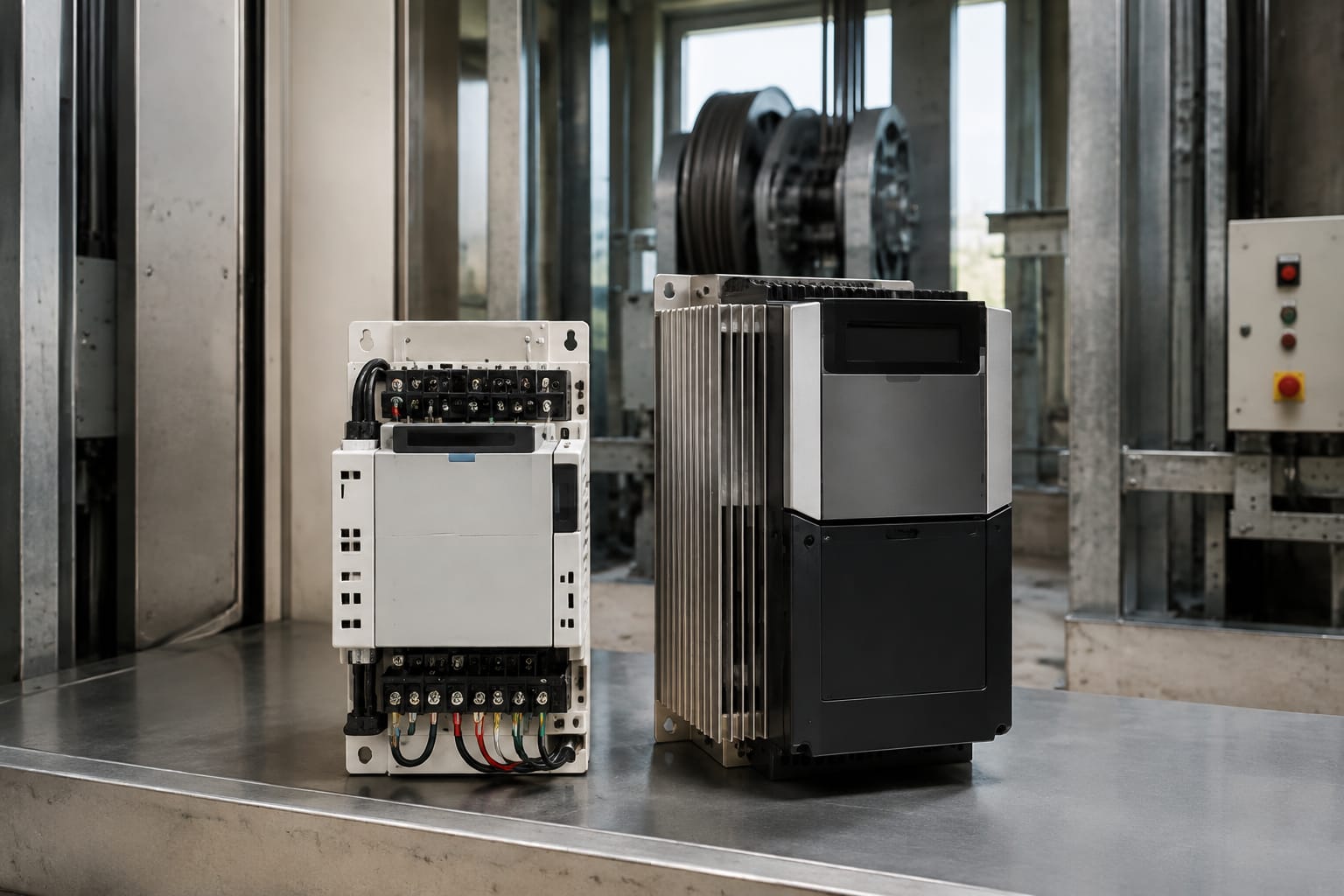
An elevator soft starter and a variable frequency drive (VFD) both reduce the harsh electrical and mechanical effects of motor starting, but they serve different purposes. A soft starter is usually suitable where the motor will run at one fixed speed after starting. A VFD is the better choice when the lift needs controlled acceleration, deceleration, levelling support, energy-conscious operation, or improved ride quality.
For elevator modernization or replacement work in the Philippines, the correct choice depends first on the motor and existing controller architecture. Replacing a soft starter with a VFD is not automatically an upgrade unless the motor, brake circuit, feedback devices, safety chain and controller logic can support it. Likewise, fitting a soft starter to a system designed for variable-speed operation can create poor levelling and operational faults.
How an elevator soft starter works
An elevator soft starter limits the voltage applied to an AC motor during starting. Rather than immediately applying full line voltage, it progressively increases the motor voltage through solid-state devices, commonly thyristors or SCRs. This reduces the initial inrush current and lowers starting torque compared with direct-on-line starting.
Once the motor reaches operating speed, many soft starter arrangements use an internal or external bypass contactor. The bypass transfers the motor to the normal supply so the solid-state components do not continuously carry the full running current.
For a suitable fixed-speed elevator application, a soft starter can help reduce:
- Electrical demand during motor starting
- Mechanical shock to shafts, couplings, gears and brake-related components
- Voltage dips that may affect other equipment on the same supply
- Sudden torque application to the motor and drive system
However, an elevator soft starter does not vary the incoming supply frequency. After ramp-up, the motor normally runs at its rated line frequency and essentially one operating speed. It cannot provide the precise continuous speed regulation expected from a modern VFD elevator system.
Soft starters may appear in older traction lift installations, certain goods lifts, platform lifts, dumbwaiters or equipment where ride refinement is less critical than limiting the starting current. The application must still be evaluated carefully, especially where the lift controller requires a specific acceleration profile or where the motor uses feedback devices.
What a soft starter does not do
A soft starter is sometimes incorrectly specified as a lower-cost substitute for a VFD. The main limitation is that voltage ramping is not speed control.
A soft starter generally cannot provide:
- Controlled low-speed travel over the full trip
- Smooth, programmable acceleration and deceleration throughout a run
- Accurate approach speed for floor levelling
- Motor speed changes to match load or operating conditions
- VFD-style torque control at low speed
- Regenerative energy handling
It may reduce the shock of starting, but it does not make a fixed-speed elevator operate like a variable-voltage, variable-frequency lift.
How a VFD controls elevator motion
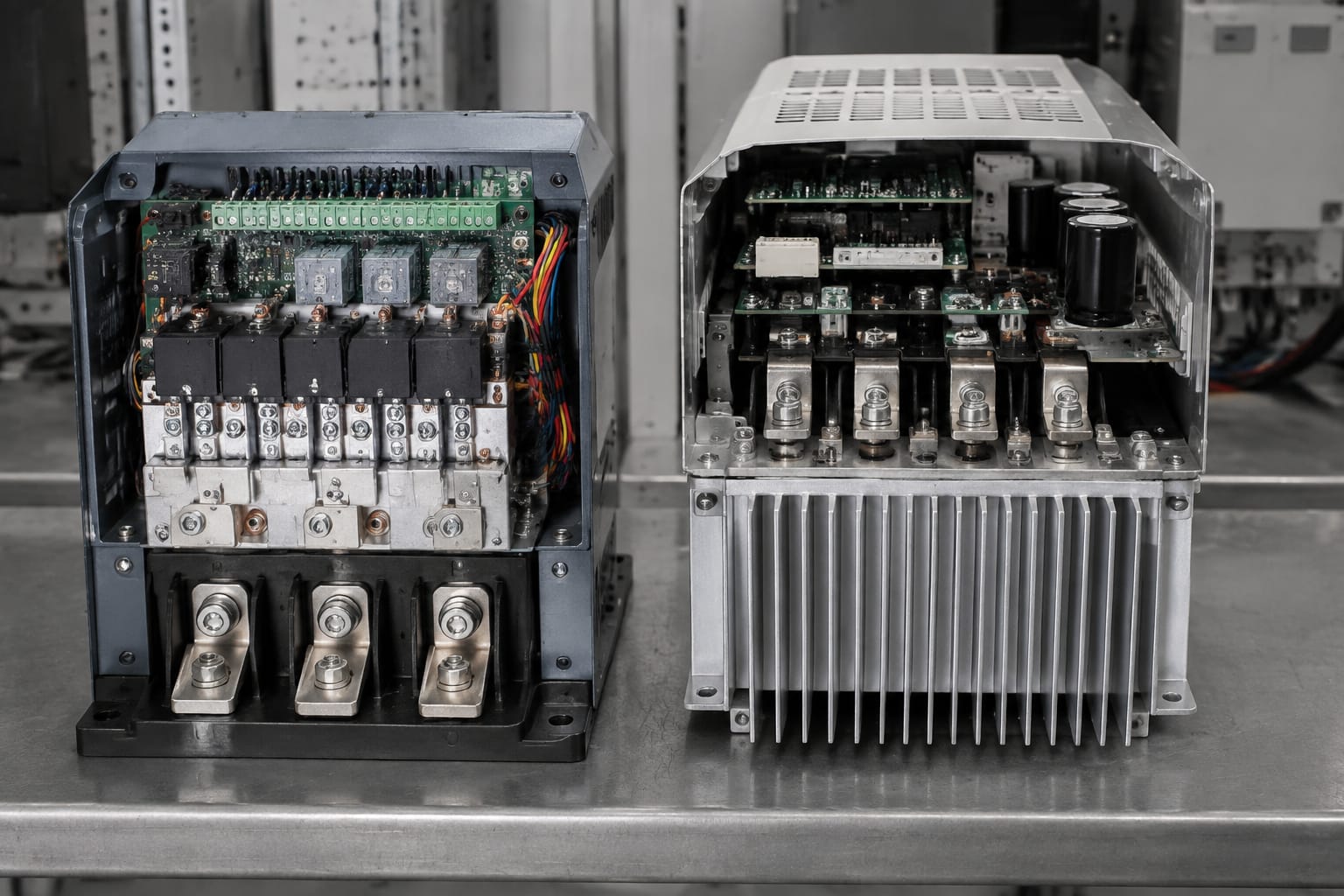
A VFD, also called an inverter drive or variable frequency drive, first converts the incoming AC supply to DC and then creates a controlled AC output. By changing output frequency and voltage, it regulates motor speed and torque over the travel cycle.
In an elevator system, the VFD can follow commands from the lift controller to accelerate the car smoothly, run at contract speed, reduce speed before the landing and stop with controlled deceleration. The exact system design varies by controller and motor type, but the central benefit is controlled motor motion rather than only reduced starting current.
A VFD can be configured with acceleration ramps, deceleration ramps, speed limits, current limits and fault parameters. Elevator-specific drives may also work with motor encoders, resolver feedback, braking arrangements and lift-controller communication. These functions are important where ride comfort, floor levelling and repeatable stopping are required.
The VFD must be sized and configured for elevator duty. A generic industrial drive should not be assumed compatible simply because its kW rating appears suitable. Lift applications can involve high starting torque, frequent starts, brake sequencing, load changes, emergency operation requirements and specific safety interfaces.
Open-loop and closed-loop VFD control
An open-loop VFD estimates motor behaviour without a direct speed feedback device. It can be appropriate in some applications, subject to the motor and controller design.
A closed-loop system uses feedback, commonly from an encoder. It provides the drive with actual speed or position information, improving control where low-speed torque, consistent stopping and accurate levelling are important.
The correct arrangement depends on the elevator type, motor, controller and intended performance. An encoder-equipped system requires confirmation of feedback type, supply voltage, signal format, resolution and mechanical mounting before replacement parts are ordered.
Starting current and motor stress
The difference in starting behaviour is one of the clearest distinctions between an elevator soft starter and a VFD.
A direct-on-line motor start can create a high inrush current. The exact value depends on motor construction, supply conditions and load, but it is substantially higher than normal running current. In a building with limited electrical capacity or long feeder cables, this can contribute to voltage drop and may disturb sensitive equipment.
A soft starter reduces the starting voltage and can limit the associated current rise. Its starting torque also falls as voltage is reduced. This means that the ramp setting must be high enough for the motor to overcome the load and bring the elevator system up to speed without prolonged starting.
A VFD controls both frequency and voltage, allowing the motor to build torque while increasing speed in a managed way. It usually offers better control of current and torque during acceleration than a soft starter, particularly where the lift needs a gradual start and controlled low-speed operation.
| Factor | Elevator soft starter | VFD elevator control |
|---|---|---|
| Main function | Reduces starting voltage | Controls motor frequency, voltage and speed |
| Starting current | Lower than direct-on-line starting | Controlled and typically limited by drive settings |
| Starting torque | Reduced with voltage reduction | Can be managed across the speed range |
| Running speed | Normally fixed after ramp-up | Variable and programmable |
| Deceleration control | Limited | Controlled through drive parameters |
| Floor levelling support | Generally unsuitable for precise levelling | Suitable when correctly designed and commissioned |
| Motor compatibility | Depends on starting duty and wiring | Depends on motor type, insulation, feedback and drive duty |
| Retrofit complexity | Often simpler in suitable fixed-speed systems | Usually requires broader system compatibility checks |
Motor stress is not only about electrical current. Sudden torque can stress mechanical components, while poor parameter settings can also cause problems. A soft starter with too short a ramp may provide little benefit. One with too long a ramp can overheat the motor or starter if the motor remains in a high-slip condition for too long.
With a VFD, incorrect acceleration, deceleration, torque boost or motor data can result in nuisance trips, rough movement, overheating or poor levelling. Parameter commissioning should be based on the motor nameplate, elevator configuration and manufacturer documentation rather than copied from an unrelated installation.
Speed control and ride quality
VFDs generally provide superior ride quality because they control the whole movement profile. Instead of a hard transition from stopped to full speed, the drive can increase speed progressively. Before reaching the landing, it can reduce speed in a controlled way before the brake is applied.
For passengers, this can mean less noticeable starting and stopping. For maintenance teams, smoother movement may also reduce shock loading on parts, although it does not eliminate the need for correct mechanical adjustment and preventive maintenance.
An elevator soft starter can make the initial start less abrupt, but the car still transitions to its normal fixed speed after the ramp. It also does not provide the same controlled deceleration near a floor. Where a lift uses two-speed motor operation, a soft starter may be part of the starting arrangement, but it is still not equivalent to a VFD system.
Ride quality is affected by more than the motor control method. A VFD cannot compensate for worn guide shoes, poor rail alignment, incorrect brake adjustment, traction issues, loose mounting hardware or unsuitable controller settings. Before blaming the drive, inspect the mechanical system and review recorded faults.
Levelling requires a complete control strategy
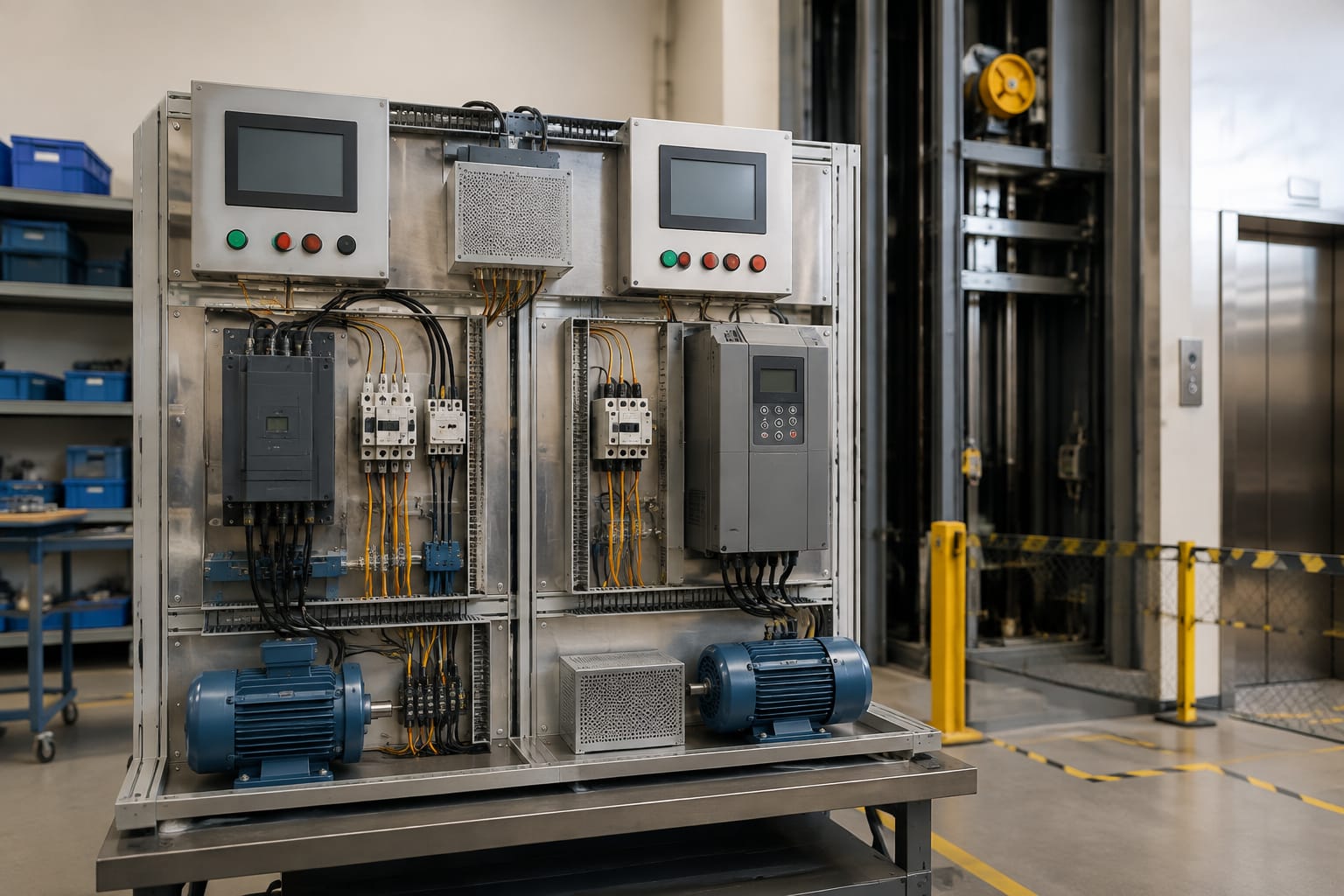
Accurate floor levelling is a safety and usability issue. A VFD can support approach and levelling speeds, but the result depends on how the controller, position system, brake and motor feedback work together.
Before changing to a VFD-based solution, confirm:
- The controller supports the intended drive interface and operating mode
- The motor is suitable for inverter duty or can be safely used with the selected drive
- Encoder, resolver or other feedback requirements are understood
- The brake is correctly controlled and monitored
- Terminal or position sensors are compatible with the revised motion profile
- Inspection, rescue and emergency operating functions remain correctly designed
- Commissioning is performed by qualified personnel following applicable requirements
Typical elevator applications
An elevator soft starter is most practical where the lift motor can operate at a fixed speed and the main objective is reducing the impact of starting. It may be considered for older, simpler systems where a full variable-speed modernization is not justified or is not technically compatible without major changes.
A VFD is normally the preferred control method for modern passenger lifts, installations where ride comfort matters, systems needing better speed management, and modernization projects that include a compatible controller and machine arrangement.
Typical considerations include the following:
| Application | Usually more suitable approach | Reason |
|---|---|---|
| Older fixed-speed goods lift | Soft starter, subject to motor and controller review | Reduces start shock without requiring full speed control |
| Passenger lift modernization | VFD | Better acceleration, deceleration and ride control |
| New variable-speed traction lift | VFD | Designed around controlled motor speed and levelling |
| Simple material-handling lift | Soft starter or VFD depending on duty | Decision depends on load, starts per hour and stopping requirements |
| Lift with poor levelling or abrupt stops | VFD system assessment | A VFD may help, but mechanical and controller causes must be checked |
| Legacy controller with limited interfaces | Soft starter may be simpler | A VFD retrofit can require controller and wiring changes |
This is guidance, not a substitute for checking the original equipment documentation. A lift’s motor and controller combination determines what is technically appropriate.
Contactors and protection devices
Contactors and protective devices remain important in both soft-starter and VFD installations, but their duties differ.
In a soft-starter circuit, contactors may be used as a line contactor, bypass contactor and, in some configurations, for reversing or other control functions. The bypass contactor must be correctly rated for the motor’s running duty and coordinated with the starter design.
For replacement work, check coil voltage, contact configuration, current rating, utilisation category, mounting style and auxiliary contacts. A replacement cannot be selected by physical appearance alone. For relevant options, review these Fuji AC contactor lift parts or Siemens-style AC110V contactors for elevator applications, then verify the technical data against the existing circuit.
A VFD installation normally should not rely on opening and closing the motor-side contactor during normal drive operation. Switching the VFD output while it is running can create faults or damage, depending on the circuit design. The controller should use the drive's intended enable, run and direction commands. Contactors may still be required for supply isolation, safety functions or code-compliant arrangements, but the exact design must follow the drive and controller documentation.
Protection device selection also needs care. Circuit breakers, fuses, overload protection, earth-fault arrangements and surge protection must be coordinated with the equipment. A VFD can introduce leakage currents, harmonics and switching characteristics that affect protective-device choice. Confirm the manufacturer's requirements for upstream protection and cable length.
When replacing a protective device, match its voltage rating, interrupting capacity, trip curve, poles, current rating and coordination requirements. A small circuit breaker for elevator equipment should be assessed as part of the complete protection scheme, not selected solely on the existing breaker’s printed ampere value.
Retrofit and compatibility questions
A control retrofit begins with identification, not component selection. The most common mistake is ordering a soft starter or VFD from motor kW alone.
Record the following before sourcing a replacement or planning an upgrade:
- Motor nameplate data: rated voltage, current, power, frequency, speed, connection method and insulation information.
- Motor type: induction motor, permanent magnet motor, geared or gearless machine.
- Existing control method: direct-on-line, star-delta, two-speed, soft starter or VFD.
- Incoming supply: voltage, phase, frequency, available fault capacity and supply quality.
- Controller details: make, model, drive interface, I/O signals, communication protocol and safety circuit arrangement.
- Feedback hardware: encoder, resolver, tachometer or no feedback device.
- Mechanical duty: rated load, travel, starts per hour, machine condition and brake arrangement.
- Existing protection: contactor ratings, fuses or breakers, overload devices, earthing and surge protection.
- Site constraints: panel space, cooling, ventilation, cable routing and electromagnetic interference control.
Motor compatibility is critical
Not every motor is suitable for VFD operation without review. Older motors may have insulation systems less tolerant of fast switching voltage pulses. Long motor cables can increase reflected voltage stresses. Motors at low speed may also lose cooling if their shaft-mounted fan slows down.
Some VFD installations need output reactors, sine-wave filters, shielded cable or separate motor cooling. These are design decisions based on the drive, motor, cable run and installation environment.
A soft starter also has compatibility limits. It must have sufficient capacity for the motor duty and the required starting profile. Starting a heavily loaded lift with an undersized or incorrectly configured soft starter can produce repeated trips, excessive heat or failure to start.
Replacement planning should include downtime risk
For maintenance contractors and sourcing teams, the practical question is often whether to replace like-for-like or modernize.
A like-for-like replacement may reduce commissioning effort when the existing control architecture is sound and the correct equivalent is available. A modernization can make sense when repeated faults, obsolete drive components, poor ride performance or unsupported controller hardware justify broader work.
Before deciding, identify whether the replacement needs:
- Parameter backup or recreation
- Software access or password-controlled settings
- New wiring diagrams
- Encoder setup and direction verification
- Brake timing adjustment
- Controller logic changes
- Functional testing in normal, inspection and emergency modes
- A phased outage plan for occupied buildings
Do not remove a failed drive or starter before preserving labels, wiring records, parameter data and fault history where possible. These details often determine whether a replacement can be commissioned efficiently.
Choosing the appropriate control method
Choose an elevator soft starter when the motor is intended to run at a fixed speed, the application mainly needs reduced starting shock, and the controller does not require variable-speed motion. It can be a practical solution for the right legacy or basic-duty application, provided torque, duty cycle and bypass arrangements are correctly sized.
Choose a VFD when the lift needs controlled speed, smooth acceleration and deceleration, refined ride quality, low-speed operation or reliable levelling support. It is the usual approach for variable-speed passenger elevator systems, but it requires a more complete compatibility assessment.
Use this decision framework:
- Select a soft starter for a verified fixed-speed motor application where reducing starting current is the primary requirement.
- Select a VFD for a compatible system needing speed and torque control through the full travel cycle.
- Retain or source the original control type when the wider controller and motor system cannot safely support a change.
- Treat repeated trips as a diagnostic issue first. A replacement component may not solve supply, mechanical, brake, wiring or parameter faults.
- Confirm every electrical rating and interface before purchase, especially when replacing obsolete equipment.
Kelevator supplies multi-brand elevator spare parts for B2B importers, distributors, maintenance contractors, modernization companies and OEM buyers. For a component enquiry, prepare the motor nameplate, controller details, existing part number, wiring information and clear photographs of labels and terminals. This helps confirm whether a direct replacement or a broader control review is appropriate.
Related product references
For practical catalog examples related to this topic, review [Fuji AC Contactor lift parts elevator accessories](/products/fuji-ac-contactor-lift-parts-elevator-accessories-2/), [SW contactor AC110V Siemens contactor elevator parts](/products/sw-contactor-ac110v-siemens-contactor-elevator-parts/), and [Small circuit breaker elevator equipment lift accessories](/products/small-circuit-breaker-elevator-equipment-lift-accessories/). Confirm the exact model, dimensions, ratings, and connectors before ordering.