
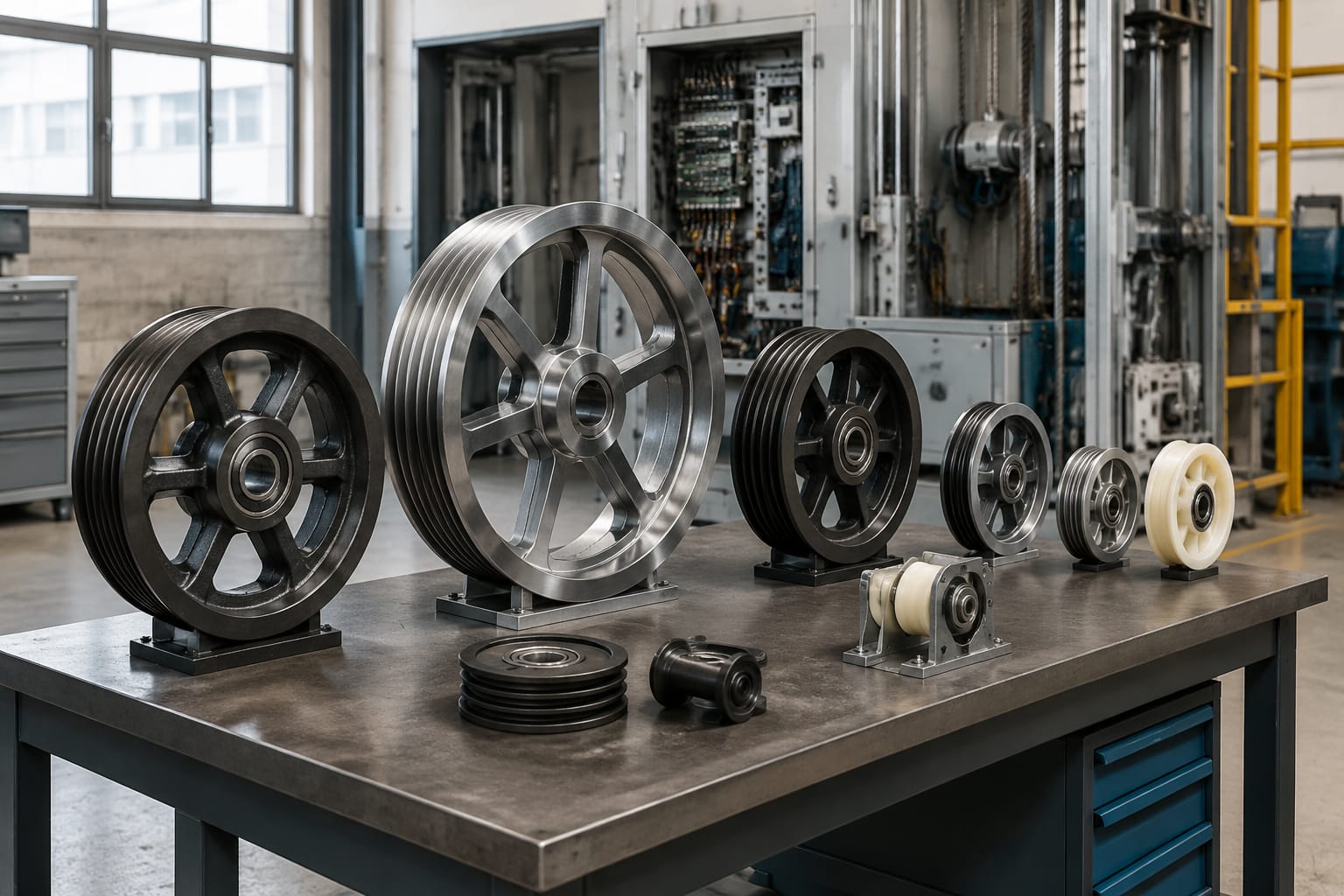
Elevator sheaves guide and support the ropes or belts that move a lift car and counterweight, or guide components within the door system. Their condition directly affects traction, ride quality, noise, rope life, and safe operation. A replacement must match more than its outside diameter: groove form, bearing arrangement, shaft fitment, mounting position, and load application all matter.
For maintenance teams and sourcing buyers in the Philippines, the practical approach is to first identify the sheave's job in the installation, inspect its running surface and bearings, then collect measured and photographed details before requesting a quotation. Ordering solely from a diameter or an unclear site description is a common cause of incompatible parts.
Traction and deflector sheaves
A traction sheave is the driven wheel in a traction elevator machine. It transfers motor torque to the suspension ropes or, in some systems, belts. The rope grooves create the friction required to move the car and counterweight under controlled conditions.
Because it is a load-bearing, drive-critical component, a traction sheave must be selected for the specific machine, rope arrangement, groove profile, and suspension ratio. Its grooves must provide consistent traction across all ropes without causing excessive rope pressure or accelerated wear.
A deflector sheave, sometimes called a deflection sheave, changes the direction of the suspension ropes between the traction machine, car, counterweight, and overhead rope paths. It does not normally drive the ropes, but it still carries significant load and must rotate smoothly. Deflector sheaves are often found in the machine room, machine-room-less (MRL) hoistway headroom, or near the counterweight path.
| Feature | Traction sheave | Deflector sheave |
|---|---|---|
| Primary purpose | Transfers drive torque to suspension ropes | Changes rope direction and supports rope travel |
| Driven by motor | Yes | No |
| Importance of groove traction | Critical | Important for rope support, but not the main drive interface |
| Typical checks | Groove wear, rope traction, runout, shaft and hub condition | Groove wear, bearing condition, alignment and free rotation |
| Replacement basis | Machine-specific compatibility is essential | Must match rope path, diameter, grooves, mounting and bearing details |
Do not assume that a non-driven sheave is a lower-risk replacement. A deflector sheave with seized bearings, uneven grooves, or poor alignment can damage ropes, increase machine load, and contribute to uneven rope tension.
For a traction-wheel requirement, compare the machine identification details and groove dimensions with the supplier's drawing or product data. A [traction wheel for Otis elevator applications](/products/traction-wheel-switch-otis-elevator-parts-lift-accessories/) illustrates the type of product category where exact compatibility details must be confirmed before purchase.
Diverting, secondary, and door sheaves
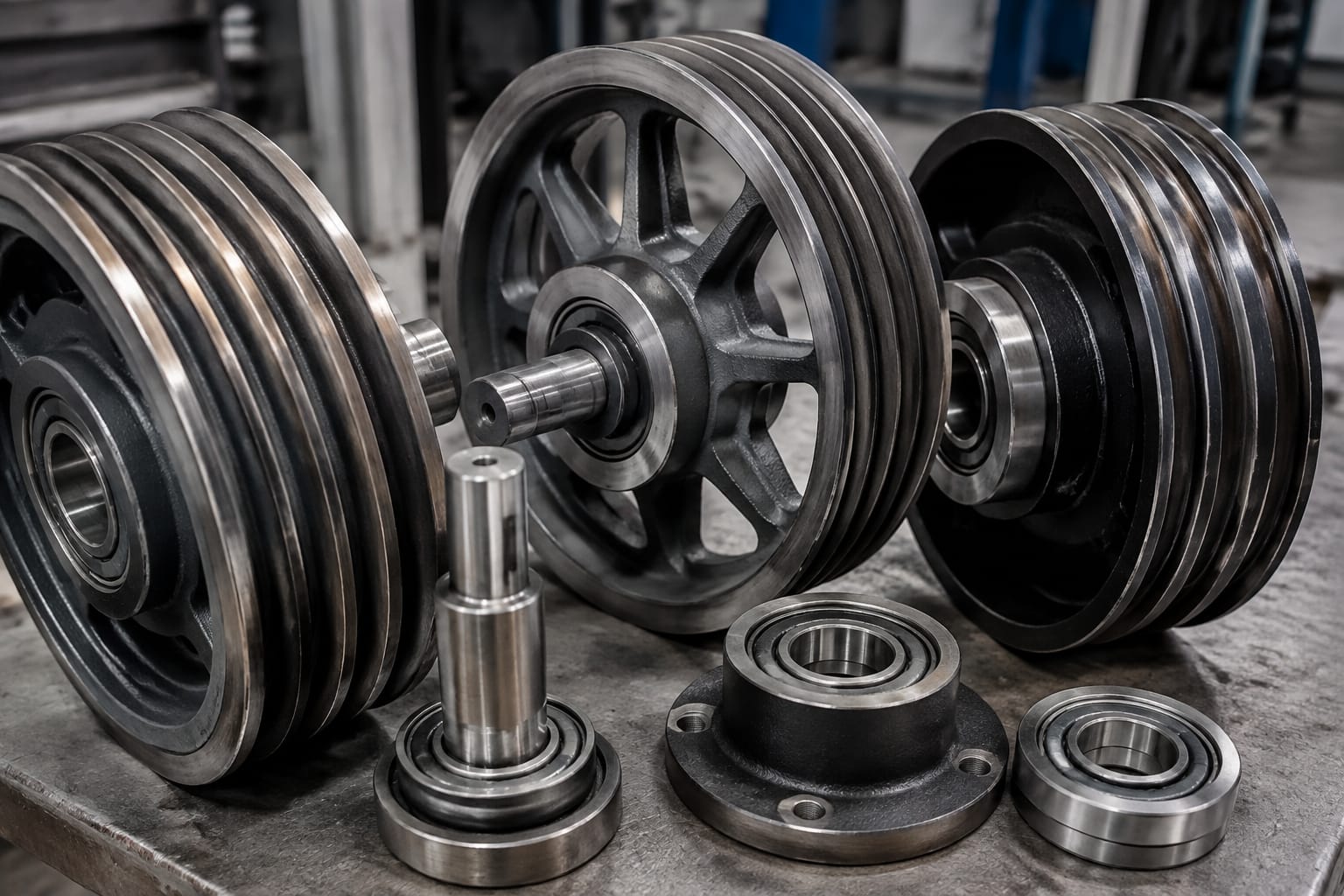
The term diverting sheave is commonly used for any sheave that redirects a rope path. In practice, naming varies between manufacturers, site teams, and spare-parts catalogues. A diverting sheave may refer to a deflector sheave in the suspension system, or to a smaller sheave in a governor, compensation, or auxiliary arrangement.
The useful question is not only “What is this sheave called?” but “What does it guide, where is it mounted, and what load does it carry?” These details determine the required material, groove profile, bearing type, and inspection priority.
Secondary sheaves in elevator systems
Secondary sheaves may be used in reeving arrangements to create a particular suspension ratio, redirect ropes around structural constraints, or support counterweight and car sling rope paths. They can be located above the car, above the counterweight, or in the machine area depending on the elevator design.
When identifying a secondary sheave, record:
- Whether it runs on suspension ropes, governor rope, compensation chain, or another component
- The number, diameter, and construction of the ropes
- The total number of grooves and whether all grooves are used
- The centre distance and relation to nearby sheaves
- Whether it has an integral shaft, a separate axle, or a removable bearing housing
- Its mounting orientation: horizontal, vertical, bracket-mounted, or frame-mounted
A visually similar wheel may be unsuitable when its groove pitch differs even slightly. Incorrect pitch can force ropes to run out of line and create uneven contact.
Door sheaves and change wheels
Door sheaves are generally smaller and serve the door operator, hanger, or coupling mechanism rather than the main suspension system. They may guide a cable, timing belt, chain, or door linkage. Their failure can present as noisy opening and closing, door reversal, dragging panels, irregular door travel, or a door operator fault.
Door wheel terminology also differs by manufacturer. A part may be described as a door change wheel, guide wheel, hanging wheel, pulley, or sheave. Confirm its function before selecting a replacement.
Useful product categories include a [74 x 19 door change wheel with a 6203 bearing](/products/74x19x6203-lift-door-change-wheel-elevator-parts/) and a [double-groove door hanging wheel, 140 x 20 with 6204 bearing](/products/door-hanging-wheel-double-groove-140x20x6204-lift-parts-elevator-accessories/). These dimensions and bearing references are identifying details, not a substitute for verifying the exact door system, groove layout, and mounting arrangement on site.
Sheave materials and groove profiles
Elevator sheaves are commonly manufactured from cast iron, steel, or engineered polymer materials, depending on their duty and location. The material must withstand contact pressure, rotation, environmental conditions, and the type of rope, belt, cable, or door component it guides.
Cast iron is widely associated with traction and larger rope sheaves because it can be machined with suitable groove geometry and handles substantial mechanical loads. Steel may be used for strength and specific fabrication requirements. Polymer or nylon-based wheels are more common in certain door applications, guide assemblies, and lower-load mechanisms where quiet operation and low component weight are useful.
Material alone does not establish suitability. The groove is equally important.
Why groove profile matters
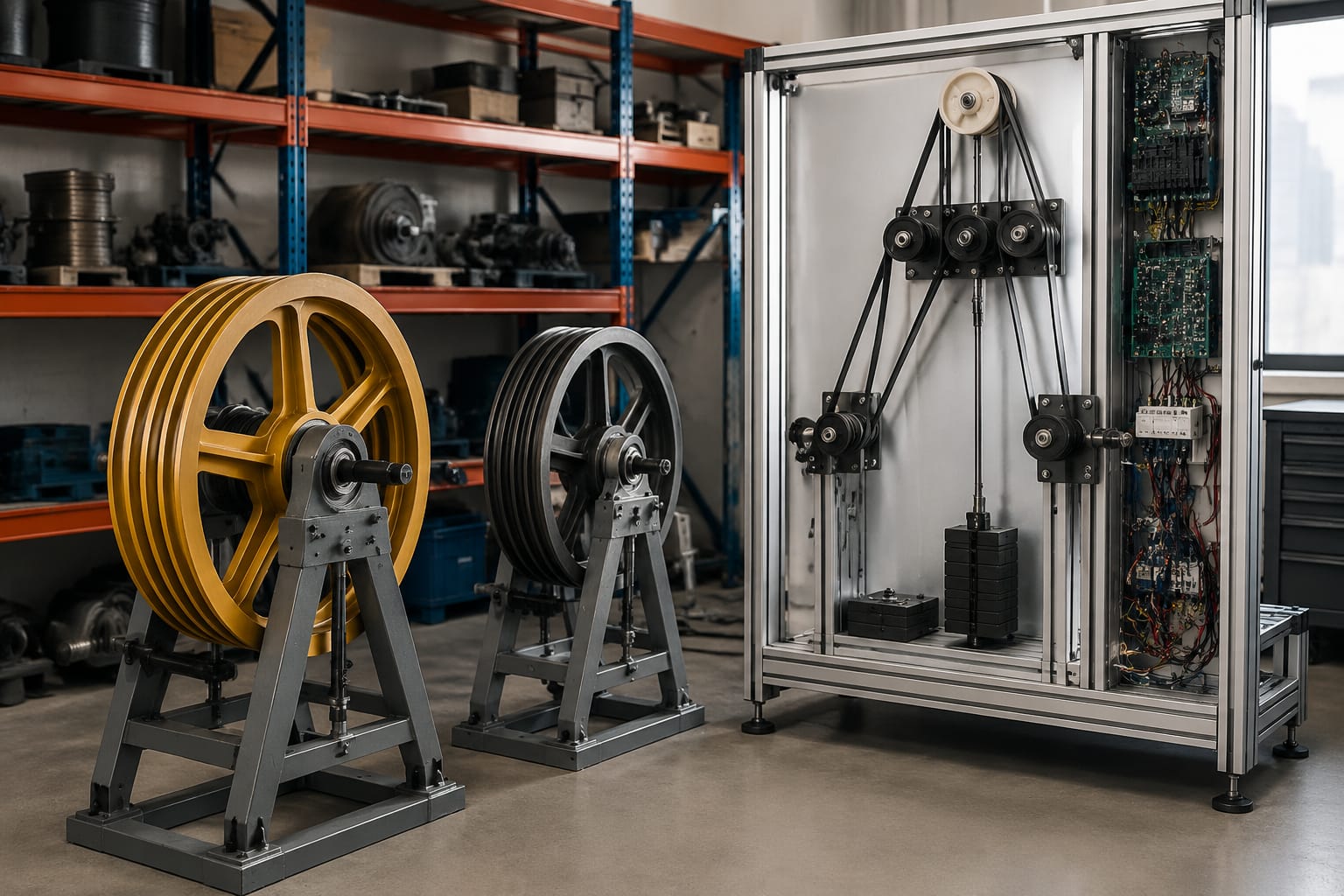
The groove profile determines how a rope or belt sits in the sheave. Common profiles include round, U-groove, undercut, V-shaped, and manufacturer-specific forms. A groove may be lined or unlined, depending on the machine design.
Correct groove geometry helps distribute load and maintain controlled grip. Worn grooves can allow ropes to sit too deeply, ride inconsistently, or lose the intended contact pattern. On traction systems, this may contribute to slip, levelling issues, uneven rope wear, or poor traction performance.
Check these groove-related points:
- Groove count and centre-to-centre pitch
- Groove radius, depth, and included angle where applicable
- Undercut shape or relief detail
- Signs of polishing, pitting, ridges, cracking, or sharp edges
- Whether the ropes sit at a consistent depth across the sheave
- Compatibility with the rope diameter and construction specified for the elevator
Do not machine or re-groove a traction sheave without an engineering assessment for the particular equipment. Removing material changes groove depth and sheave condition, and the result must remain compatible with the rope and machine requirements.
Bearings, shafts, and mounting
A sheave can have sound grooves but still fail in service because of bearing, shaft, hub, or mounting problems. These components control rotation and alignment, making them as important as the wheel diameter.
Smaller door sheaves often use standard sealed ball bearings. Their codes, such as 6203 or 6204, can help identify bore, outside diameter, and width, but buyers should still verify the actual bearing installed. Previous repairs may have introduced an incorrect bearing, sleeve, spacer, or wheel assembly.
Larger suspension sheaves may have sealed bearings, open bearings, roller bearings, bushings, or a design integrated into the machine or sheave frame. The replacement process may require attention to retaining rings, locking collars, bearing covers, lubrication arrangements, and shaft-end retention.
Before sourcing, inspect and record:
- Shaft diameter and usable shaft length
- Bore diameter and whether it is plain, keyed, tapered, splined, or bushed
- Bearing designation, quantity, and position
- Hub width and offset from the mounting face
- Mounting hole pattern, bracket profile, and fastener size
- Retainers, circlips, spacers, washers, and protective covers
- Rotation direction where the design has a directional feature
Never force a sheave onto a shaft or compensate for a loose fit with improvised packing. A poor bore-to-shaft fit can create eccentric running, noise, bearing damage, or movement under load.
Common wear and noise symptoms
Elevator sheave faults usually develop gradually, although bearing failure or impact damage can create sudden symptoms. Regular maintenance inspection helps distinguish a wheel issue from rope, machine, door operator, rail, or alignment faults.
The following symptoms are reasons to inspect the sheave and surrounding system.
| Symptom | Possible sheave-related cause | Other items to check |
|---|---|---|
| Rumbling or grinding during travel | Worn, contaminated, or damaged bearing | Machine bearings, rope contact, drive components |
| Squeal or slipping sensation | Worn traction grooves, incorrect rope condition, contamination | Rope tension, brake operation, drive settings |
| Repetitive clicking at one point of rotation | Damaged groove, crack, debris, or bearing defect | Rope damage, guards, nearby brackets |
| Uneven rope wear | Groove wear, groove pitch issue, misalignment | Rope equalisation, reeving, car and counterweight alignment |
| Door noise or jerky travel | Door wheel bearing wear, worn running surface, damaged groove | Door hanger rollers, track cleanliness, operator linkage |
| Visible side-to-side movement | Bearing clearance, loose shaft, damaged hub or bracket | Fasteners, mounting frame, adjacent guide components |
| Rope dust or metal particles near the sheave | Abnormal rope-groove contact or severe wear | Rope condition, contamination source, sheave alignment |
A noise diagnosis should never rely on sound alone. Isolate the point in the travel cycle, inspect safely with the equipment under proper control, and check for visible evidence. A defect that occurs once per sheave revolution often points to a local wheel, groove, or bearing issue.
Inspection and measurement checklist
Perform inspection in line with the elevator manufacturer's maintenance instructions, site safety procedures, and the competency requirements for the work. Secure the equipment before accessing moving or suspended components. Do not place hands near ropes, sheaves, or door mechanisms while they can move.
Visual and functional inspection
Start with a clean view of the assembly. Remove loose dust only when this can be done safely and does not conceal evidence needed for diagnosis.
Check for:
- Cracks, broken flanges, corrosion, impact marks, or distorted wheel faces
- Groove wear, sharp edges, embedded debris, or uneven contact marks
- Rope position and consistent seating in each groove
- Bearing noise, stiffness, roughness, excess heat, or lubricant leakage
- Axial or radial play at the sheave
- Loose fasteners, worn bracket holes, or damaged retaining hardware
- Misalignment between the entering rope path and groove
- Guard condition and clearance from the rotating assembly
- Door wheel flat spots, damaged running surfaces, and worn guide tracks
For traction and suspension sheaves, compare rope seating across every groove. A rope sitting materially deeper or higher than adjacent ropes may indicate unequal groove wear, rope diameter variation, tension imbalance, or an unsuitable rope replacement.
Measurement record for replacement
Use calibrated measuring tools suitable for the tolerance needed. A steel rule is useful for rough checks but is not enough for critical bore, groove, or bearing measurements.
Record the following in millimetres unless the equipment documentation specifies otherwise:
- Overall outside diameter of the sheave.
- Groove root diameter, if accessible and relevant.
- Face width and hub width.
- Number of grooves.
- Groove pitch, measured between groove centres.
- Groove width, depth, radius, angle, and undercut where applicable.
- Bore diameter, keyway dimensions, or shaft dimensions.
- Bearing code, internal diameter, outside diameter, and width.
- Mounting-hole locations or bracket dimensions.
- Offset from the mounting face to the groove centreline.
- Rope, cable, belt, or door-component size being guided.
Take clear photographs from the front, side, rear, mounting area, bearing markings, and machine or door-operator identification plate. Include a scale in photographs where practical, but do not use photographs as the sole basis for final dimensions.
Information needed for sourcing
A complete sourcing request reduces the chance of receiving a part that appears correct but cannot be installed. This is particularly important for B2B importers, distributors, modernization firms, and maintenance contractors handling equipment from different manufacturers or older installations with incomplete records.
Provide the following information to a supplier:
- Elevator manufacturer, model, serial number, and installation details available from the site
- Component name used in the equipment manual, if available
- Function and exact installed location of the sheave
- Clear photographs and a sketch showing key dimensions
- Wheel material and any cast, stamped, or engraved part numbers
- Outside diameter, face width, groove count, and groove pitch
- Full groove profile details and the rope or belt specification
- Bearing number and arrangement, shaft or bore dimensions, and mounting method
- Quantity required and whether adjacent sheaves should be assessed together
- Evidence of the fault, such as wear pattern, noise description, or failed bearing condition
For older lifts, confirm whether the existing sheave is original, previously reworked, or part of a past modernization. A legacy part number can be useful, but measurements and fitment details remain essential.
Kelevator supplies multi-brand elevator spare parts for B2B importers, distributors, maintenance contractors, modernization companies, and OEM buyers. When requesting a sheave or related wheel, provide the technical record above so the proposed part can be checked against the actual application rather than matched by appearance alone.
Alignment and testing after replacement
Installing the correct replacement sheave is only part of the repair. Alignment, retention, and functional testing determine whether the new component will operate as intended.
Before returning the lift to normal service, confirm that the sheave is fully seated on its shaft or mounting, bearings are retained correctly, and all fasteners are tightened to the applicable manufacturer requirements. Restore guards and verify that no tool, loose hardware, or temporary restraint remains in the working area.
Check that ropes, belts, or cables enter and leave the sheave without visible side loading. The running path should be aligned with the grooves, and no rope should rub a flange, guard, bracket, or adjacent component. Where the elevator design requires rope tension equalisation or adjustment, follow the manufacturer's procedure.
Run the equipment under controlled conditions and observe:
- Smooth sheave rotation without wobble or abnormal runout
- Correct tracking and seating through the full travel range
- Absence of bearing rumble, scraping, clicking, or unusual vibration
- Door movement that is smooth, complete, and free from wheel or track interference
- Normal levelling, acceleration, deceleration, and stopping behaviour for traction equipment
- No new fault indications after the required functional checks
For traction sheaves, do not treat a successful short run as a complete assessment. Observe rope behaviour, traction performance, and any relevant machine parameters over the maintenance checks required for that installation.
The right elevator sheave is identified by its application, groove geometry, bearing and shaft arrangement, and installed alignment, not by diameter alone. Build a clear measurement record before sourcing, replace associated worn components where inspection justifies it, and complete alignment and operational checks before releasing the equipment.