
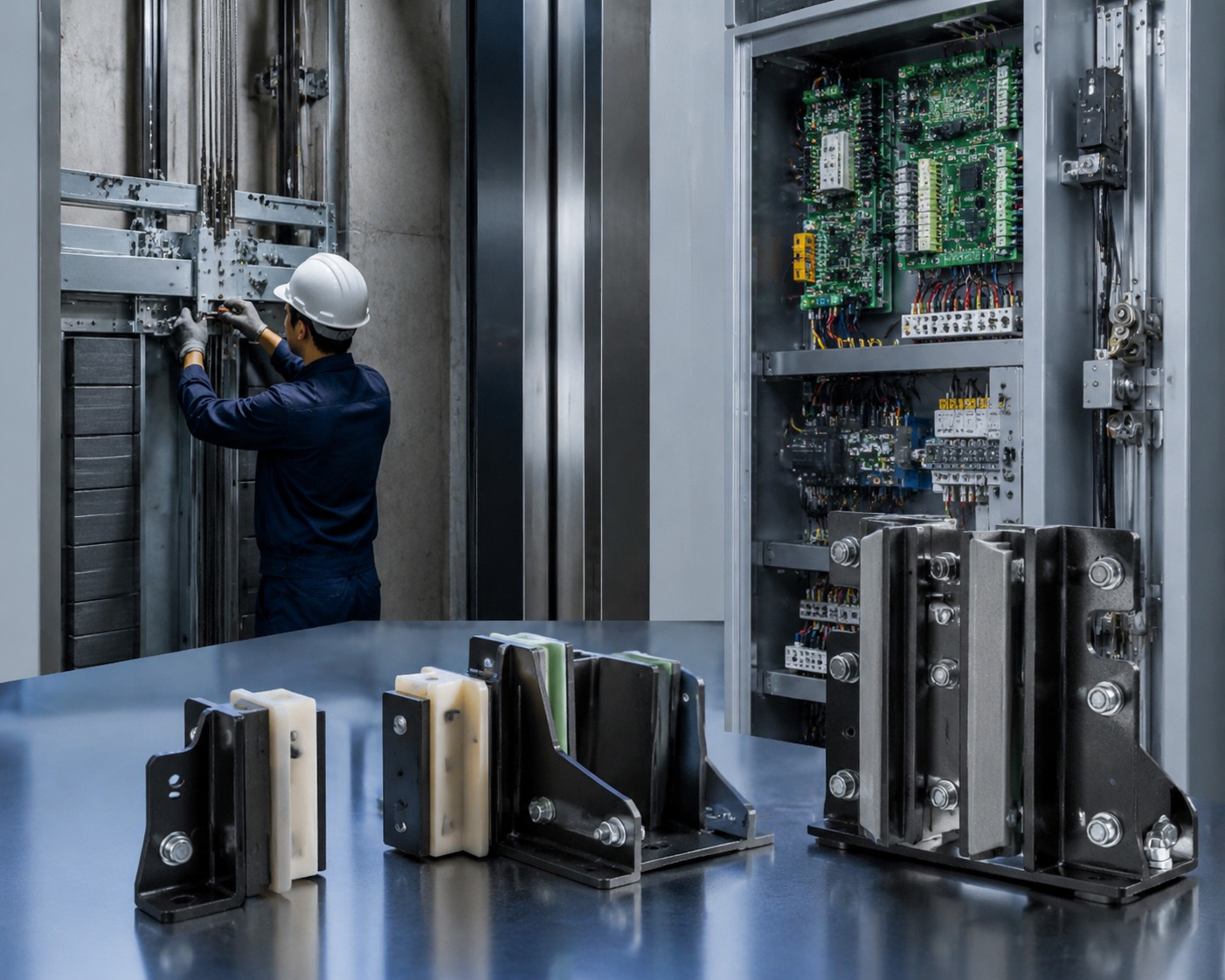
Elevator guide shoes and guide shoe liners are small parts with a big effect on ride quality, rail protection, and long-term maintenance cost. In the Philippines, where elevators operate in coastal humidity, dense mixed-use towers, hospitals, malls, offices, hotels, and residential buildings, selecting the right guide shoe lining helps reduce vibration noise, stabilize car travel, and minimize rail wear. For maintenance teams and building owners, a correct liner choice is not just a parts decision. It directly affects passenger comfort, callback frequency, and modernization planning.
The simplest answer is this: guide shoes keep the elevator car and counterweight aligned on the rails, while the guide shoe lining provides the sliding or contact surface that absorbs friction and dampens movement. When the lining size, hardness, material, or fit is wrong, the elevator may become noisier, less stable, and harsher during acceleration or leveling. When the liner is worn, cracked, glazed, or loose, it can lead to uneven travel, rail marking, and increased service calls.
For buyers in Metro Manila, Cebu, Davao, Clark, Subic, Iloilo, Cagayan de Oro, and other Philippine growth centers, sourcing compatible elevator spare parts also means checking brand matching, rail dimensions, operating load, travel speed, environment, and packaging quality. A reliable supplier should help confirm model details, provide stable quality inspection, and reduce the risk of ordering a lining that is close in appearance but wrong in tolerance.
What elevator guide shoes do
Elevator guide shoes are mounted on the elevator car frame and on the counterweight frame. Their purpose is to keep these moving assemblies guided along the rails in a controlled path. In sliding guide shoe systems, the guide shoe lining is the wear component that contacts the rail surface. This liner absorbs small irregularities, supports alignment, and reduces direct metal-to-metal contact.
In practical terms, guide shoes do four important jobs. First, they maintain directional stability so the car does not sway excessively during travel. Second, they help control vibration and mechanical noise, especially in older buildings or where rail joints and mounting conditions are less than ideal. Third, they protect the rail by using a sacrificial lining material that wears more economically than the rail itself. Fourth, they support safer operation by helping the car and counterweight remain properly guided under changing loads.
In the Philippines, these functions matter even more in towers exposed to heat, dust, salt-laden coastal air, and frequent traffic cycles. An office building in Makati may need consistent ride quality during morning peak traffic. A hotel in Cebu may prioritize quiet travel for guest experience. A hospital in Quezon City may require stable, smooth movement for patient transfer. In each case, the guide shoe lining plays a direct role in how the elevator feels and how often it needs corrective maintenance.
| Guide Shoe Function | What It Does | Operational Benefit | Common Failure If Neglected |
|---|---|---|---|
| Rail guidance | Keeps car or counterweight centered on the guide rail | Stable vertical travel | Side sway and rough movement |
| Friction control | Creates a controlled contact surface between shoe and rail | Lower noise and smoother sliding | Scraping noise and rail marking |
| Vibration damping | Absorbs small shocks from rail joints and misalignment | Better passenger comfort | Cabin vibration and rattling |
| Wear management | Uses a replaceable liner instead of wearing the metal body | Lower lifecycle cost | Premature rail and shoe damage |
| Load support | Helps maintain guided movement under changing passenger load | Predictable operation | Uneven contact and liner cracking |
| Noise reduction | Reduces direct harsh contact against the rail | Quieter runs in residential and hotel settings | Increasing travel noise over time |
The table above shows why guide shoes should never be treated as minor consumables. Even though the liner is inexpensive compared with large drive or control components, its effect on ride quality, maintenance frequency, and customer complaints is significant.
Main rail and counterweight guide shoe differences
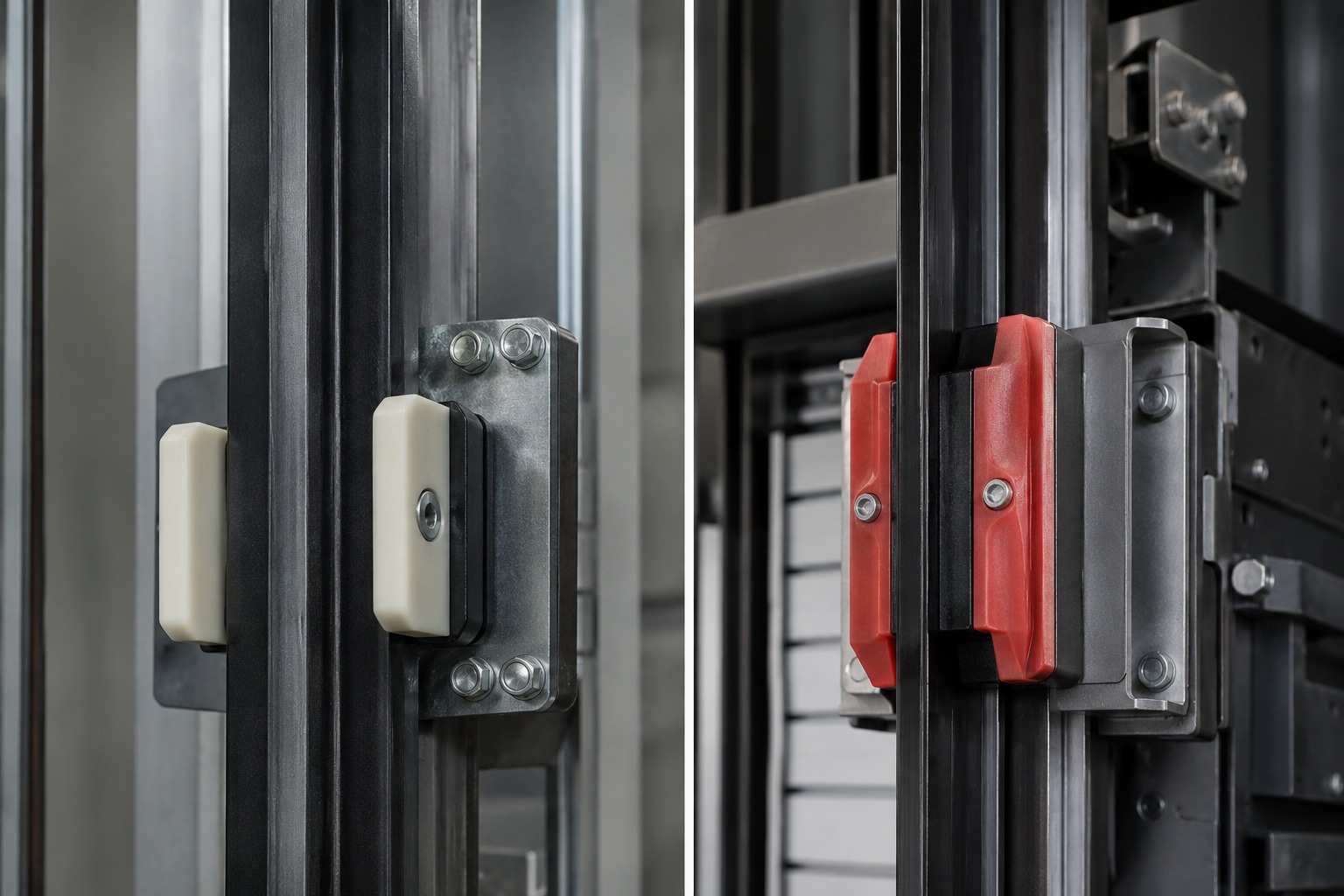
Main rail guide shoes are installed on the elevator car and are designed around passenger or freight car load, speed, and comfort expectations. Counterweight guide shoes are installed on the counterweight side and handle a different load pattern and movement behavior. While both serve the same basic guiding purpose, they are not always interchangeable.
The car side usually has stricter ride comfort demands because passengers directly feel vibration, rubbing noise, and instability. Counterweight shoes may experience different pressure distribution and may use different liner dimensions or body geometry depending on elevator model. In many modernization projects across the Philippines, confusion between main rail and counterweight components causes unnecessary installation delays. A liner can appear similar in width or slot design but still fail because thickness, mounting groove, or rail profile differs.
Another difference is wear pattern. Main rail liners often show wear related to car loading imbalance, door-side traffic concentration, and ride comfort issues. Counterweight liners may show wear from rail alignment, compensation behavior, or higher repetitive movement without passenger damping expectations. A good maintenance technician checks both sides together, because replacing only the visibly worn side may leave a hidden alignment problem unresolved.
| Feature | Main Rail Guide Shoe | Counterweight Guide Shoe | Buying Reminder |
|---|---|---|---|
| Mounted on | Elevator car frame | Counterweight frame | Confirm assembly location before ordering |
| Primary concern | Ride comfort and cabin stability | Balance guidance and stable movement | Do not assume same liner specification |
| Wear feedback | Often felt by passengers as noise or vibration | Often seen in inspection before complaints occur | Inspect both during preventive maintenance |
| Load effect | Changes with passenger or cargo load | Related to balancing conditions | Review operating pattern |
| Replacement priority | High in hotels, offices, residences | High in older modernization projects | Replace as a matched maintenance plan |
| Interchangeability | Limited | Limited | Use exact dimensions and model matching |
If you need replacement options for different elevator positions, a sliding guide shoe for elevator systems may be suitable for some car-side assemblies, while a counterweight guide shoe lining is typically selected by exact counterweight application. For car-side wear parts, many maintenance teams also ask for a car main rail sliding guide shoe lining after confirming rail size and model details.
How to select lining size and material
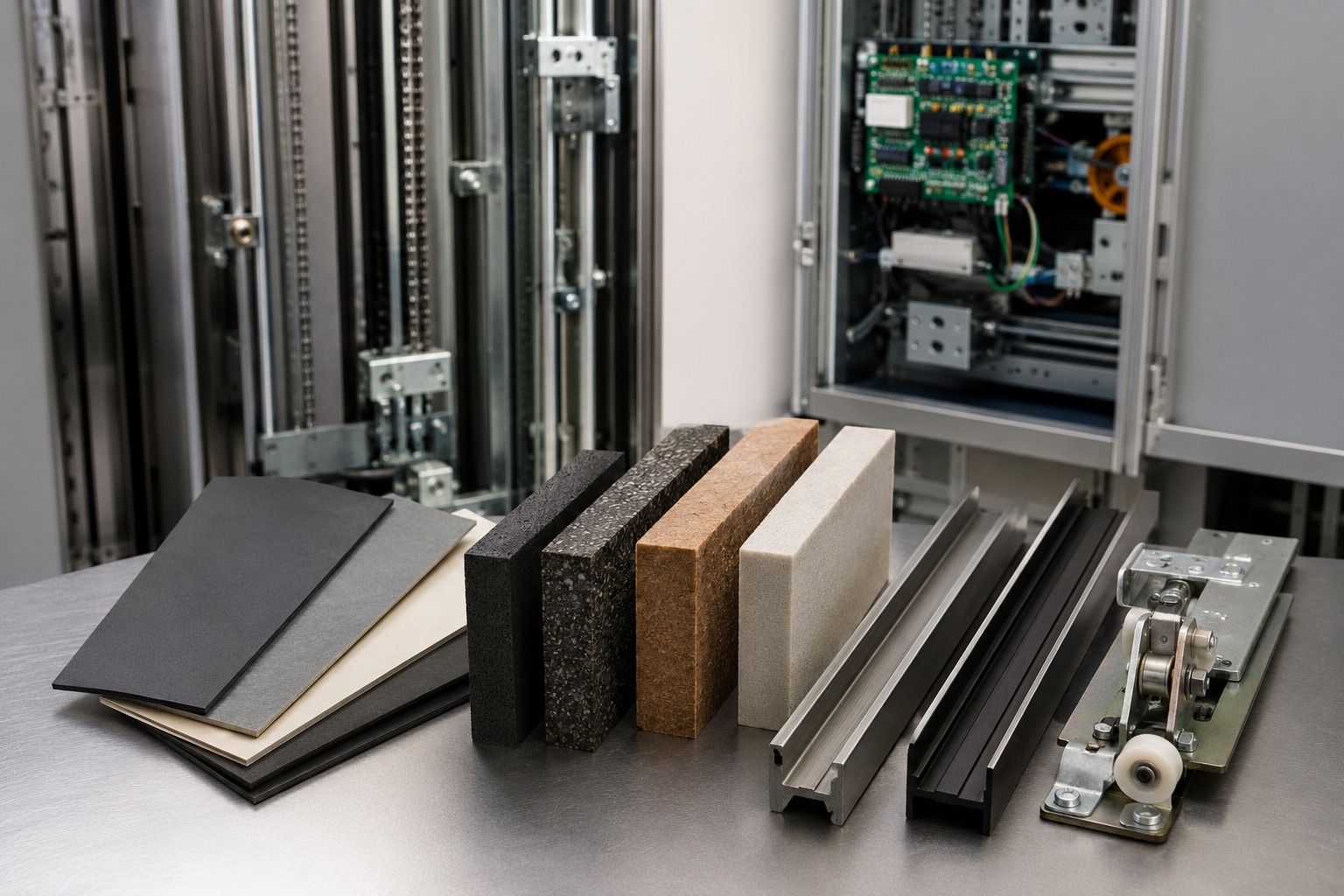
Selecting the correct guide shoe lining starts with dimensional accuracy. The basic checks include overall length, width, thickness, groove or slot shape, mounting style, and the guide rail size it is designed to contact. A few millimeters of error can lead to loose fit, over-tight contact, or accelerated wear. Never buy solely by photo similarity.
Material selection matters just as much as size. Sliding guide shoe liners are commonly made from engineering plastics or composite materials chosen for low friction, controlled wear, and noise reduction. The best material depends on operating speed, environment, rail condition, and original equipment design. In humid Philippine environments, stable material performance is important because heat and moisture can influence friction behavior, dust retention, and long-term dimensional consistency.
When choosing a lining, ask these questions: What is the elevator brand and model? Is it for the car or counterweight? What is the rail size? What is the existing liner dimension? Is the elevator low-rise, mid-rise, or high-rise? Is the ride quality currently acceptable, or is there already vibration and noise? Has the rail condition been checked? A liner cannot fix every mechanical issue, but the wrong liner can make a manageable problem worse.
For example, buyers looking for a specific format may need a guide shoe lining 88x20mm for Hitachi-type applications, but model verification remains essential before purchase. Even within one brand family, dimensions and hardness can vary by generation, rail arrangement, or modernization history.
| Selection Factor | Why It Matters | What to Check | Risk If Wrong |
|---|---|---|---|
| Length | Determines proper contact area | Measure old liner and compare with drawing | Uneven loading and instability |
| Width | Affects fit inside the guide shoe body | Confirm exact width tolerance | Loose fit or forced installation |
| Thickness | Controls rail contact pressure | Check new and worn dimensions separately | Noise, drag, or rapid wear |
| Material grade | Influences friction, wear, and noise | Verify plastic or composite specification | Short service life |
| Application side | Car and counterweight may differ | Identify installation position clearly | Wrong part supplied |
| Brand/model match | Ensures geometry compatibility | Share nameplate, photos, or part code | Delay and reordering cost |
The selection table above shows why careful model matching saves time. For Philippine buyers dealing with urgent repairs, it is tempting to choose by approximate dimension alone. However, the most reliable results come from combining measurements, photos, rail data, and brand information.
Signs of worn guide shoe liners
Guide shoe liners usually do not fail all at once. They wear progressively, and the elevator often gives warning signs first. The most common symptom is increasing scraping or rubbing noise, especially when the car passes certain floors or rail joints. Another common sign is noticeable vibration in the cabin, often felt near the handrail, floor, or door jamb.
Visual inspection may reveal polished glazing, edge chipping, cracking, uneven contact marks, discoloration from heat, or reduction in thickness. In some cases, maintenance teams also find black dust or plastic residue near the guide shoe area. If one side wears faster than the other, that may indicate rail misalignment, poor adjustment, frame twist, or uneven loading rather than just normal wear.
In many Philippine buildings, guide shoe liner wear becomes obvious during rainy-season humidity changes, after long periods of high passenger use, or during modernization when newer control systems reveal older mechanical imperfections. Replacing the liner without checking alignment can give only short-term improvement. A complete maintenance decision should review liner condition, rail condition, shoe body fit, fasteners, lubrication practices where applicable, and overall travel behavior.
| Wear Sign | What It Usually Means | Effect on Elevator | Recommended Action |
|---|---|---|---|
| Scraping noise | Increased friction or bad fit | Louder travel | Inspect liner and rail contact |
| Cabin vibration | Uneven wear or misalignment | Reduced ride comfort | Check both shoes and rail line |
| Cracks or chips | Material fatigue or impact | Risk of sudden deterioration | Replace liner promptly |
| Glazed surface | Heat buildup and polishing | Less damping, more noise | Review contact pressure and material |
| Uneven side wear | Alignment issue or uneven loading | Fast repeat failure | Correct root cause before full return to service |
| Loose mounting | Incorrect fit or wear of holder | Rattle and unstable tracking | Inspect shoe body and retainer parts |
The warning signs listed above should be treated as maintenance indicators, not cosmetic issues. Early replacement is generally cheaper than waiting for rail damage, repeated complaints, or emergency service interruptions.
Hitachi guide shoe replacement notes
Hitachi elevators are widely installed across commercial and residential projects in the Philippines, so replacement requests for Hitachi-compatible guide shoe liners are common. The key point is that not all Hitachi applications use the same liner dimensions or mounting design. Technicians should verify the exact car or counterweight position, the liner profile, and any stamped part references before ordering.
For older units or partially modernized installations, visual similarity can be misleading. Some replacement projects in Manila and Cebu involve mixed histories where the guide shoe assembly may have been changed during earlier repairs. This is why photos of the installed part, the removed liner, rail size information, and equipment nameplate details are highly useful. A supplier with experience in model matching can help confirm whether a requested size is correct or whether another specification is more suitable.
Another practical note is inventory planning. If a building has several identical Hitachi units, it is often smarter to stock a small number of critical wear parts in advance rather than wait for a breakdown. This is especially important for properties with heavy traffic or where parts lead time affects tenant operations, such as hospitals, business process outsourcing offices, and mixed-use towers.
When replacing Hitachi-type liners, technicians should also inspect the guide shoe body for wear, cracks, and retainer integrity. A new liner installed into a distorted holder may fail early. If the existing rail surface shows damage, polishing marks, or alignment irregularities, the replacement plan should include corrective adjustment rather than only a parts change.
Installation and alignment checks
Correct installation is just as important as correct part selection. A high-quality guide shoe lining can still perform poorly if installed with dirt under the seat, improper pressure, damaged retainers, or misaligned rails. Before installation, the old liner should be removed carefully and the guide shoe body cleaned thoroughly. Inspect for cracks, burrs, deformation, corrosion, and looseness in the mounting area.
The liner should fit securely without forced distortion. If trimming, hammering, or improvised shimming is needed, the part is probably incorrect or the shoe body has a condition that needs repair. After installation, check the contact condition on both sides and compare wear history with current alignment. Uneven pressure usually leads to early wear and recurring noise.
Rail alignment checks should include straightness, bracket condition, joint quality, and fastening security. On older buildings in dense urban zones such as Pasig, Mandaluyong, and Makati, building movement, long service life, and repeated repairs can gradually influence alignment. In ports and logistics facilities near Batangas or Subic, vibration and heavy-duty use may add different stress patterns. Good guide shoe maintenance therefore combines parts replacement with a broader mechanical review.
| Installation Check | Purpose | Acceptable Result | If Not Acceptable |
|---|---|---|---|
| Clean shoe body | Remove debris and old residue | Flat and clean seating surface | Reclean before fitting |
| Inspect retainer | Ensure liner stays secure | No cracks or looseness | Repair or replace holder parts |
| Verify liner fit | Prevent distortion and play | Firm, correct seating | Recheck dimensions and model |
| Check rail contact | Confirm balanced pressure | Even contact pattern | Adjust alignment or pressure |
| Run test at low speed | Detect abnormal noise early | Smooth and quiet movement | Stop and inspect immediately |
| Record replacement data | Support future maintenance planning | Dimensions and date logged | Update maintenance records |
The installation table above is useful because guide shoe liner issues often return when documentation is poor. Recording the removed dimension, wear pattern, and replacement date helps maintenance companies in the Philippines manage repeat servicing across multiple sites.
Maintenance tips for smoother travel
Smoother elevator travel comes from preventive maintenance, not reactive replacement alone. First, schedule periodic visual inspections of both car and counterweight guide shoes, especially on older elevators and units with high daily cycles. Second, listen for pattern changes in noise. A scraping sound that appears only at certain floors can point to rail issues rather than simple liner wear.
Third, monitor cabin vibration and door-side stability complaints. Occupants may describe the problem as shaking, rubbing, or rough stopping, even when the cause is on the guide system. Fourth, replace liners before they are fully consumed. Waiting too long increases the chance of rail wear and secondary damage. Fifth, maintain good spare-part records by brand, model, dimension, and installation position.
For maintenance contractors serving multiple cities such as Manila, Cebu, Davao, Bacolod, and Iloilo, standardized inspection forms make ordering faster and reduce mismatched parts. Building owners should also avoid mixing unverified liner materials from unknown sources, because inconsistent wear performance can increase downtime over the long term.
From a 2026 trend perspective, the market is moving toward more data-based maintenance, better model traceability, and stronger sustainability expectations. Building managers increasingly want parts that support lower noise, longer replacement intervals, and less material waste. Modernization contractors are also paying closer attention to compatibility, because software upgrades and ride-quality expectations often expose mechanical wear that used to be tolerated. In addition, policy and safety compliance trends are encouraging more disciplined documentation of replacement parts and service actions.
The line chart shows a realistic growth pattern in demand for guide shoe liners in the Philippines, driven by urban expansion, aging installed elevators, and modernization of commercial buildings.
The bar chart highlights why malls, offices, and hospitals are major buyers. High traffic, longer operating hours, and stronger comfort expectations typically lead to more frequent inspection and replacement cycles.
FAQ about guide shoe lining
How often should guide shoe liners be replaced?
There is no single interval for every elevator. Replacement depends on traffic, rail condition, environment, and material type. High-use elevators in Metro Manila may need closer monitoring than low-traffic provincial residential units.
Can I replace only one worn liner?
Sometimes yes, but it is better to inspect the full set on the same assembly. If wear is uneven, replacing only one piece may hide a larger alignment issue.
Do main rail and counterweight liners use the same size?
Not always. They may look similar but differ in width, thickness, groove shape, or material. Always confirm the exact application.
What causes fast wear?
Common causes include rail misalignment, incorrect liner size, improper installation, worn shoe bodies, heavy traffic, and unsuitable material grade.
Can a new liner solve vibration by itself?
Only if the liner was the actual cause. If rail condition or alignment is poor, the new liner may help briefly but the symptom can return.
Why is model matching important for Hitachi parts?
Because dimensions and configurations can vary by generation and installation. Exact matching reduces delays and repeat orders.
Philippines market outlook for guide shoe liners
The Philippine elevator service market continues to expand with urban redevelopment, condominium turnover, office retrofits, hospital upgrades, and mixed-use construction. Metro Manila remains the largest concentration of service demand, but strong activity is also visible in Cebu, Davao, Clark, Iloilo, and growth corridors linked to logistics, tourism, and manufacturing. As buildings age, small mechanical wear parts such as guide shoe liners become increasingly important because owners want to improve ride quality without full system replacement.
Replacement demand also grows in buildings near coastal and trade zones where environmental conditions can accelerate wear patterns. Properties in areas connected to Manila Port, Batangas Port, Subic Bay, and Cebu’s logistics network often prioritize reliable spare-part sourcing to avoid extended downtime. In these markets, suppliers that can support careful model matching and protective packaging have a practical advantage.
The area chart suggests a market trend toward planned replacement and inventory management. This shift is expected to continue into 2026 as building managers focus on lifecycle cost, downtime prevention, and service transparency.
Buying advice for maintenance companies and building owners
When buying guide shoe liners in the Philippines, start by gathering all matching information before sending an inquiry. The ideal package includes brand, model, application side, dimensions, clear photos, quantity, and urgency level. If the old liner is badly worn, note both the current measured thickness and the estimated original size if known. This helps avoid confusion.
Second, ask the supplier about quality inspection and packaging. Guide shoe liners may be small, but they still need stable quality control and protection against deformation or mix-up during shipping. Third, consider ordering a small spare stock for repetitive service accounts. This is especially useful for facilities with multiple identical units.
Fourth, evaluate total support rather than unit price alone. A slightly cheaper part that requires reordering, causes mismatch, or arrives without clear model confirmation often costs more in labor and downtime. Fifth, choose suppliers who respond quickly to technical questions and can support compatible replacements for brands such as Hitachi, Toshiba, KONE, Mitsubishi, and others used in the Philippine market.
| Buyer Checklist | Why It Matters | Best Practice | Cost Risk If Ignored |
|---|---|---|---|
| Brand and model confirmation | Prevents mismatch | Share nameplate and photos | Reorder and delay |
| Exact dimensions | Ensures proper fit | Measure length, width, thickness | Installation failure |
| Application position | Car and counterweight differ | Label each part location | Wrong replacement part |
| Material verification | Affects wear and noise | Ask for specification consistency | Short service life |
| Packaging quality | Prevents damage and mixing | Request protective packing | Broken or confused stock |
| Supplier response speed | Reduces downtime | Choose technically responsive support | Longer elevator outage |
This checklist is especially helpful for distributors and service companies handling multiple building accounts. A disciplined ordering process improves first-time matching and lowers callback costs.
Industries and applications that rely on proper guide shoe lining
Guide shoe liners are used across nearly every elevator application, but the buying priorities vary by industry. Residential towers usually focus on noise reduction and stable daily operation. Offices emphasize peak-hour reliability and reduced complaints. Hotels value smooth travel and quiet running. Hospitals require stable ride quality, predictable maintenance, and reduced service interruption. Malls need durable wear performance under constant traffic. Industrial and logistics sites often prioritize rugged service conditions and practical parts availability.
In the Philippines, these applications are distributed across major urban and commercial centers. Condominiums in Bonifacio Global City may demand quiet operation and rapid maintenance turnaround. Healthcare facilities in Quezon City and Cebu City may prioritize planned replacement and stock readiness. Retail and mixed-use properties in Ortigas, Davao, and Iloilo often need suppliers capable of supporting multiple brands and modernization histories.
| Industry | Main Concern | Typical Wear Driver | Recommended Buying Focus |
|---|---|---|---|
| Residential | Noise and comfort | Daily repetitive travel | Stable material and exact fit |
| Office | Peak reliability | Rush-hour cycles | Preventive replacement planning |
| Hotel | Quiet guest experience | 24-hour operation | Low-noise liner quality |
| Hospital | Smooth patient transport | Continuous essential service | Stock availability and traceability |
| Mall | Heavy public traffic | Long daily run time | Durability and fast supply |
| Industrial | Practical uptime | Harsh use conditions | Compatibility and robust inspection |
The industry comparison shows why there is no universal buying standard. The right liner for a quiet residential tower may not be the best economic choice for a freight-heavy or public retail environment.
Case studies from the Philippine market
Case 1: Office tower in Makati. A building experienced growing passenger complaints about rubbing noise during morning peak periods. Inspection found worn car main rail liners with uneven side wear. The root cause included both liner wear and minor alignment correction needs. After replacing the liners with correctly matched parts and adjusting the contact condition, ride quality improved and complaint frequency dropped.
Case 2: Hotel in Cebu. Guest feedback mentioned intermittent vibration at mid-travel floors. The maintenance team first suspected door-related causes, but a detailed check found glazed guide shoe liners and contact inconsistency. After replacement and rail review, the elevator became quieter and smoother, improving guest perception without a major modernization cost.
Case 3: Mixed-use tower in Quezon City. During modernization planning, technicians discovered that previous repairs had introduced non-standard liner dimensions. This caused repeated short service life and irregular stock ordering. Once the site standardized the correct compatible specification and documented it properly, maintenance planning became easier and downtime risk decreased.
Case 4: Hospital in Davao. Because service interruption affected patient movement, the facility decided to keep a small stock of critical wear parts including guide shoe liners. This reduced lead-time stress and supported planned preventive maintenance rather than emergency replacement.
How to evaluate local suppliers and imported part support
Buyers in the Philippines often balance local availability with imported brand compatibility. The best supplier is not always the one with the biggest catalog. The real value comes from technical confirmation, consistency, and service reliability. Ask whether the supplier can help identify parts from photos and dimensions, whether they understand brand-specific differences, and whether they protect goods properly for domestic or overseas delivery.
For imported-compatible elevator spare parts, traceability is important. A supplier should be able to explain how model matching is confirmed and how quality is checked before dispatch. This is particularly valuable for maintenance companies serving multiple brands across NCR, Visayas, and Mindanao.
The comparison chart reflects what many Philippine buyers value most in a parts partner: accurate model matching, dependable quality inspection, secure packaging, fast communication, broad brand support, and responsive follow-up.
Our company support for the Philippines market
Technological capabilities. We support elevator spare-part sourcing with careful model matching, photo-based verification, and compatibility review for guide shoes, liners, and related lift accessories. For customers managing equipment from Hitachi, Toshiba, KONE, Mitsubishi, and other major brands, our approach focuses on reducing ordering errors and helping maintenance teams confirm the right replacement before shipment.
Manufacturing capabilities. We work with stable production and inspection processes for elevator wear parts and accessories, with attention to dimensional consistency, material suitability, and protective packaging. For guide shoe liners, this matters because small tolerance differences can change fit, rail contact, and wear behavior. Our packaging and checking process is designed to help distributors, contractors, and service companies receive parts in organized, usable condition.
Service capabilities. We serve maintenance companies, distributors, building owners, and modernization contractors with responsive communication and practical support for urgent or recurring requirements. Our goal is to help Philippine customers reduce downtime, source compatible replacement parts, and keep elevator systems operating safely and smoothly across commercial, residential, and institutional projects.
Whether the requirement is a single urgent replacement or repeat supply for multiple sites, the best results come from sharing complete technical details early. That allows faster confirmation, better stock planning, and fewer on-site surprises.