
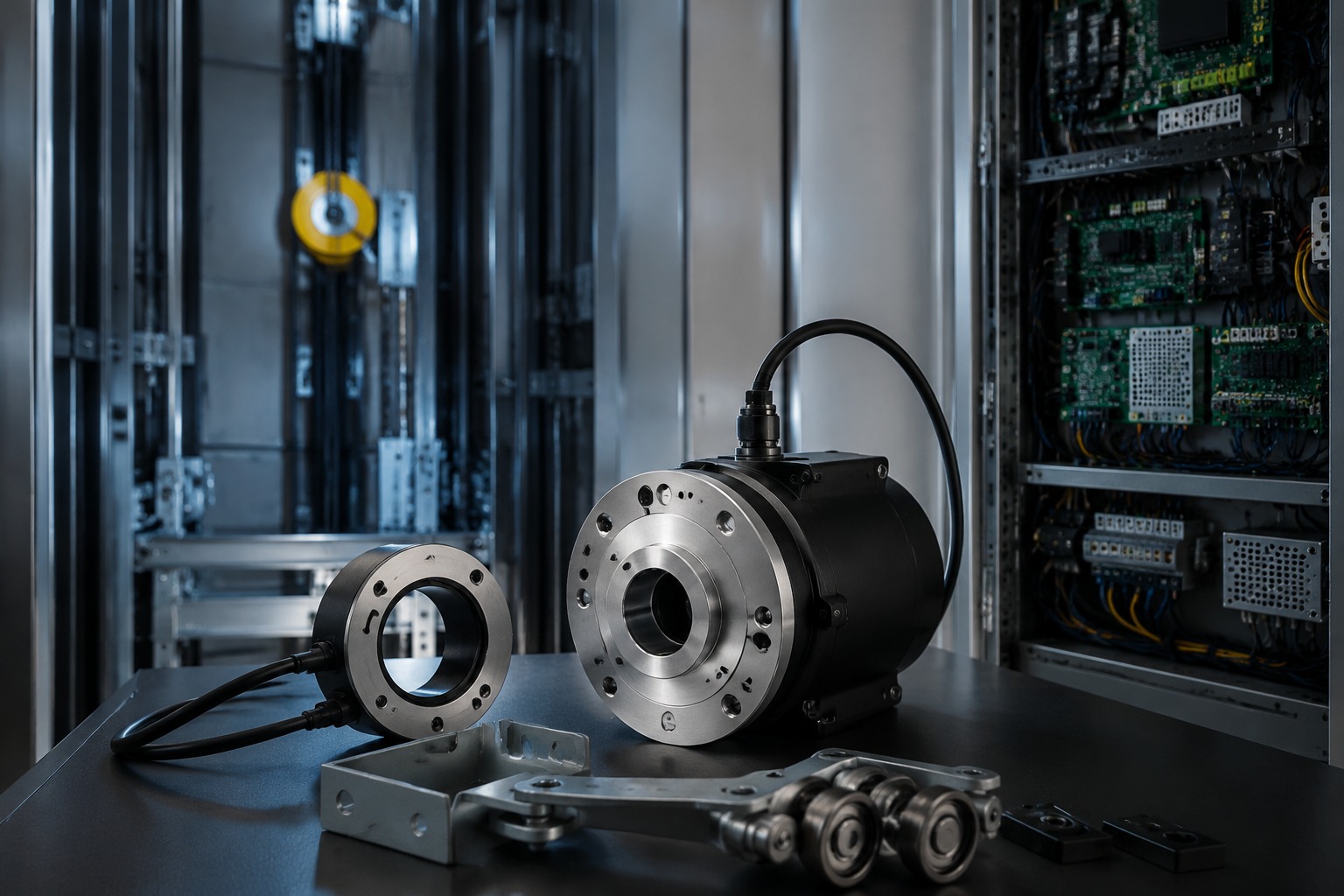
Accurate speed feedback is one of the most important foundations of safe elevator operation. In practical terms, an elevator encoder tells the control system how fast the traction motor is turning, in which direction it is moving, and whether the car is accelerating, decelerating, or holding speed correctly. When this feedback is stable, the lift can level smoothly, start and stop with less jerk, and maintain traction control with better precision. When the signal is unstable, the elevator may hunt for speed, level poorly, trip on faults, or become unavailable to passengers.
For building owners, maintenance contractors, and modernization teams in the Philippines, encoder selection is not just a matter of ordering a similar-looking part. Metro Manila high-rise traffic, mixed-use towers in Makati and BGC, hotels in Cebu, hospitals in Davao, and commercial buildings near ports such as Batangas and Subic all depend on reliable vertical transport. A mismatched encoder can create repeated callbacks, longer downtime, and unnecessary inverter or controller troubleshooting.
This guide explains how to choose the right elevator encoder for traction systems, what warning signs usually appear before failure, how to compare pulse output and shaft type, what to note when selecting a Hitachi UAX encoder, and how to confirm correct speed feedback after replacement. It also covers stocking strategies for urgent repairs in the Philippine market, where fast logistics between Luzon, Visayas, and Mindanao can make the difference between a quick restoration and a prolonged outage.
As a professional elevator parts supplier serving maintenance companies, distributors, building owners, and modernization contractors, we focus on reliable model matching, stable quality inspection, careful packaging, and responsive coordination. That matters especially for encoders, because even a small mismatch in connector layout, mounting dimensions, pulse count, or shaft interface can lead to field issues. If you are checking replacement options, you may review our Hitachi UAX elevator encoder listing, as well as other elevator encoder spare parts, compatible lift encoder models, and replacement encoder options for service teams.
How an Elevator Encoder Supports Speed Control
An elevator encoder converts shaft rotation into electrical pulses or signals that the controller or inverter can read. In a traction elevator, it is commonly mounted on the motor shaft or an associated rotating element. The controller uses that information to calculate speed, direction, and position-related behavior. The result is closed-loop control: instead of guessing how the motor is moving, the system constantly compares commanded speed with actual speed.
This is especially important during four operating phases:
- Start-up acceleration, where smooth torque buildup reduces jerk.
- Constant travel speed, where accurate feedback helps maintain ride quality.
- Deceleration, where the system must reduce speed predictably before landing.
- Leveling, where fine control allows the car floor to align with the landing sill.
In modern elevator applications, the encoder signal often supports both comfort and safety logic. If the controller detects that commanded movement and feedback movement do not match, it may trigger a protective fault. In other words, the encoder is not just a convenience component. It plays a direct role in traction control quality and operational stability.
Buildings in cities such as Quezon City, Pasig, Iloilo, and Cagayan de Oro often face heavy daily traffic cycles. In these environments, a stable encoder helps reduce repeated door re-openings caused by poor leveling, minimizes passenger complaints about rough travel, and supports efficient service calls by giving the controller a dependable speed reference.
| Encoder Function | What It Measures | Why It Matters in Elevator Use | Operational Impact |
|---|---|---|---|
| Speed feedback | Rotational speed of the motor or shaft | Allows the inverter to regulate travel speed accurately | Smoother acceleration and deceleration |
| Direction detection | Clockwise or counterclockwise movement | Confirms up or down travel command | Prevents control confusion and faults |
| Pulse counting | Incremental pulse output | Supports motion calculation and control response | Improves control stability |
| Leveling support | Fine motion changes near landing | Helps align car floor with landing threshold | Better passenger safety and comfort |
| Slip monitoring | Difference between command and actual rotation | Helps identify abnormal traction behavior | Supports fault protection |
| Ride quality tuning | Feedback consistency | Enables better controller tuning | Reduced vibration and jerk |
The table above shows why the encoder is central to elevator performance. It is a small component, but it influences the behavior of the inverter, the controller, and the passenger experience across the whole travel cycle.
The line chart reflects a realistic upward trend in replacement demand in the Philippines. Growth is influenced by aging installed bases, modernization activity, and the expansion of mixed-use and residential towers. By 2026, many service teams are expected to maintain more structured spare-parts plans for speed feedback devices, especially in high-utilization projects.
Symptoms of Encoder Failure
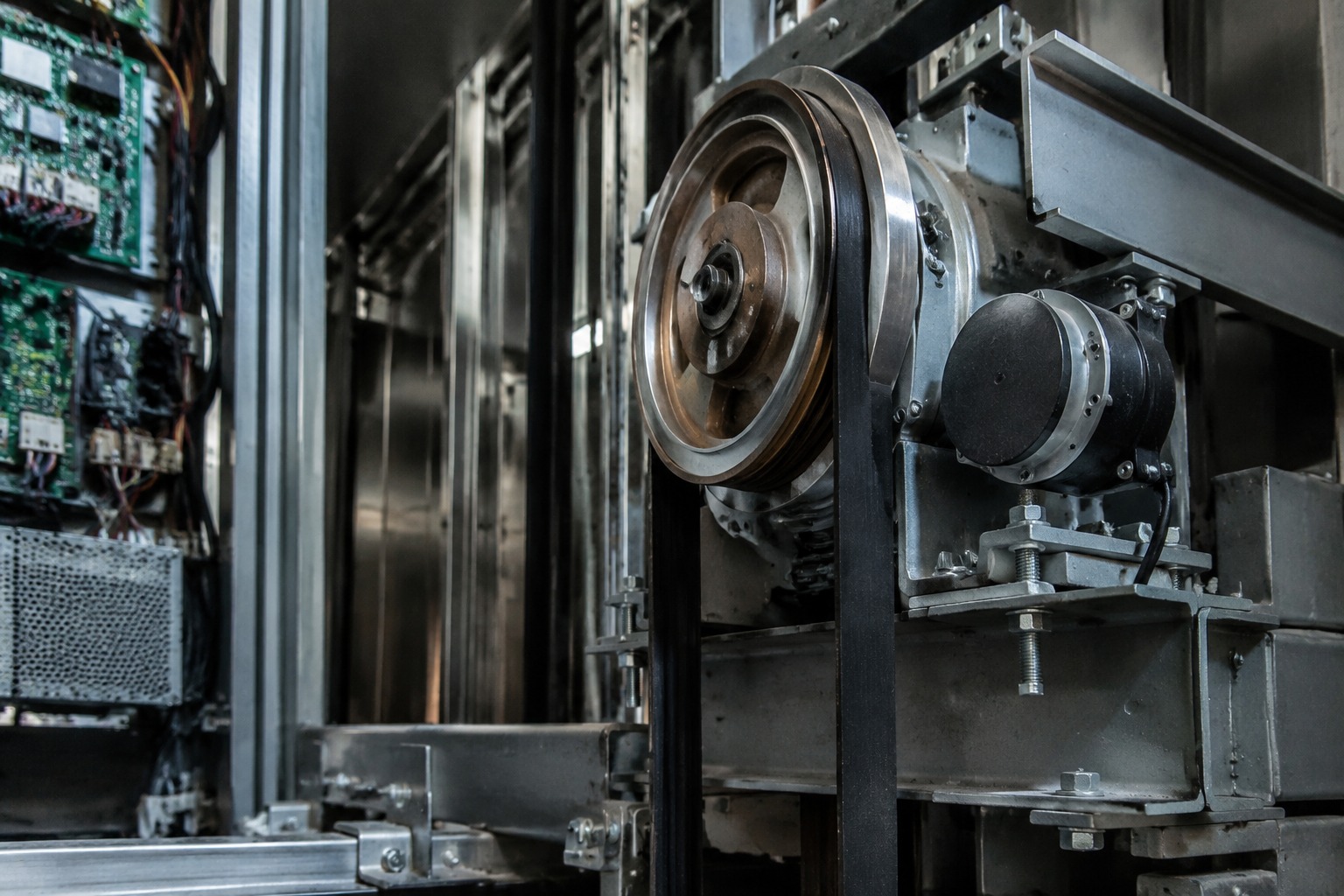
Encoder failure does not always appear as a complete breakdown on the first day. In many elevators, the early signs are intermittent. A technician may reset a fault and the unit returns to service temporarily, only to fail again under load, heat, or vibration. Recognizing these symptoms early helps prevent sudden downtime.
Common symptoms include rough takeoff, unstable travel speed, misleveling, random inverter alarms, direction detection faults, and loss of speed feedback during operation. In some cases, the elevator slows unexpectedly or refuses to run because the control system does not trust the signal. If the problem occurs only during certain times of day, temperature, cable flexing, and connector condition should also be checked.
Environmental conditions in the Philippines can worsen these issues. Coastal humidity in cities like Manila and Cebu can accelerate connector oxidation. Dust and heat in machine rooms may affect cable life. Buildings near industrial zones or logistics hubs may also expose equipment to vibration and airborne contaminants.
| Symptom | Likely Encoder-Related Cause | What the Technician May Observe | Priority Level |
|---|---|---|---|
| Rough acceleration | Irregular pulse output | Jerky start or unstable torque response | High |
| Misleveling at landing | Weak or noisy feedback signal | Car stops above or below floor level | High |
| Intermittent inverter fault | Signal dropout or damaged cable | Random trip, often resets temporarily | High |
| No run command completion | No pulse detected | Motor command present but system blocks movement | Critical |
| Wrong direction alarm | A/B channel mismatch | Controller reads reversed rotation logic | Critical |
| Speed hunting | Pulse instability or poor shielding | Noticeable speed fluctuation during travel | High |
| Issue after rain or humidity spike | Connector contamination | Fault appears in damp conditions | Medium to High |
The practical lesson from these symptoms is simple: do not assume every speed-related fault is caused by the inverter or controller. An encoder, a connector, a broken shield, or a damaged cable route can create the same complaint. Good troubleshooting starts with signal integrity, installation condition, and exact model matching.
How to Match Pulse Output and Shaft Type
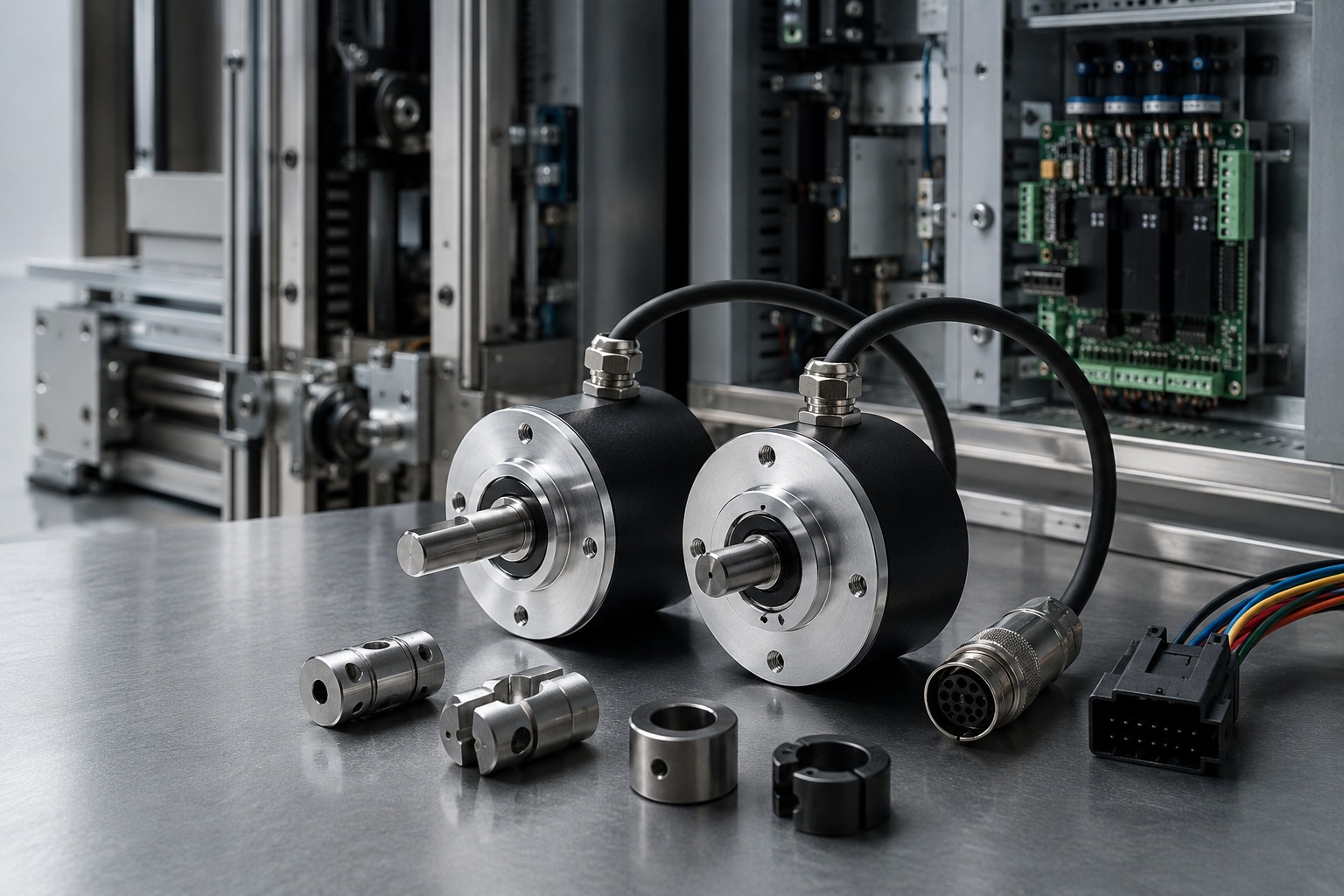
One of the most common mistakes in encoder replacement is matching only the brand or physical appearance while ignoring electrical and mechanical details. An elevator encoder must match the original specification closely enough for the system to read it correctly and mount it securely.
The first parameter to confirm is pulse output. Incremental encoders are commonly identified by pulses per revolution, often abbreviated as PPR. If the original system expects a certain pulse count and the replacement differs, the controller may calculate the wrong speed or distance-related behavior. This can affect ride quality, leveling, and fault logic.
The second parameter is signal format. The system may require A, B, and Z channels, differential output, line driver characteristics, or specific voltage levels. The connector pinout must also match, because an electrically similar encoder can still fail if the wiring order differs.
The third parameter is shaft type and mounting style. Hollow shaft, solid shaft, flange dimensions, coupling method, shaft diameter, and anti-rotation bracket all matter. An encoder that is electrically correct but mechanically loose or misaligned will not provide reliable long-term service.
| Matching Item | What to Verify | Why It Is Important | Risk If Incorrect |
|---|---|---|---|
| Pulse output | PPR or equivalent resolution | Needed for accurate speed calculation | Misleveling, unstable control |
| Signal channels | A, B, Z and output type | Controller must read direction and reference correctly | No run or direction fault |
| Supply voltage | Required input voltage range | Ensures proper encoder operation | Weak signal or damage |
| Connector and pinout | Plug type and wiring order | Prevents signal misconnection | Fault at startup |
| Shaft type | Hollow or solid shaft, diameter | Determines mechanical fit | Slippage or impossible installation |
| Mounting dimensions | Flange, bracket, bolt spacing | Supports stable alignment | Vibration and shortened life |
| Environmental rating | Heat, dust, vibration tolerance | Supports field durability | Premature repeat failure |
When customers in the Philippines request urgent support, we usually recommend collecting a clear nameplate photo, connector photo, shaft measurement, cable length, and old fault description before ordering. This approach reduces replacement risk, especially when the original encoder is already removed from a machine in a tower in Ortigas, Alabang, or Bacolod and the service window is limited.
Hitachi UAX Encoder Selection Notes
Hitachi elevator systems often require careful model identification, and UAX encoder selection should be handled with attention to part codes, mating dimensions, and electrical characteristics. Do not assume every UAX-marked unit is interchangeable across different machines or controller generations. Even within the same brand family, there can be differences in pulse specification, shaft interface, and connector arrangement.
For field replacement, technicians should confirm the exact model reference from the original label whenever possible. If the label is damaged, compare the housing style, shaft type, wiring count, and connector structure. In some cases, machine model data, controller documentation, or old maintenance records can help verify the correct selection.
For customers handling Hitachi-related repair jobs, the most efficient approach is to send complete identification data before dispatch. This is particularly helpful when the site is in a busy commercial area such as Makati CBD, where downtime penalties are high, or in regional projects where second delivery attempts can add delay.
| Hitachi UAX Checkpoint | What to Review | Reason | Field Benefit |
|---|---|---|---|
| Part code | Full model string on label | Primary identification reference | Improves selection accuracy |
| Pulse specification | Required output resolution | Must match controller expectations | Reduces speed feedback errors |
| Connector format | Pin count and orientation | Prevents miswiring during replacement | Faster installation |
| Shaft interface | Diameter, type, coupling method | Ensures mechanical compatibility | Stable operation |
| Mounting style | Bracket and flange dimensions | Avoids forced fitting | Lower vibration risk |
| System generation | Machine and controller family | Some encoder variants are system-specific | Better compatibility planning |
| Cable condition | Check old cable and shielding | Fault may not be in encoder only | Avoids repeat service call |
This is also where supplier technical capability becomes important. Our technical support process emphasizes model cross-checking, photo-based review, connector comparison, and practical feedback from elevator maintenance use cases. Instead of simply shipping by keyword, we work to reduce mismatch risk through detail confirmation, especially for branded components such as UAX encoder variants.
The bar chart shows that replacement demand is strongest in office towers, malls, and residential high-rises, where traffic cycles are frequent and service continuity matters. Hospitals also rank high because accurate leveling and dependable operation are essential for patient transport.
Installation Alignment and Cable Checks
Even a correct encoder can perform poorly if installation quality is weak. Replacement should include careful alignment, bracket stability review, coupling inspection, cable routing check, and connector cleaning. Many repeat failures are not caused by defective parts but by mechanical stress, cable bending, or shielding problems left unresolved during the previous repair.
Alignment matters because excessive radial or axial stress can damage the encoder bearing or cause unstable output. The mounting surface should be firm, and the shaft connection should not be forced. If the encoder uses a hollow shaft, the clamping method must be correct. If it uses a coupling, the coupling condition should also be verified.
Cable checks are equally important. Inspect for crushed sections, sharp bends, oil contamination, abrasion against metal edges, and loosened shielding. In machine rooms exposed to heat or moisture, damaged insulation can produce intermittent noise that resembles encoder failure. Connectors should be clean, firmly seated, and protected from unnecessary strain.
In our supply work, manufacturing capability is reflected in how encoder products are sourced, inspected, and packed before shipment. Stable incoming inspection, model traceability, connector and appearance review, and protective packaging all help reduce the chance of receiving a damaged or mismatched part. For urgent shipments to the Philippines, strong packaging is particularly important when goods move through air cargo channels in Manila or domestic transfers toward Cebu, Iloilo, or Davao.
| Installation Check Item | What to Inspect | Acceptable Condition | Problem If Ignored |
|---|---|---|---|
| Mounting bracket | Rigidity and bolt tightness | No looseness or distortion | Vibration, pulse instability |
| Shaft alignment | Coaxial fit and stress level | Smooth fit without forcing | Bearing wear, signal loss |
| Coupling condition | Wear, crack, slippage | Secure transmission of rotation | Incorrect speed reading |
| Cable routing | Bends, abrasion, interference | Protected and supported route | Intermittent faults |
| Shield grounding | Proper termination | Reduced electrical noise | Feedback noise issues |
| Connector seating | Pin condition and lock | Firm connection with clean contacts | Signal dropout |
| Environmental exposure | Heat, moisture, dust | Controlled as much as possible | Shortened service life |
The best replacement result comes from treating encoder work as both an electrical and a mechanical task. A quick changeout without alignment and cable review may restore the lift temporarily but leaves the root cause unresolved.
Testing Speed Feedback After Replacement
Once the new encoder is installed, the job is not complete until speed feedback is verified. The goal is to confirm that the controller sees a stable, correct, and directionally consistent signal across start, travel, deceleration, and leveling.
A practical test sequence usually includes:
- Power-off recheck of mounting, connector seating, and pinout.
- Low-speed or inspection run to confirm basic motion feedback.
- Direction verification to ensure A/B phase interpretation is correct.
- Observation of acceleration and deceleration smoothness.
- Landing leveling check at multiple floors.
- Repeated runs under normal traffic simulation.
- Review of fault history for new or recurring speed-related alarms.
If the system allows diagnostic monitoring, compare commanded speed and actual feedback value. Large deviations, erratic traces, or sudden dropouts indicate a continuing problem. In some cases, the encoder is correct but the cable or shield path introduces noise under load. That is why repeated travel testing matters.
Service capability also matters here. We support customers with responsive coordination for model confirmation, replacement planning, and post-installation review based on field feedback. For maintenance contractors handling urgent callbacks in cities such as Manila, Cebu, or Davao, timely communication can shorten the gap between part arrival and successful return to service.
The area chart shows a clear market shift from purely reactive repairs toward more planned replacement and spare holding. By 2026, many Philippine elevator service teams are expected to adopt preventative encoder strategies, especially for older traction systems in high-rise properties.
Stocking Encoders for Urgent Repair
Encoders are often treated as order-only items until a breakdown happens. That approach can be costly. For critical sites, keeping selected encoder models in stock is often more economical than waiting for an urgent shipment after the elevator is already down.
Not every building needs a large spare inventory. The smarter approach is to stock according to installed base, traffic criticality, and historical failure risk. High-use commercial towers, hospitals, transport-linked properties, and hotels usually benefit most from priority stocking. If a contractor maintains multiple elevators with the same machine family, one or two carefully selected spares can prevent major service disruption.
In the Philippines, stocking decisions should also consider geography and logistics. A part stored in Metro Manila may reach nearby projects quickly, but remote delivery to Visayas or Mindanao can still take valuable time. Contractors serving multiple regions often maintain a core stock in Luzon and a smaller field reserve in Cebu or Davao for faster response.
| Site Type | Traffic Level | Recommended Stock Strategy | Reason |
|---|---|---|---|
| Grade A office tower | Very high | Keep priority encoder spare available | Downtime affects tenants and operations |
| Hospital | High | Maintain immediate replacement stock | Operational continuity is critical |
| Hotel | Medium to high | Stock common machine-specific encoder | Service interruption impacts guests |
| Large residential condominium | High at peak hours | Shared spare by building cluster | Reduces passenger complaints and queueing |
| Shopping mall | Very high | On-hand spare for key units | Heavy daily cycle increases urgency |
| Industrial facility | Variable | Stock based on process criticality | Some units affect operations directly |
| Provincial mixed-use building | Moderate | Regional stock or supplier quick-ship plan | Delivery lead time may be longer |
Beyond stocking itself, supplier comparison should include model coverage, quality consistency, response speed, and packing reliability. A lower unit price does not help if the part arrives late, poorly protected, or incorrectly matched.
The comparison chart highlights the factors buyers should review when choosing a supply partner for elevator encoders. In urgent repair situations, consistent model matching and fast response are often more valuable than choosing solely by initial price.
FAQ About Elevator Encoders
1. Can an elevator run with a partly damaged encoder?
Sometimes it may run intermittently, but operation is unreliable and can produce faults, poor leveling, or unsafe ride behavior. Replacement and full verification are recommended.
2. Is the encoder the same as the floor position sensor?
No. The encoder mainly provides rotational speed and direction feedback related to the machine. Floor position systems may use separate sensors, magnets, or positioning devices.
3. Can I replace an encoder with any unit that has the same size?
No. Mechanical size is only one factor. Pulse output, voltage, connector, pinout, signal type, and shaft details must also match.
4. Why does the elevator still fault after encoder replacement?
Possible causes include cable damage, connector oxidation, wrong pinout, poor grounding, coupling slip, controller parameter mismatch, or another issue in the feedback circuit.
5. What information should be sent before buying?
Provide the encoder label photo, machine or elevator brand, shaft type, connector photo, cable details, mounting dimensions, and any fault code or symptom description.
6. Are Hitachi UAX encoders always interchangeable?
No. UAX-related parts should be checked carefully by exact code and configuration, because similar housings may still differ electrically or mechanically.
7. How soon should a replacement be tested?
Immediately after installation. Perform low-speed checks, direction verification, full-speed runs, and leveling observation before closing the job.
8. Is it worth keeping spare encoders in stock?
For high-traffic sites and maintenance contractors with repeated machine families, yes. Spare stock can significantly reduce downtime and passenger disruption.
9. What are the 2026 trends for elevator encoders?
The market is moving toward better predictive maintenance, stronger spare planning, improved compatibility documentation, and sustainability-focused repair strategies. More building operators are expected to favor replacing only the failed component rather than larger assemblies when technically appropriate, reducing waste and controlling lifecycle cost.
10. Are policy and sustainability factors relevant in the Philippines?
Yes. By 2026, property managers are likely to pay more attention to maintenance documentation, energy-efficient system performance, and component-level repairs that extend equipment life. In modernization planning, accurate speed feedback also supports smoother control behavior and can contribute to better ride efficiency.
Buying Advice for Elevator Owners and Maintenance Teams
For buyers in the Philippines, the most effective encoder purchasing process is to combine exact identification, technical verification, and realistic logistics planning. Start with the original part data. Confirm pulse output, shaft type, connector, and mounting details. Review whether the failure is definitely inside the encoder or if the cable path also needs repair. Then choose a supplier that can support cross-checking rather than simply offering a visually similar item.
Consider the full operating context of the building. A luxury condominium in Bonifacio Global City, a hospital in Cebu, and a logistics-linked office facility near the Port of Manila do not all carry the same downtime risk. The more critical the elevator service is, the more valuable it becomes to work with a supplier capable of stable sourcing, careful pre-shipment inspection, and fast coordination.
It is also wise to look ahead to 2026 trends. Elevator maintenance is becoming more data-based, and building operators increasingly expect shorter downtimes and better lifecycle planning. That means replacement parts such as encoders should not be treated as generic commodities. They are precision components within a closed-loop traction control system, and the buying process should reflect that reality.
In summary, a good elevator encoder replacement supports safe traction control, smoother leveling, fewer callbacks, and more reliable service continuity. Whether you are sourcing a Hitachi UAX-related model or another traction encoder for a modernization or urgent repair project in the Philippines, careful matching and proper installation are the keys to success.