
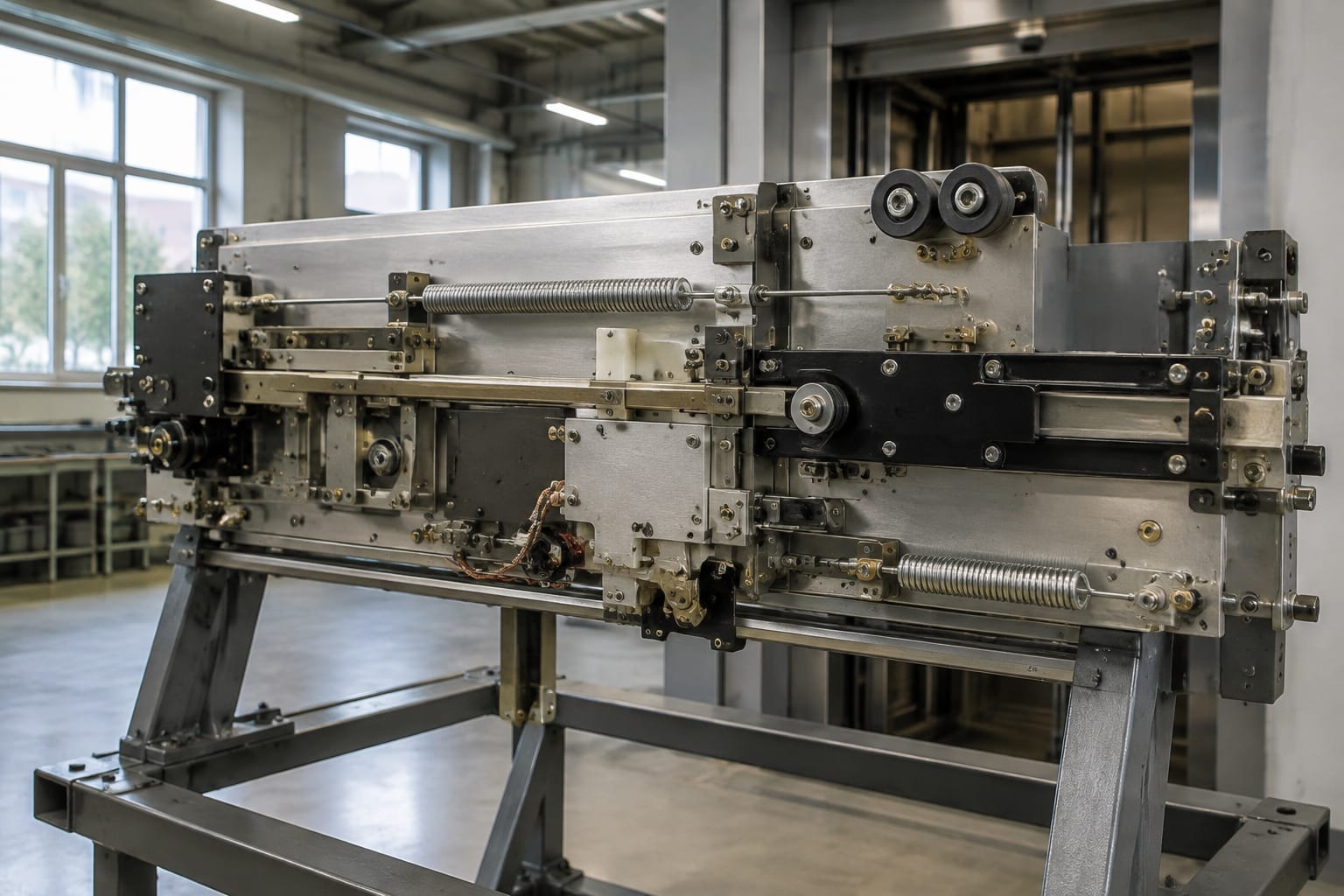
An “elevator door stopper” is not always one named part. In door equipment, buyers often use the term for any component that cushions the door at its end position, restricts its travel, or helps it stop without a hard impact. Depending on the door operator and landing-door arrangement, this may be a buffer, stopper bracket, spring, rubber bumper, roller, or a limit-setting mechanism.
For maintenance and sourcing work, identify the failed component by its function and exact position before ordering. A door that bangs, rebounds, fails to close fully, or stops short can have a stopper-related issue, but poor adjustment, worn hangers, track contamination, or an electrical door-zone issue can produce similar symptoms.
What buyers mean by elevator door stopper
In practical Philippine elevator maintenance work, “door stopper” commonly refers to the part that prevents excessive movement at the fully open or fully closed end of travel. It may absorb impact, establish a repeatable final position, or work with the operator settings to slow the door before it reaches the end.
The term can refer to different parts on different equipment:
| Part commonly called a stopper | Main function | Typical location | Important buying checks |
|---|---|---|---|
| Rubber bumper or buffer | Cushions impact at the end of travel | Door operator or landing-door assembly | Diameter, thickness, stud/thread size, rubber condition |
| Stopper bracket or block | Physically limits travel | Operator frame, track, or door panel assembly | Hole centres, profile, handedness, mounting face |
| Compression or tension spring | Absorbs force or returns a mechanism | Operator linkage, clutch, vane, or door assembly | Free length, outside diameter, wire diameter, end type |
| Mechanical limit cam or actuator | Triggers a limit switch near end travel | Door operator mechanism | Cam profile, mounting position, switch compatibility |
| Door-closing spring | Assists door return or mechanism movement | Landing-door lock or related assembly | Length, coil dimensions, hook/end configuration |
| Door knife spring | Maintains proper action in the coupling assembly | Specific door-operator arrangements | Exact dimensions and equipment compatibility |
A stopper is therefore not interchangeable simply because it looks similar. A buffer that fits physically but has the wrong thickness can alter the closed-door position. A spring with the wrong rate may overload a linkage or produce weak, inconsistent operation.
Springs, buffers, and travel limits
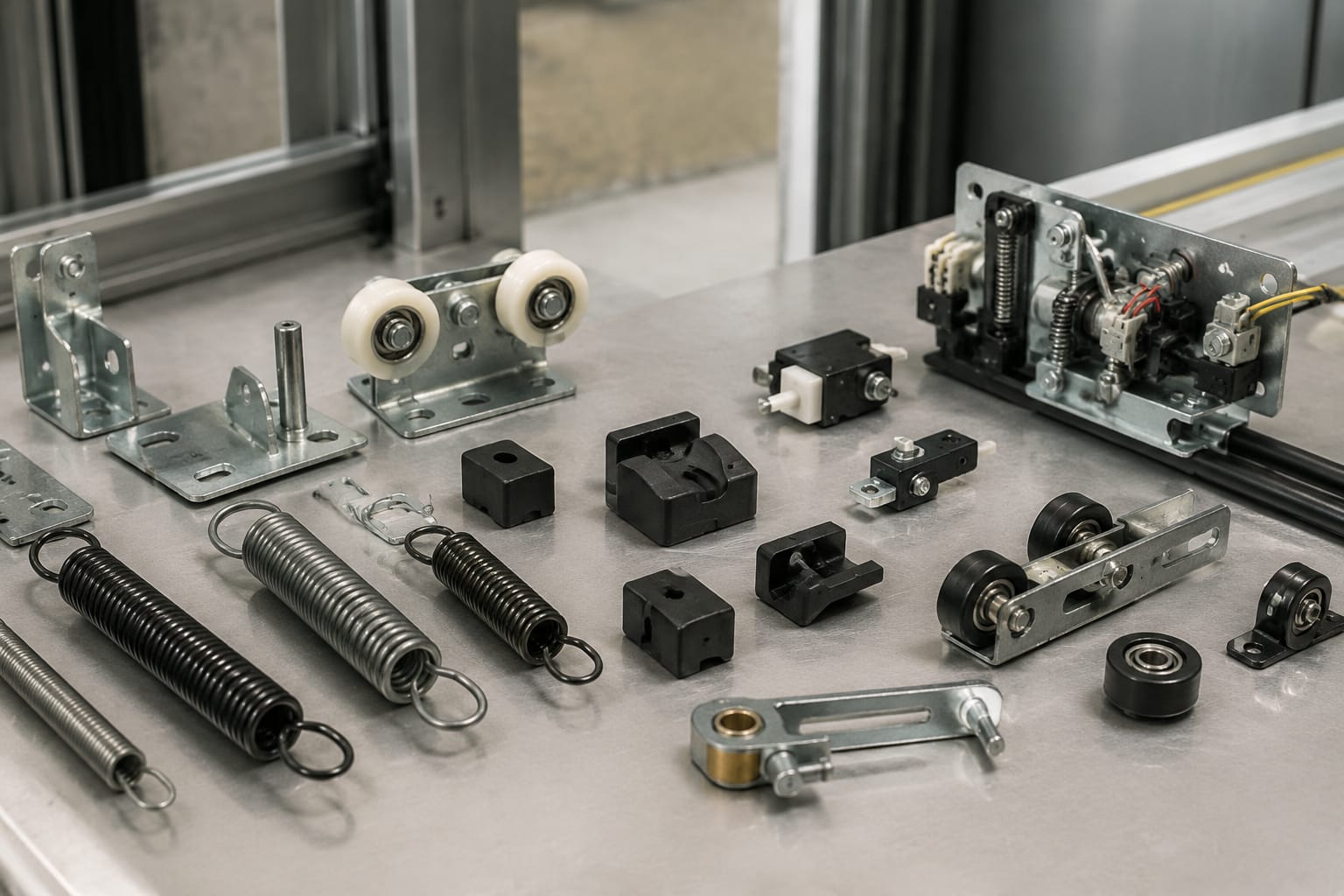
A controlled door stop usually depends on more than one item. The door operator slows the moving panels, a mechanical limit establishes the permitted travel, and a buffer or spring reduces residual impact. The correct arrangement varies by manufacturer, door type, and whether the component is on the car door or the landing door.
Springs that influence door stopping
Springs can act directly as a cushioning device or indirectly through a linkage. Their purpose may be to maintain pressure, return a lever, assist closing, or absorb motion at the end of travel.
When evaluating a spring, record:
- Free length, measured with no load applied
- Outside diameter and, where needed, inside diameter
- Wire diameter
- Number of active coils
- End design: plain, closed, ground, hook, loop, or shaped end
- Direction of winding when relevant
- Mounting points and installed length
- Signs of corrosion, stretched coils, rubbing, or distortion
A spring that has permanently elongated, developed uneven coil spacing, or rubbed against an adjacent component should generally be replaced rather than stretched or reshaped in the field. Reworking it does not reliably restore its intended force.
For door and lift accessory sourcing, compare the actual sample with the supplier’s dimensional drawing or stated specification. For example, door springs for lift accessories should be matched by dimensions, ends, and application rather than by a general product name alone.
Buffers and rubber bumpers
Rubber buffers are common where moving hardware needs a final cushion. They can harden with age, split, flatten, detach from their mounting stud, or become oil-contaminated. In a humid environment, surface cracking and corrosion at the fixing point are practical inspection concerns.
Replace a bumper when it is:
- Cracked, torn, loose, or missing
- Flattened enough to change the end position
- Hardened and no longer providing a resilient stop
- Swollen by oil, grease, or chemical exposure
- Misaligned so the moving part strikes its edge
- Fitted with a damaged stud, thread, washer, or mounting plate
Do not compensate for a collapsed rubber bumper by increasing motor force or altering a travel setting. The underlying impact will remain, and the altered setting can create a separate closing or reopening problem.
Travel limits and stop positions
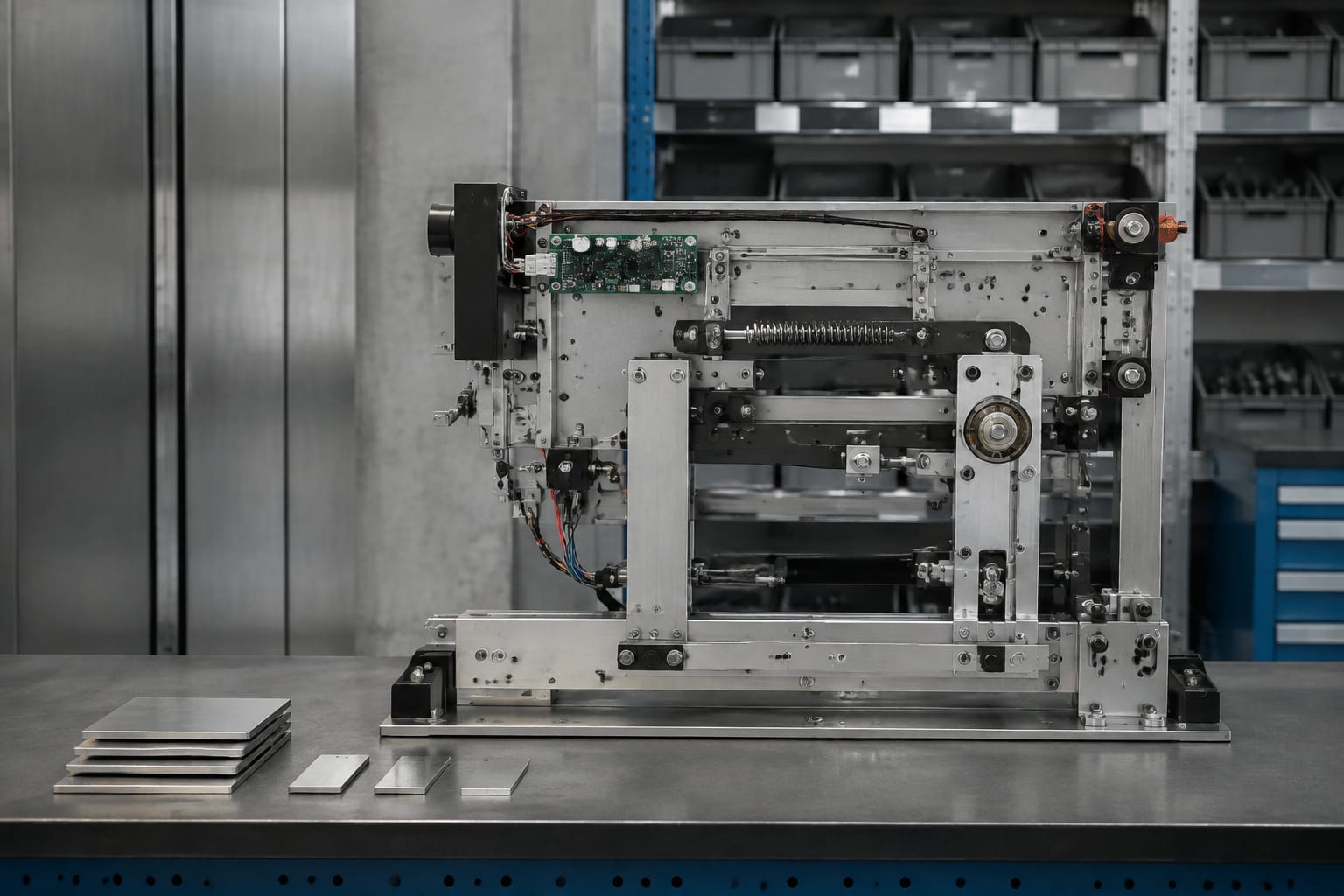
Mechanical stops and limit cams should be inspected together. A physical stop may prevent overtravel, while an electrical limit or encoder setting signals the operator to decelerate or stop. If these positions no longer agree, the door may hit the stop at excessive speed, reverse unexpectedly, or fail to reach a fully closed position.
Before changing any travel setting, establish which component is intended to determine the final position. This information should come from the equipment documentation or an established maintenance procedure for that door operator. Do not assume the same sequence applies across brands or generations of equipment.
Related rollers and hanging components
Not every door-stopping complaint is caused by the stopper itself. Door rollers, hangers, tracks, gibs, and panel fixings determine how smoothly the panel approaches its final position. Wear in these components often transfers extra force to the buffer or makes a correctly adjusted stop appear faulty.
Hanger rollers and tracks
Hanger rollers support and guide the door panels along the track. Worn bearings, flat spots, incorrect roller adjustment, damaged track surfaces, or loose hanger hardware can create a dragging or jerking motion. The operator then has to work harder, and the panel may strike the stop unevenly.
Inspect for:
- Roller tread wear, flat spots, cracks, or excessive side play
- Rough, noisy, or seized bearings
- Track dirt, burrs, dents, corrosion, and loose fixings
- Uneven contact between rollers and track
- Loose hanger bolts or shifted panel position
- Scraping marks that indicate a panel is rubbing
Clean only with materials and methods compatible with the manufacturer’s requirements. Excess lubricant can collect dust and produce another drag point. Do not grind or reshape a track without confirming that it is an approved repair for the equipment.
Bottom gibs and sill engagement
Bottom guides, commonly called gibs, keep the panel aligned at the sill. A worn, broken, or incorrectly sized gib can allow the door to move sideways. This can cause the panel to meet a stopper at an angle, rub in the sill, or make the closing gap inconsistent.
Check the sill groove for debris, damaged inserts, and signs of repeated contact. Also check that the gib remains properly engaged throughout opening and closing travel. A door panel that is stable when open may still shift when it approaches its closed position.
Door clutch, knife, and coupling items
On applicable systems, the car-door clutch or knife engages the landing door to open and close it. Springs in this area affect how the mechanism returns and maintains engagement. A weak or damaged knife spring may be mistaken for a generic door stopper fault when the real issue is inconsistent coupling action.
Where the original sample and application match, a 119 x 17 mm Mitsubishi elevator door knife spring is an example of a component that must be identified by exact dimensions and compatible mechanism. Its name alone is not enough to establish interchangeability with another Mitsubishi arrangement or another door operator.
Symptoms of poor stopping or closing
Observe the complete door cycle before removing parts. The moment and direction of the fault help narrow down whether the problem is related to the final stop, door motion, coupling, or door protection system.
| Symptom | Likely mechanical causes | Other checks before ordering parts |
|---|---|---|
| Loud bang at full open or closed | Missing/hardened buffer, stop out of position, excessive operator speed | Deceleration and travel settings, loose panel hardware |
| Door rebounds after reaching its stop | Stop impact too hard, misaligned bumper, excessive force, loose linkage | Door protection response, encoder/limit input |
| Door stops short of full open | Obstruction, roller drag, damaged track, premature limit position | Operator fault codes, drive settings |
| Door does not close fully | Worn gibs, misaligned panels, stopper position, dragging roller | Light curtain or safety edge, landing-door lock engagement |
| Uneven closing gap | Hanger adjustment, panel shift, worn rollers/gibs | Sill condition, fixing screws, door coupling |
| Rubbing or scraping near the end of travel | Misaligned panel, worn gib, damaged sill or track | Foreign material and cover interference |
| Repeated door reopen | Mechanical resistance can trigger protection response | Light curtain, safety edge, closing force, control signals |
| Different behaviour at one landing | Local landing-door roller, lock, sill, or stopper issue | Car-door operation at other floors |
A door fault can have more than one cause. For example, a hardened bumper may create an impact, while worn rollers cause the panel to arrive at that bumper out of alignment. Replacing only the bumper may reduce noise without correcting the mechanical wear.
Inspect alignment and mechanical wear
Carry out inspection under the site’s approved isolation, access, and safety procedures. Door mechanisms contain moving parts, stored spring energy, and pinch points. Door safety circuits and interlocks must never be bypassed merely to make diagnosis faster.
A practical mechanical inspection sequence is:
- Confirm the reported behaviour and note whether it occurs on opening, closing, or both.
- Compare the affected landing or side with a similar, properly operating location when possible.
- Inspect the stopper, buffer, bracket, and fasteners for damage, movement, and witness marks.
- Check door panel alignment, hanger security, roller condition, and track cleanliness.
- Inspect bottom gibs and sill grooves for wear, foreign material, and side movement.
- Examine springs for breakage, distortion, corrosion, and incorrect attachment.
- Check the coupling mechanism and door lock interaction where applicable.
- Review operator settings only after the mechanical condition is understood.
Witness marks are especially useful. Fresh metal marks, polished contact points, rubber transfer, or asymmetric wear can show where the moving part is striking. Take clear photographs before removing an item, including the component’s mounting direction and nearby reference points.
A common mistake is to adjust a stopper until the noise disappears without checking why the panel is arriving too quickly or at an angle. This may shift the symptom to another stage of travel, increase stress on the operator, or leave inadequate clearance at the closed position.
Measure the original component
For spare parts procurement, an intact sample is the most dependable starting point. When the original part is unavailable or severely damaged, measurements must be supported by photographs, mounting details, and door-operator information.
Record these details in a purchasing enquiry:
- Lift or door-operator manufacturer, model, and available part number
- Whether the part is from the car door, landing door, or operator assembly
- Quantity required and whether parts are required per door, per car, or per site
- Overall dimensions in millimetres
- Mounting-hole diameter and centre-to-centre spacing
- Thread size, stud length, washer arrangement, and fastener type
- Material: rubber, steel, nylon, polyurethane, or another material
- Spring wire diameter, coil diameter, free length, active coils, and end shape
- Left-hand or right-hand orientation for handed brackets and levers
- Clear photographs from front, side, rear, and installed positions
- Markings, stamped codes, or labels on the original part
Use callipers for diameters and hole dimensions where accuracy matters. A tape measure is useful for overall length but is less reliable for a small spring wire diameter or a mounting hole. Measure at least twice and state whether a measurement is approximate.
For a hall-door spring, a relevant option may be a 600 mm hall-door spring accessory, but the 600 mm length by itself does not establish a correct match. Confirm the end configuration, coil properties, fitting method, and the exact equipment application.
Adjustment versus replacement
Adjustment is appropriate only when the component is sound, the original setting has moved, and the equipment procedure permits adjustment. Replacement is the better choice when a part is degraded, structurally damaged, dimensionally altered, or no longer retains its intended function.
| Condition found | Adjustment may be suitable | Replacement is normally indicated |
|---|---|---|
| Stopper bracket position | Yes, if secure and within documented adjustment range | If bent, cracked, stripped, or repeatedly shifting |
| Rubber buffer | No meaningful adjustment beyond correct mounting | If hard, split, flattened, loose, or contaminated |
| Spring | Only reattachment or documented tension setting | If broken, stretched, corroded, distorted, or rubbing |
| Hanger roller | Limited alignment adjustment where specified | If worn, noisy, flat-spotted, cracked, or loose |
| Bottom gib | Alignment check may be possible | If worn, broken, undersized, or unable to guide the panel |
| Limit cam | Yes, following manufacturer procedure | If damaged, loose, or unable to hold adjustment |
Do not use makeshift packing, extra washers, tape, welded patches, or non-rated rubber pieces as a permanent door-stop repair. These may change the travel position or degrade quickly, making future servicing more difficult.
Likewise, do not replace a spring based only on free length. Two springs of equal length can produce very different force because of their wire diameter, coil diameter, material, and active coil count. For a stopper assembly, incorrect force can result in excessive impact, weak return action, or unreliable coupling.
Final door-motion and safety tests
After repair or adjustment, test the complete operating cycle rather than only the original symptom. A door that closes quietly but does not achieve correct panel alignment or locking is not a completed repair.
The final checks should follow the applicable manufacturer procedure and site requirements. In general, verify:
- Smooth opening and closing without scraping, binding, or abnormal impact
- Correct full-open and fully closed positions
- Consistent panel alignment and sill engagement
- No contact between moving parts and guards, covers, or cables
- Correct landing-door coupling and lock engagement where applicable
- Proper response of the door protective device
- No unexpected reopening, reversal, or stopping
- Secure fasteners, clips, retainers, and spring attachment points
- Repeatable operation over several cycles
- No abnormal noise, heat, or signs of component movement after testing
Where a door operator has programmable settings, record the final authorised settings and repair details in the maintenance record. This helps later technicians distinguish an approved adjustment from a gradual mechanical change.
FAQ
Is an elevator door stopper the same as a door buffer?
Sometimes. A buffer is often the cushioning element at the end of travel, while the stopper may be the bracket, block, or mechanism that physically defines the stop position. In supplier enquiries, describe the part’s location and function instead of relying on one general name.
Why does an elevator door bang only at one floor?
A fault limited to one landing often points to local landing-door hardware, such as a worn roller, damaged sill guide, shifted stopper, or door-lock-related resistance. Compare that landing with another floor that operates normally before changing car-door settings.
Can a worn rubber stopper cause the door to reopen?
It can contribute indirectly. A hard or misplaced stopper can create excessive impact or resistance, which may cause the operator or protection system to react. The door protection device, closing force, roller condition, and operator feedback should also be checked.
Can technicians stretch a door spring back into shape?
No. A spring that has stretched or distorted has likely lost its intended operating characteristics. Replacement with a correctly matched component is more dependable than reshaping it.
What should a buyer send when ordering an unknown elevator door stopper?
Send the original sample if feasible, plus accurate dimensions, equipment details, part markings, installation photos, mounting-hole information, and the quantity required. This gives a supplier enough information to assess compatibility rather than guessing from a broad description.
For multi-brand spare-part sourcing, Kelevator supplies elevator parts to B2B importers, distributors, maintenance contractors, modernization companies, and OEM buyers. Start with the original component’s dimensions and installed photos, then confirm the proposed replacement against the door operator, mounting arrangement, and required function before purchase.
Related product references
For practical catalog examples related to this topic, review [600mm hall door spring lift accessories elevator spare parts](/products/600mm-hall-door-spring-lift-accessories-elevator-spare-parts/), [Door spring lift accessories elevator spare parts](/products/door-spring-lift-accessories-elevator-spare-parts/), and [Elevator door knife spring 119x17mm Mitsubishi elevator parts lift accessories](/products/elevator-door-knife-spring-119x17mm-mitsubishi-elevator-parts-lift-accessories/). Confirm the exact model, dimensions, ratings, and connectors before ordering.