
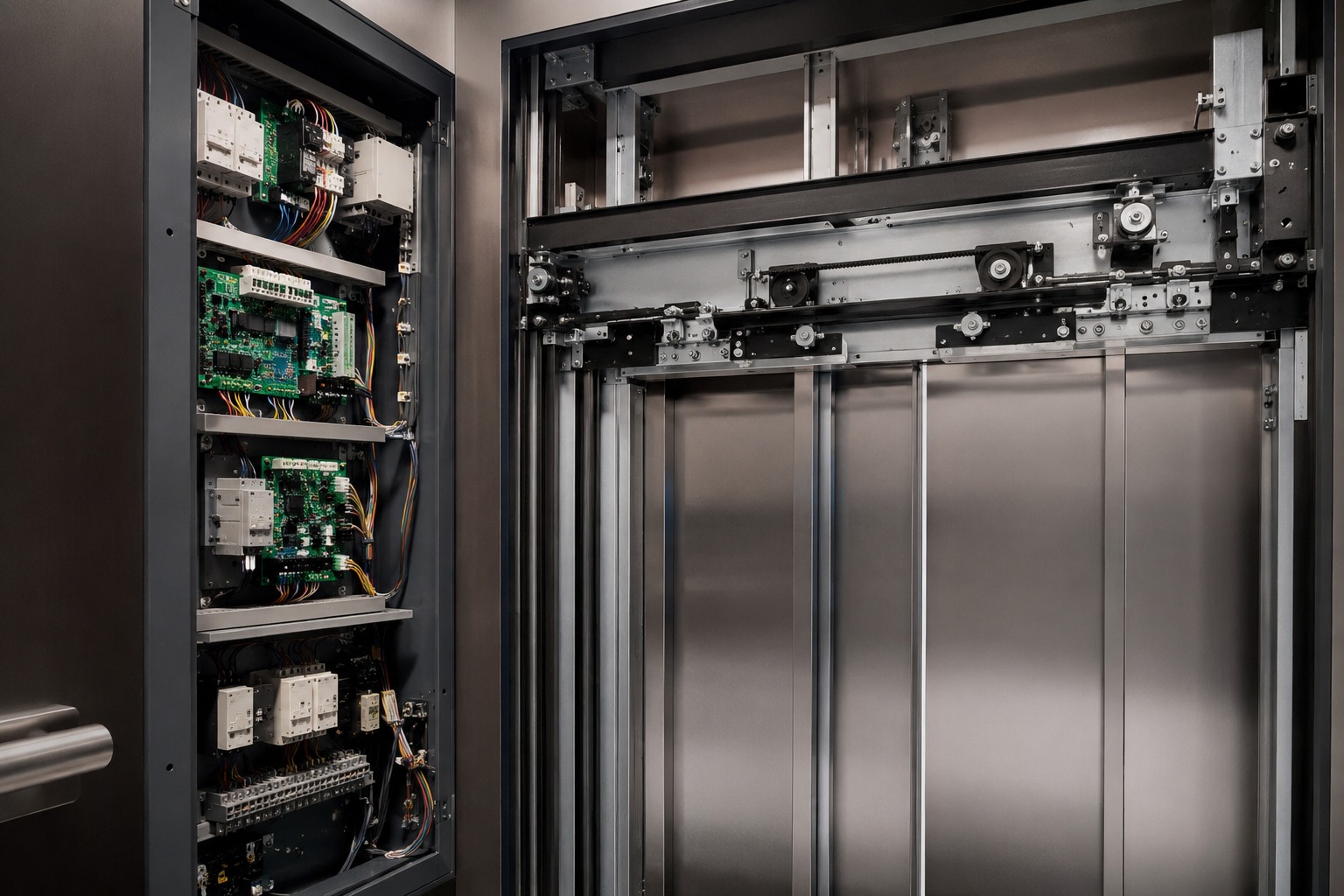
Elevator door problems are among the most common causes of lift downtime in residential towers, offices, hospitals, hotels, and mixed-use buildings across the Philippines. In cities such as Metro Manila, Cebu, Davao, Makati, Quezon City, Pasig, and Taguig, frequent traffic cycles, humidity, dust, and uneven maintenance standards can place extra stress on door systems. The door control panel plays a central role in keeping the operator, motor, sensors, and safety devices working together smoothly. When this board fails or drifts out of adjustment, symptoms can include slow opening, hard closing, repeated reopening, door lock faults, nudging issues, and intermittent service interruptions.
In simple terms, the elevator door control panel is the electronic coordinator of the door operator. It receives commands from the main lift controller, processes inputs from door sensors and lock circuits, and drives the motor using defined speed, torque, and timing parameters. For maintenance companies and modernization contractors in the Philippines, understanding the panel’s function is essential for safe troubleshooting and correct replacement work.
This guide explains what elevator door control panels do, important Toshiba replacement notes, how to set speed and torque, how to check light curtain and lock signals, a practical fault diagnosis workflow, commissioning steps after replacement, maintenance tips, and frequently asked questions. It also includes buying advice for local sourcing, application examples, market observations, and 2026 trends in lift door electronics.
For buyers looking for matched replacement parts, a Toshiba elevator door control panel should always be selected by exact model, software version, connector layout, and operator compatibility rather than appearance alone. Door systems can vary significantly even within the same brand family.
How Elevator Door Control Panels Work
An elevator door control panel manages the movement of the car door and, in some systems, coordinates with the landing door through the mechanical coupling and lock chain. Its main tasks include receiving open and close commands, controlling motor rotation, monitoring encoder or position feedback, checking safety inputs, and adjusting performance based on programmed parameters.
In a modern door operator, the panel typically communicates with several key components:
| Function | What It Does | Typical Input | Typical Output | Common Fault If Failed | Field Note |
|---|---|---|---|---|---|
| Command processing | Receives open, close, nudging, and hold commands | Main controller signals | Motor start or stop logic | No response to hall or car command | Check terminal voltage and command logic level |
| Motor drive control | Adjusts speed, direction, acceleration, and deceleration | Parameter set and feedback | Drive current to door motor | Jerky motion or no movement | Verify motor type and wiring match |
| Position feedback | Tracks door opening width and motion status | Encoder or sensor input | Precise motion control | Overtravel, hunting, incomplete closing | Encoder pulse loss is often intermittent |
| Safety monitoring | Checks light curtain, door lock, and obstruction signals | Safety devices | Reopen, stop, or alarm | Door reopens repeatedly | Inspect both device and signal wiring |
| Torque management | Limits force during closing and obstruction events | Load or current feedback | Safe door pressure behavior | Hard slam or weak closing | Overly high torque can mask mechanical defects |
| Fault reporting | Stores or displays alarm codes | Internal diagnostics | Error code or relay status | Intermittent shutdown without clear cause | Record code before power cycling |
The table above shows that the panel is not just a simple relay board. It is a logic and motion-control device. When a technician replaces it without checking motor type, sensor polarity, parameter set, and safety input state, the new board may power up but still fail to operate correctly.
In high-traffic sites such as shopping malls near SM districts, office towers in BGC, logistics hubs in Cavite, and hospitals in Metro Cebu, door cycles can be extremely high. Door panels in these buildings need stable electronics, clean feedback signals, and properly adjusted mechanical components. Even the best control board cannot compensate for worn rollers, bent tracks, contaminated sill grooves, or a misaligned lock assembly.
Toshiba Door Control Panel Replacement Notes
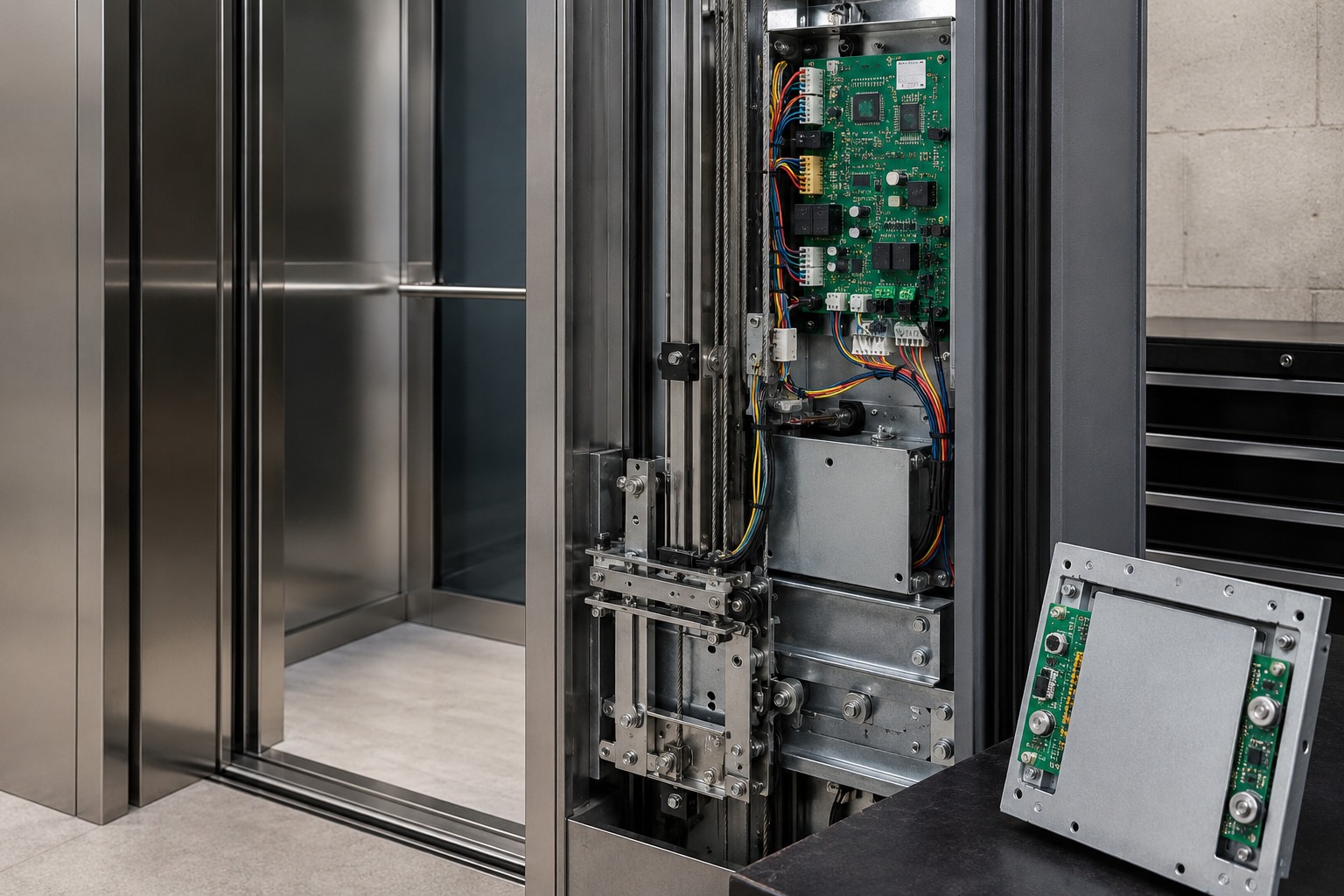
Toshiba elevator systems are widely used in commercial and residential buildings in the Philippines, and replacement work requires careful model matching. A Toshiba door control panel may differ by operator generation, firmware, connector pinout, motor rating, and the expected input type from the light curtain or lock circuit. For this reason, maintenance teams should avoid assuming that two visually similar boards are interchangeable.
Before replacement, verify the following information from the original unit: board model number, door operator model, motor nameplate, encoder specification, software label, parameter backup, connector position, and fault history. If the old panel is still readable, photograph every terminal and plug before removal. This reduces commissioning time and prevents costly rewiring errors.
| Checklist Item | Why It Matters | What to Record | Risk If Ignored | Recommended Action | Priority |
|---|---|---|---|---|---|
| Board model and revision | Different revisions may use different logic | Full label photo | Wrong board replacement | Match exact code before order | High |
| Motor specification | Voltage and power must match drive output | Nameplate data | Motor overheating or no motion | Cross-check with supplier | High |
| Encoder or sensor type | Feedback format affects motion control | Pulse rating and wiring | Unstable opening width | Confirm compatibility | High |
| Terminal mapping | Prevents plug mismatch | Photos and notes | Input or output damage | Label every connector | High |
| Parameter values | Speed and torque depend on setup | All menu settings | Poor door performance | Back up before shutdown | Medium |
| Fault history | Helps distinguish board fault from system fault | Error codes and symptoms | Repeat failure after replacement | Review with technician team | Medium |
The checklist above is especially useful for service teams working on older buildings in Manila, Pasay, Mandaluyong, or provincial city centers where original documentation may be incomplete. If the panel failed after a power event, flood exposure, or moisture ingress, inspect the surrounding enclosure as well. A new board installed into a damp or contaminated environment may fail again.
When a matched motor is also required, selecting the correct permanent magnet synchronous door motor or equivalent door operator motor should be based on electrical specification, shaft dimensions, mounting style, and control compatibility. Brand references help, but exact application data matters more than generic part names.
From a sourcing perspective, our technical capability is built around careful model matching rather than broad assumptions. For maintenance companies that manage multiple sites, we help compare board codes, connector details, and door operator data so replacements are selected accurately. This is particularly valuable for mixed portfolios where one contractor may handle Toshiba, Hitachi, KONE, Mitsubishi, and other lift systems in different properties.
Door Speed and Torque Settings
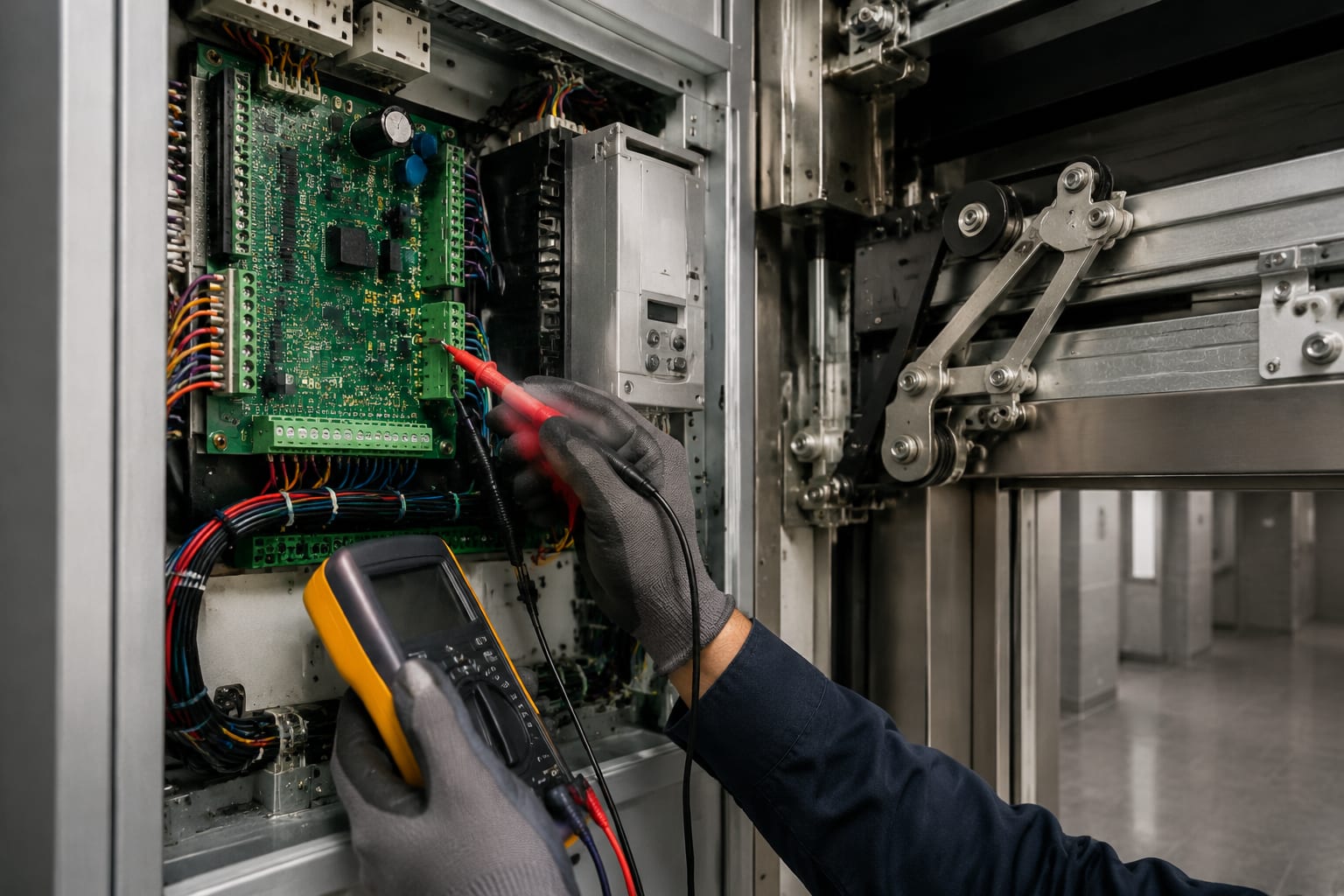
Door speed and torque settings have a major effect on ride experience, safety performance, and component life. In busy buildings, owners often request faster opening and closing to improve passenger flow. However, aggressive settings can lead to hard impacts, premature wear, nuisance reversals, and lock engagement problems. Good adjustment balances smooth operation, acceptable cycle time, and safe obstruction response.
Most door control panels allow parameter adjustment for opening speed, closing speed, acceleration, deceleration, creep speed, close torque, nudging torque, dwell time, and obstruction sensitivity. These settings should be adjusted only after confirming that the mechanical side is in good condition. A dragging track or worn hanger roller can make a technician increase torque unnecessarily, which hides the root cause and stresses the system.
| Setting | Purpose | If Too Low | If Too High | Operational Impact | Tuning Advice |
|---|---|---|---|---|---|
| Opening speed | Controls time to fully open | Slow passenger flow | Shock at end of travel | Queue delay in peak hours | Increase gradually and observe deceleration |
| Closing speed | Controls return to closed position | Long waiting time | Unsafe or abrupt closing feel | Passenger complaints | Coordinate with light curtain response |
| Opening torque | Provides force to start opening | Stall at start | Excessive strain on linkage | Inconsistent opening | Check rollers before increasing |
| Closing torque | Ensures positive closing action | Door remains slightly open | Hard closing pressure | Door lock may not engage correctly | Set to minimum stable value |
| Creep speed | Final alignment before lock | Door may stop short | Lock impact or bounce | Repeated lock faults | Fine-tune during final 10% travel |
| Nudging force | Allows controlled close after prolonged obstruction | Fails to recover service | Passenger discomfort and complaints | Safety and accessibility concerns | Follow site safety requirements |
The table shows that no setting should be changed in isolation. For example, increasing closing speed without adjusting deceleration may create a door bounce that prevents stable lock closure. Similarly, high torque can make doors seem reliable for a short time, but it may accelerate wear on couplers, shoes, clutch parts, and lock contacts.
In the Philippines, temperature, dust, and salt exposure can also affect tuning. Buildings near Manila Bay, Subic, Batangas Port, and Cebu Port may experience more corrosion on door hardware. Industrial properties in Laguna, Cavite, and Clark may face fine dust or heavier traffic cycles. Door settings should therefore be evaluated under actual site conditions, not just factory assumptions.
The chart above illustrates a realistic upward trend in replacement demand as the installed base of elevators grows and more aging buildings enter modernization cycles. This is especially relevant in urban centers with dense vertical development and expanding mixed-use projects.
Light Curtain and Lock Signal Checks
When an elevator door reopens unexpectedly or refuses to complete a close cycle, technicians often suspect the control panel first. In many cases, however, the actual problem is an unstable input from the light curtain, door lock, safety edge, or related wiring. A correct diagnosis starts by checking the signal chain before replacing electronics.
The light curtain detects passengers or objects in the doorway using multiple infrared beams. If the beams are blocked, misaligned, dirty, or electrically noisy, the door controller will interpret this as an obstruction and reopen the door. Likewise, if the lock signal fails to prove closed status within the expected time, the elevator will not continue normal operation.
| Component | What to Inspect | Common Symptom | Likely Cause | Test Method | Corrective Action |
|---|---|---|---|---|---|
| Light curtain emitter | Power supply and lens cleanliness | Door reopens randomly | Low supply or dirty optical surface | Measure voltage and clean lens | Restore supply and clean carefully |
| Light curtain receiver | Alignment and secure mounting | Intermittent obstruction signal | Loose bracket or vibration | Observe status LED during door travel | Realign and tighten hardware |
| Traveling cable section | Broken strands or flex damage | Fault appears only in motion | Intermittent wire break | Continuity test during movement | Repair or replace cable section |
| Door lock contact | Contact wear and alignment | Door closes but not ready status | Pitted contact or poor engagement | Check continuity at final closed position | Adjust or replace lock parts |
| Lock roller and cam | Mechanical travel and return action | Repeated lock fault at some floors | Mechanical binding or floor misalignment | Manual operation inspection | Lubricate or correct alignment |
| Input terminal on panel | Voltage level and terminal tightness | False signal despite good device | Loose terminal or board input issue | Measure signal at the board | Retighten or continue board diagnosis |
The table confirms why signal verification is essential. If a light curtain is weak or contaminated, replacing the board alone will not solve the problem. For compatible optical safety replacement options, a correctly matched elevator light curtain can help restore stable doorway detection when the original device has become unreliable.
From a manufacturing perspective, consistency in board protection, connector quality, and packaging matters because many replacement parts travel through logistics hubs such as Manila, Cebu, and Davao before reaching the site. We place strong emphasis on stable quality inspection, model verification, and protective packaging to reduce damage in transit and improve first-time installation success.
Fault Diagnosis Workflow
A structured diagnosis workflow saves time, reduces incorrect parts replacement, and improves safety. Rather than jumping directly to the conclusion that the door control panel is defective, technicians should move through a logical sequence: confirm the symptom, inspect mechanics, verify power, check inputs, review outputs, compare parameters, and only then isolate the board.
A common service challenge in the Philippines is intermittent faults in buildings with inconsistent utility quality, previous repair history, or undocumented modifications. In such sites, the best approach is to document everything carefully. Record the fault code, the exact door position when the issue occurs, whether it happens at all floors or only some floors, and whether the problem appears more often during peak traffic.
| Step | Focus Area | Question to Ask | Tool Needed | Typical Finding | Next Move |
|---|---|---|---|---|---|
| 1 | Symptom confirmation | Does the door fail to open, close, or lock? | Observation and service log | Repeatable or intermittent symptom | Reproduce safely if possible |
| 2 | Mechanical inspection | Are track, rollers, clutch, and sill clean and free? | Flashlight and hand tools | Drag, dirt, bent parts, wear | Correct mechanics before electrical tuning |
| 3 | Power supply check | Is the board receiving correct supply voltage? | Multimeter | Low or unstable input power | Trace upstream power source |
| 4 | Input signal check | Are open, close, safety, and lock inputs valid? | Meter and status LEDs | Missing or fluctuating input | Repair device or wiring |
| 5 | Motor and feedback | Does the motor respond and does feedback change? | Meter and parameter monitor | Motor stalls or encoder is unstable | Test motor, encoder, connector |
| 6 | Parameter review | Are speed, torque, and learn values correct? | Service menu access | Corrupted or incorrect settings | Reload correct parameters |
The workflow above helps distinguish among mechanical faults, wiring faults, sensor faults, motor faults, and actual board failure. A board is more likely to be defective when supply power is correct, inputs are stable, mechanics are smooth, motor and encoder are known good, and outputs remain abnormal or the unit shows clear internal alarm behavior.
This industry demand comparison reflects real operating conditions: retail, office, and residential properties often generate the highest service requirement because of heavy daily door cycling. Hospitals may have slightly lower cycle counts than malls, but they usually demand stricter reliability because transport interruptions affect patient movement and clinical operations.
Commissioning After Replacement
After replacing a door control panel, commissioning is more than a power-on test. The door operator must be checked as a complete system. That means verifying wiring, confirming direction, loading parameters, testing opening and closing travel, checking lock engagement, validating safety devices, and observing repeated cycles under normal traffic conditions.
A recommended commissioning sequence begins with isolation and safety preparation, followed by visual inspection of all terminals and connectors. Load or confirm the parameter set, then perform initial low-risk motion tests. If the system supports auto-learn or self-learning travel calibration, run it only after mechanics are known to be correct and safety conditions are in place.
| Stage | Task | Expected Result | What Can Go Wrong | Verification Method | Pass Criteria |
|---|---|---|---|---|---|
| 1 | Connector and terminal review | All wiring matches original mapping | Misplugged inputs or outputs | Visual cross-check with photos | No mismatch found |
| 2 | Power-up inspection | Board starts without abnormal alarm | Immediate fault due to supply or logic issue | LED, display, or service tool | Normal startup state |
| 3 | Direction and motion test | Open and close commands are correct | Reversed direction or unstable movement | Controlled manual command | Smooth correct motion |
| 4 | Travel calibration | Full opening and proper closed position learned | Stops short or overruns | Observe complete travel path | Stable full travel |
| 5 | Safety device validation | Light curtain and lock signals operate properly | False reopen or no lock proof | Simulated obstruction and continuity checks | Correct safety response |
| 6 | Repeated cycle test | Consistent performance over multiple runs | Heat-related or intermittent fault returns | Cycle test under observation | No recurring abnormality |
The commissioning checklist helps prevent callbacks. Many replacement jobs appear successful during the first few cycles, then fail when the door heats up, traffic increases, or the car stops at floors with less precise sill or lock alignment. For that reason, site testing should include several landing conditions and realistic operating sequences.
Our service capability is centered on responsive support, model matching assistance, and practical replacement guidance for maintenance teams, distributors, building owners, and modernization contractors. This includes helping customers verify part numbers, compare compatible options, and reduce downtime through careful pre-shipment checks and communication.
The trend shift shown above reflects a broader market move toward planned replacement, predictive maintenance, and modernization rather than purely reactive repair. In the Philippines, this is being driven by older building stock, increasing expectations for tenant experience, and stronger attention to safety and operational continuity.
Maintenance Tips for Door Operators
Preventive maintenance remains the most cost-effective way to extend the life of a door control panel and its related operator components. Because door systems cycle far more frequently than many other lift parts, even small mechanical or electrical issues can quickly become recurring service calls. A good maintenance routine focuses on cleanliness, alignment, secure connections, stable power, and parameter discipline.
Technicians should regularly inspect tracks, rollers, sill grooves, couplers, belts or linkages, lock assemblies, motor mounting, and all related fasteners. On the electrical side, check connector tightness, look for signs of heat or moisture, review input signal stability, and keep a record of any parameter changes. If a board has conformal coating damage or signs of corrosion, investigate the enclosure environment immediately.
Building owners in coastal and humid areas such as Manila Bay districts, Iloilo, Bacolod, and parts of Mindanao should pay extra attention to condensation and corrosion control. In parking levels, podiums, and service access zones, dust and vibration may also shorten component life.
- Clean door tracks and sill grooves before adjusting torque or speed.
- Replace worn rollers and guides before they damage panel performance.
- Inspect light curtain lenses during each preventive maintenance visit.
- Check door lock engagement at multiple floors, not just one landing.
- Retighten terminals if the environment involves vibration or temperature swings.
- Back up parameter values whenever a stable setup is confirmed.
- Record fault codes with date, floor, and operating condition.
- Use protective packaging and dry storage for standby spare boards.
Buying advice is equally important. For local suppliers and contractors, the best purchasing decision is not always the lowest unit price. Consider model accuracy, technical support, inspection consistency, packing quality, lead time, and the ability to cross-check with photos and nameplate data. This is especially important for projects in remote areas where repeat shipping can significantly increase downtime and labor cost.
Across industries, door operator parts are needed in condominiums, BPO offices, hospitals, hotels, retail centers, transport terminals, warehouses, and government buildings. Applications range from passenger lifts and service elevators to hospital beds lifts and freight-capable units with high door loads. Each application may require different tuning priorities: patient comfort in hospitals, traffic flow in malls, or durable repeated cycling in logistics and industrial sites.
As for local sourcing, many buyers in the Philippines prefer suppliers that can support mixed-brand portfolios and modernization work. The most reliable partners are usually those that verify model details carefully, communicate clearly about compatibility, and maintain disciplined inspection and packaging standards.
FAQ About Elevator Door Control Panels
1. What are the most common signs of a failing elevator door control panel?
Common signs include doors that do not respond to commands, erratic opening width, repeated reopening without obstruction, sudden stopping during travel, unstable fault codes, burnt components, or no output to a confirmed good motor. However, these symptoms can also be caused by sensors, wiring, or mechanical drag, so diagnosis should be systematic.
2. Can a Toshiba door control panel be replaced by a similar-looking board from another model?
No. Even if the size and connector arrangement appear similar, differences in firmware, input logic, motor drive characteristics, and feedback requirements can make the board incompatible. Exact code matching is strongly recommended.
3. Why does the door reopen even after the board has been replaced?
This often happens when the real issue is a dirty or unstable light curtain, a damaged cable, a lock contact problem, poor floor alignment, or excessive mechanical resistance. The new board is responding correctly to a faulty input or abnormal condition.
4. How important are speed and torque settings after board replacement?
They are critical. Even a correct board can perform badly if settings do not match the door operator and site condition. Smooth acceleration, proper creep speed, and safe closing torque are essential for reliable service.
5. Should technicians always run an auto-learn function?
Only if the system requires it and the mechanical condition is sound. If the track is dirty, rollers are worn, or lock alignment is poor, the learned values may be inaccurate and create unstable door behavior.
6. What spare parts are often replaced together with a door control panel?
Depending on the fault, related replacements may include the door motor, encoder, light curtain, power supply module, lock contacts, rollers, belts, or couplers. It is best to inspect the full operator assembly before ordering.
7. What should building owners in the Philippines ask their supplier before buying?
Ask about exact model matching, revision compatibility, testing procedure, packing method, lead time, warranty terms, and whether technical review of labels and site photos is available before shipment.
8. Are modernization projects increasing demand for door control panels?
Yes. Many aging buildings are upgrading door operators and controls to improve reliability, passenger comfort, and spare parts availability. Modernization is especially common where elevators are structurally sound but control electronics are becoming obsolete.
9. What are the key 2026 trends for elevator door systems?
By 2026, the market is expected to move further toward smarter fault monitoring, improved energy efficiency, reduced standby power, better component traceability, and stronger focus on sustainable lifecycle management. Policy and building management trends are also encouraging more planned maintenance, safety documentation, and modernization rather than emergency-only repair.
10. How does sustainability relate to door operator repair?
Sustainability means extending equipment life through correct diagnosis, replacing only what is necessary, choosing reliable compatible parts, minimizing repeat transport and repacking, and supporting modernization strategies that improve efficiency without full system replacement.
The supplier comparison priorities shown above reflect what many professional buyers now value most: accurate matching, consistent quality control, strong communication, and lower total downtime risk. These factors often matter more than headline price, especially for service-critical buildings.
Market Outlook, Applications, and Practical Buying Advice in the Philippines
The Philippine elevator service market continues to expand along with urban development, mixed-use towers, healthcare growth, tourism, and industrial logistics. Metro Manila remains the largest concentration of vertical transport equipment, but strong demand also comes from Cebu, Davao, Clark, Iloilo, Bacolod, Cagayan de Oro, and growth corridors linked to ports, business parks, and residential expansion.
For maintenance companies, the most practical buying strategy is to classify needs into three categories: urgent breakdown replacement, preventive stocking for known aging equipment, and modernization planning for obsolete door operator systems. Urgent jobs require fast and accurate verification. Preventive stocking requires identifying the highest-failure components by site portfolio. Modernization planning requires evaluating whether repeated door faults are better solved through a wider operator upgrade rather than continued piecemeal replacement.
A useful case example is a mid-rise office building in Makati where repeated door lock alarms were initially blamed on the control panel. After structured diagnosis, the maintenance team found a combination of worn lock hardware, unstable light curtain signal, and inconsistent creep speed settings. Replacing the correct parts and retuning the system solved the issue more effectively than board replacement alone. In another example from a residential tower in Cebu, a genuine board failure following moisture exposure required both panel replacement and enclosure sealing improvements to prevent repeat damage.
For local suppliers and building owners, the lesson is clear: the most successful repair outcomes come from complete system thinking. The board, motor, sensors, lock circuit, and mechanical operator all influence each other. Choosing a supplier that understands this relationship can reduce misorders, callbacks, and long outages.
As a professional elevator parts supplier serving maintenance companies, distributors, building owners, and modernization contractors, we support projects with careful model confirmation, steady inspection practices, broad spare-parts coverage, protective packing, and responsive communication. Rather than pushing one-size-fits-all substitutions, we focus on helping customers source compatible replacement parts that keep elevator systems operating safely and reduce downtime in real site conditions across the Philippines.
In summary, elevator door control panels are the electronic core of the door operator system. They coordinate motor action, sensor feedback, and safety devices; they require precise replacement matching; and they perform best when mechanical and electrical conditions are both in good order. For Toshiba and other major brands, correct diagnosis, parameter management, commissioning discipline, and preventive maintenance are the keys to reliable long-term operation.