
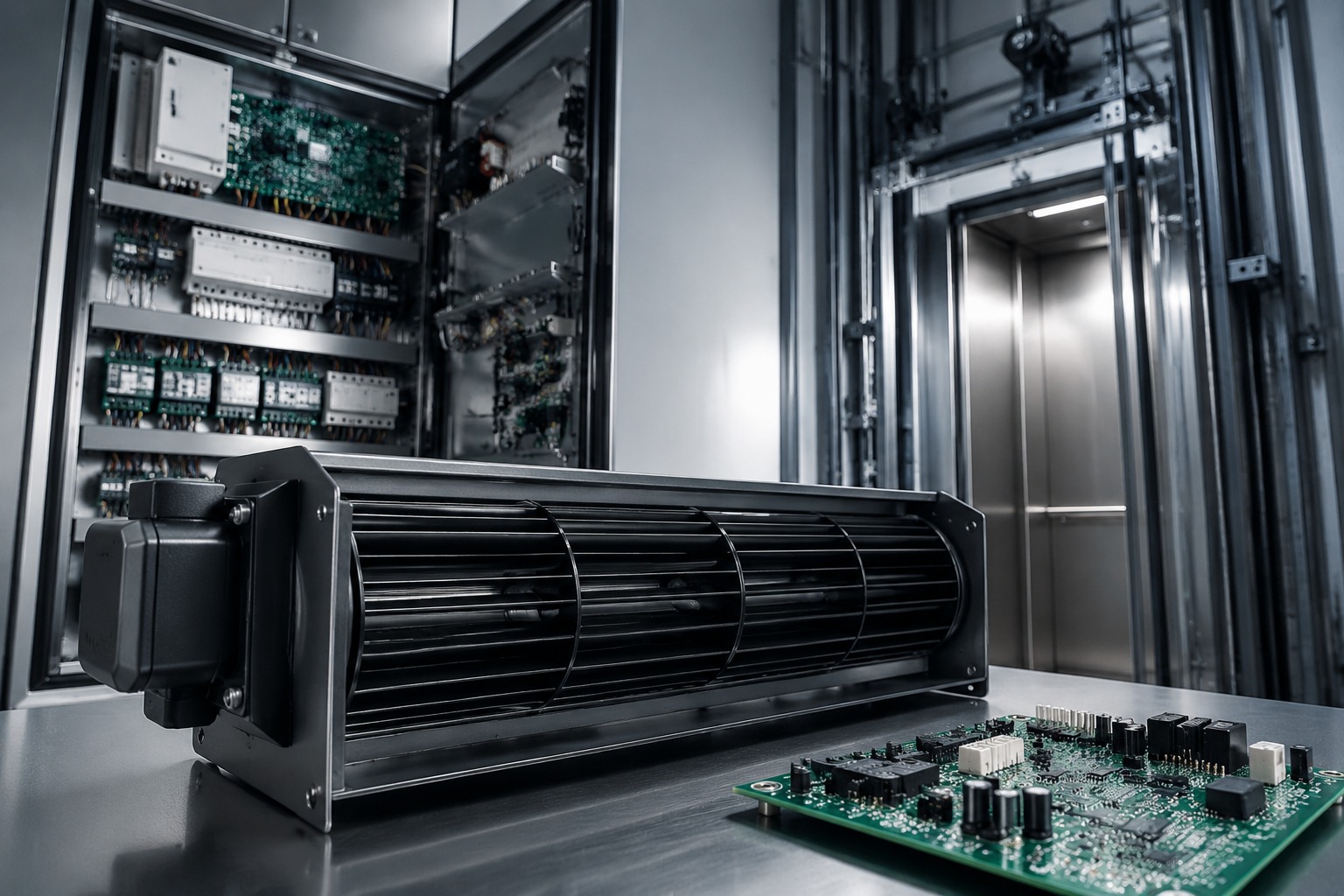
Elevator fans are small components with a big effect on ride comfort, equipment reliability, and maintenance cost. In the Philippines, where heat, humidity, salt-laden air in coastal cities, and dust from dense urban traffic can all affect lift systems, choosing the right cabin or cabinet fan matters. Cross flow fans are widely used for smooth air distribution inside elevator cars and for selected cooling layouts, while axial flow fans are often chosen for direct cabinet ventilation where high spot airflow is needed. For building owners, maintenance companies, distributors, and modernization contractors in Metro Manila, Cebu, Davao, Clark, Iloilo, Cagayan de Oro, and Batangas, the correct fan specification helps reduce nuisance shutdowns, passenger complaints, and premature wear of control electronics.
This guide explains practical fan selection for elevators in the Philippines, including where cross flow fans are installed, how they compare with axial fans, how to choose voltage, dimensions, and airflow, and what to check during replacement of inverter cabinet fans. It also covers vibration, noise, dust, installation, wiring, routine maintenance, and frequently asked questions. If you are sourcing replacement parts, you can review our cross flow fan options for lift accessories and compare them with our axial flow fan models for elevator use based on actual installation conditions.
Elevator ventilation demand in the Philippines market
The Philippines market has unique elevator ventilation challenges. High-rise residential towers in Makati, BGC, Ortigas, and Cebu IT Park often need stable cabin ventilation to maintain comfort during peak commuting periods. Hospitals, hotels, malls, and mixed-use developments may run elevators for long daily cycles, increasing motor heat, controller temperature, and airborne dust accumulation. In coastal business centers such as Manila Bay, Subic, Batangas, and parts of Cebu, salt exposure can also accelerate corrosion on fan housings, terminals, and mounting brackets if protection is poor.
For this reason, elevator fan selection should not be based on dimensions alone. Buyers should look at duty cycle, motor insulation quality, voltage compatibility, connector type, mounting pattern, and whether airflow is intended for passenger comfort or for localized cabinet cooling. Modernization projects especially need careful model matching because a replacement fan may physically fit but still create noise, undercool the inverter, or overload the existing power circuit.
| Market factor in the Philippines | Typical effect on elevator fans | Recommended response |
|---|---|---|
| High ambient temperature | Higher cabinet heat and lower passenger comfort | Select adequate airflow with thermal margin |
| High humidity | Moisture exposure on motors and terminals | Use reliable insulation and protected packaging |
| Coastal salt air | Faster corrosion on metal parts | Check coatings, connectors, and storage conditions |
| Dense urban dust | Clogged fan blades and filters | Plan frequent cleaning intervals |
| Long operating hours | Bearing wear and speed instability | Choose proven continuous-duty models |
| Mixed brand modernization | Model mismatch risk | Verify part number, dimensions, and electrical data |
The table above shows why fan selection in the Philippines should combine local environmental conditions with exact equipment data. A low-cost fan that ignores site conditions can increase maintenance calls and shorten the life of sensitive boards and inverters.
Where cross flow fans are used in elevators
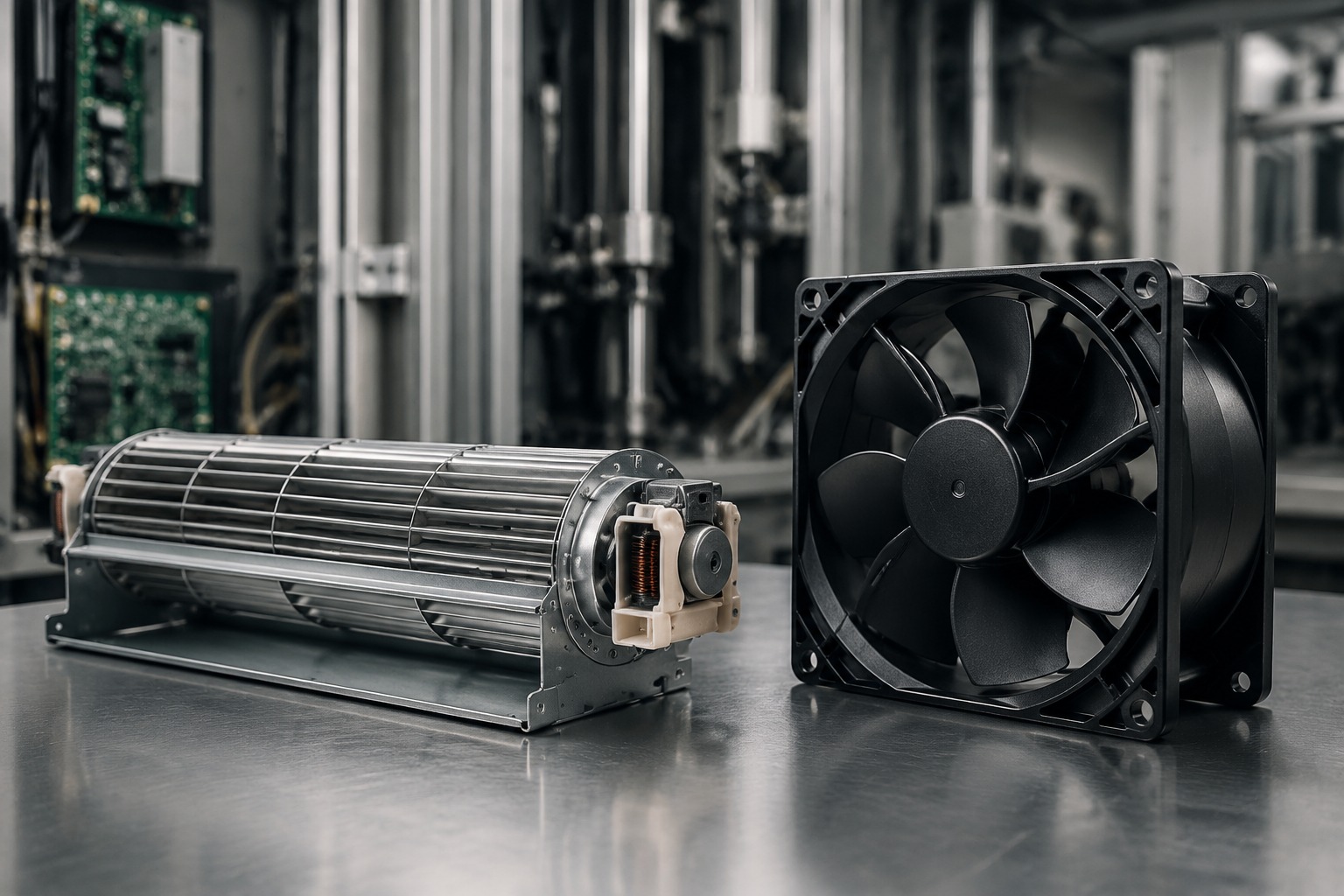
Cross flow fans, sometimes called tangential fans, move air in a long, even curtain across the length of the impeller. In elevators, they are commonly used where broad, uniform airflow is preferred over concentrated point airflow. The most common application is the elevator cabin ceiling or upper decorative panel, where the goal is to spread ventilation gently across passengers instead of blasting air in one spot.
They are also used in some car-top or concealed ventilation assemblies where narrow spaces make a long and slim fan body more practical than a deep axial fan. In selected cabinet and electronics cooling layouts, a cross flow fan can support side-to-side airflow across multiple components, although axial models remain more common for direct cabinet exhaust or intake. If you need examples of available replacement styles, see our H-type cross flow fan for elevator spare parts for installations where a specific housing layout or mounting profile is required.
Cross flow fans are especially useful in the following cases:
- Passenger cabins where uniform airflow and lower perceived draft are important
- Decorative ceiling assemblies with limited depth but enough length
- Lift cars in hotels, offices, and condominiums where ride comfort affects tenant satisfaction
- Retrofit projects where the existing grille layout is long and narrow
- Systems that need quieter, more evenly distributed air movement
| Elevator location | Why a cross flow fan is used | Main benefit |
|---|---|---|
| Cabin ceiling vent panel | Long narrow installation space | Even airflow across passengers |
| Decorative top panel | Hidden ventilation behind fascia | Better aesthetics with functional cooling |
| Premium residential elevators | Comfort-focused ride environment | Softer air distribution and reduced draft sensation |
| Hotel passenger lifts | Quiet and consistent ventilation required | Improved passenger experience |
| Modernized older cars | Existing vent opening is elongated | Simpler retrofit without major metalwork |
| Selected side-flow cooling layouts | Components need broad lateral airflow | Coverage across multiple heat sources |
The table above shows that cross flow fans are chosen more for airflow pattern and available space than for raw airflow volume alone. This distinction is important during replacement because installing a different fan type without considering air distribution can produce complaints even if the measured airflow looks acceptable.
Cross flow fan versus axial flow fan
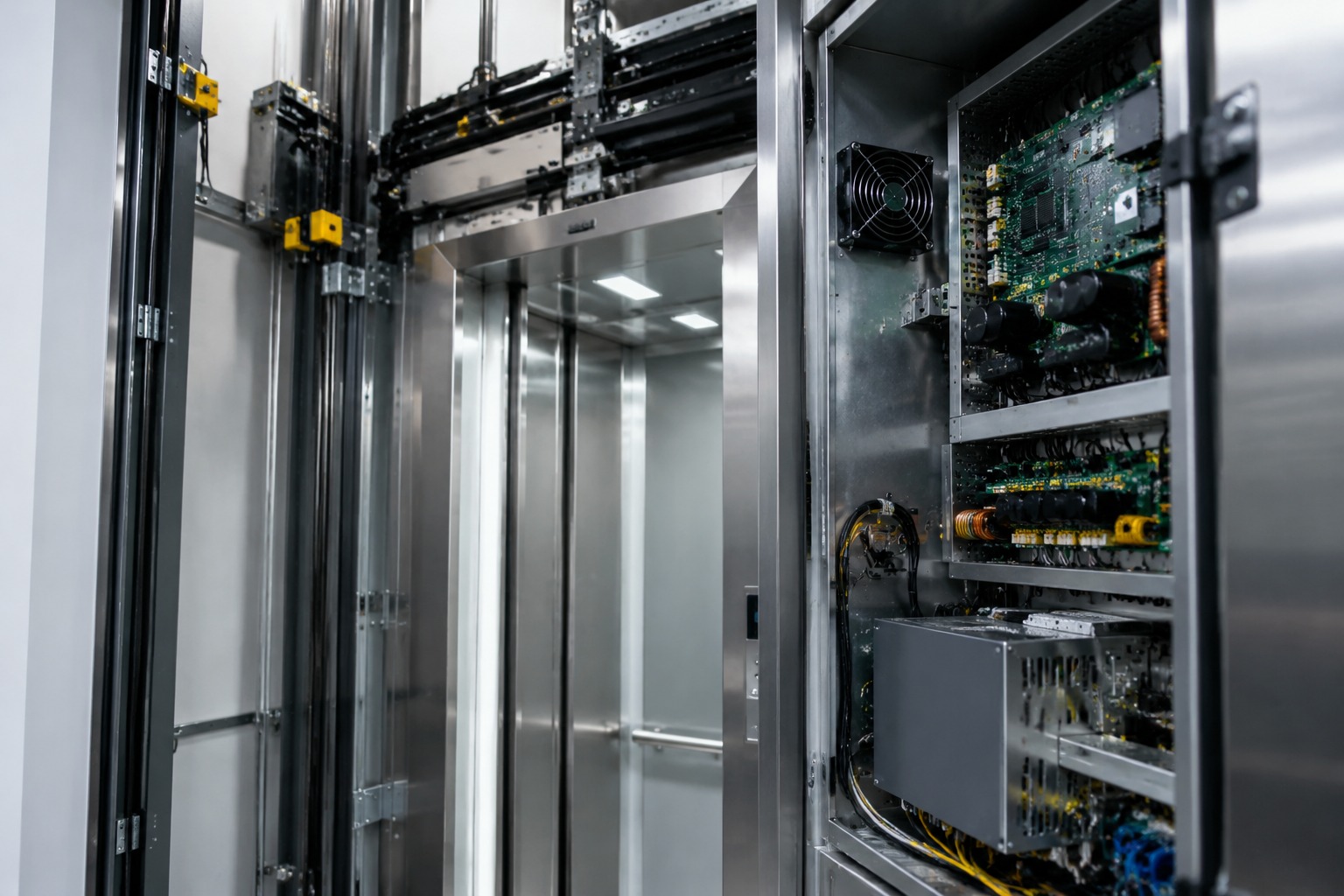
The main difference between cross flow and axial flow fans is how they move air. A cross flow fan creates a wide, continuous sheet of air. An axial fan moves air straight along the axis of the blades, similar to many standard cooling fans. In elevator applications, neither is universally better. The best choice depends on the location, duty, and mechanical constraints.
Cross flow fans usually win when a cabin needs broad and comfortable ventilation. Axial fans usually win when an inverter cabinet, control cabinet, or machine-room enclosure needs stronger point cooling, simpler airflow direction, or easier replacement in standardized square or round cutouts. For cabinet service work, many maintenance teams prefer compact axial units because they are common, cost-effective, and easy to stock. You can review our inverter control cabinet fan solutions when comparing options for controller and drive cooling.
| Feature | Cross flow fan | Axial flow fan |
|---|---|---|
| Airflow pattern | Wide and uniform | Direct and concentrated |
| Best use in elevators | Cabin ventilation | Cabinet and inverter cooling |
| Shape | Long, slim body | Round or square compact frame |
| Passenger comfort | Usually better for even air distribution | Can feel more localized |
| Ease of sourcing | More model-specific | Often easier to find standard sizes |
| Retrofit complexity | May require exact length match | Often simpler if cutout is standard |
| Noise character | Smoother if well matched | Can be louder at high speed |
| Cabinet cooling efficiency | Good in lateral flow designs | Usually strong for direct intake or exhaust |
The comparison above helps buyers avoid a common mistake: selecting a fan by appearance only. In actual elevator maintenance, airflow path matters as much as fan rating. A cabinet with poor exhaust layout may still overheat even after a higher-rated fan is installed.
How to choose the right voltage, size, and airflow
Choosing an elevator fan correctly starts with the original data plate and the application. Voltage mismatch can damage the motor, blow a fuse, or cause weak performance. Size mismatch may prevent proper mounting or reduce airflow because of gaps and recirculation. Airflow mismatch can leave the car stuffy or the inverter too hot. In the Philippines, where ambient temperatures can remain high for much of the year, it is wise to allow some performance margin instead of choosing the minimum acceptable specification.
Check the following data before ordering:
- Rated voltage: common values include 12VDC, 24VDC, 110VAC, and 220VAC
- Frequency for AC models: usually 50/60Hz compatibility should be confirmed
- Physical dimensions: length, width, height, mounting hole pitch, and shaft direction if relevant
- Airflow rating: measured in CFM or m³/h
- Rotation direction and airflow direction
- Connector type and lead length
- Current draw and power rating
- Operating temperature range
For cabin ventilation, airflow should balance comfort and noise. Too little airflow causes heat buildup and passenger complaints. Too much can create draft, noise, and a low-quality ride impression. For cabinets, airflow should be matched to the heat load of drives, braking resistors, power supplies, and control boards. On modernization projects in Quezon City, Pasig, Cebu, or Davao, technicians often find that a previous replacement was physically similar but electrically wrong. This is why careful model matching matters.
| Selection factor | Cabin cross flow fan guidance | Cabinet axial or cross flow fan guidance |
|---|---|---|
| Voltage | Match original exactly | Match original exactly and verify control circuit |
| Airflow | Choose for comfort and even distribution | Choose for heat removal and airflow path |
| Noise level | High importance | Medium importance but still relevant |
| Dimensions | Critical for ceiling fit | Critical for cutout, guard, and bracket fit |
| Duty cycle | Continuous use in busy buildings | Continuous use near electronics heat sources |
| Environment | Passenger comfort area | Dust, oil mist, and heat may be higher |
| Replacement priority | Ride quality and appearance | Equipment protection and uptime |
The table above separates comfort-driven and equipment-driven fan selection. In practice, the best replacement is the one that maintains original design intent while improving reliability where possible.
As a supplier focused on elevator spare parts, we support technical matching by checking model references, dimensions, wiring details, and installation photos before shipment. This technological capability is important when dealing with mixed fleets from Hitachi, Toshiba, KONE, Mitsubishi, and other brands, because two fans with similar dimensions may not share the same electrical or airflow characteristics.
Replacement notes for inverter cabinet fans
Inverter cabinet fan replacement should be handled with more care than a simple like-for-like swap. The fan directly affects the thermal condition of the variable frequency drive, power modules, and nearby boards. If airflow drops or changes direction, controller faults, drive trips, and shortened component life can follow. In hot service environments such as malls in Metro Manila or mixed-use towers in Cebu, inadequate cabinet cooling can become visible quickly.
Before replacement, isolate power according to site safety procedure, inspect the fan label, photograph the wiring, and confirm whether the fan is intake or exhaust. Check if the cabinet uses a filter, grille, finger guard, or thermostat-controlled operation. Dust packed into the grille or filter can make a good fan appear weak. Also inspect for heat discoloration on terminals, cracked insulation, bearing noise, and vibration marks on the cabinet frame.
When replacing an inverter cabinet fan, pay attention to:
- Voltage and frequency compatibility
- Airflow direction arrows on the housing
- Static pressure needs if filters or dense grilles are used
- Connector compatibility or terminal adaptation
- Bearing quality for continuous duty
- Clearance from wiring harnesses and PCB edges
- Cabinet sealing and recirculation paths
| Replacement checkpoint | Why it matters | Common field issue |
|---|---|---|
| Correct voltage | Prevents motor failure and weak speed | Fan runs slow or burns out |
| Airflow direction | Maintains intended cooling path | Hot air trapped inside cabinet |
| Mounting size | Avoids vibration and air leakage | Improvised drilling or unstable fit |
| Connector type | Ensures safe reliable wiring | Loose splice or wrong polarity |
| Filter condition | Preserves airflow after installation | New fan but poor cooling remains |
| Operating noise | Indicates bearing or blade problems | Ignored until failure occurs |
| Thermal test after replacement | Confirms real cooling result | No verification after fitment |
This table shows why a replacement should end with a functional check, not just mechanical installation. Measure cabinet temperature before and after, especially during normal traffic periods, to confirm that the new fan delivers the expected cooling improvement.
Our manufacturing capability supports this process through stable sourcing, careful quality inspection, and protective packaging that helps prevent damage to fan blades, housings, and terminals during transport to projects in Luzon, Visayas, and Mindanao. This reduces the risk of receiving parts that look acceptable but arrive with hidden deformation or connector stress.
Checks for noise, vibration, and dust buildup
Noise complaints are often the first sign that an elevator fan needs attention. In the cabin, passengers notice rattling, buzzing, scraping, or high-pitched bearing sounds quickly. In a control cabinet, noise may not be heard by passengers, but maintenance teams can detect early failure from changes in sound. Vibration can loosen fasteners, wear mounting points, and transfer resonance into decorative panels or cabinet doors.
Dust is another major issue in the Philippines, particularly in roadside buildings, transport hubs, industrial zones, and construction-heavy districts. Dust on fan blades changes balance and reduces airflow. Dust on cabinet filters increases static resistance. Dust on electronics can trap heat and encourage moisture retention. If a building is near a port, logistics zone, or busy road in areas like Manila, Batangas, Cebu, or Davao, inspection intervals may need to be shortened.
Good practice includes visual checks, listening checks, vibration checks by touch and instrument where available, and airflow checks at the grille. Technicians should also look for worn rubber mounts, warped fan wheels, accumulated lint, or signs that a replaced grille is too restrictive for the fan being used.
| Inspection item | What to look for | Action |
|---|---|---|
| Bearing noise | Whining, grinding, rough sound | Replace fan before seizure |
| Blade balance | Wobble or uneven rotation | Clean first, then replace if persistent |
| Mount vibration | Rattle on panel or cabinet wall | Tighten fixings and inspect mounts |
| Dust accumulation | Visible dirt on blades and grille | Clean fan, filter, and nearby surfaces |
| Reduced airflow | Weak output at vent or hot cabinet | Check blockage, rotation, and rating |
| Electrical heating | Warm terminals or discoloration | Repair wiring and confirm current draw |
| Corrosion | Rust on screws, grille, or terminals | Replace damaged hardware and protect area |
The table above connects symptoms to action. In many cases, cleaning is enough at the early stage. However, a noisy bearing or a fan with stable power but weak speed usually points to replacement rather than cleaning alone.
Installation and wiring tips
Correct installation is just as important as selecting the correct fan. Poor wiring practice, reversed airflow, or misaligned mounting can cancel the benefit of a good replacement part. Always lock out and verify isolation before handling wiring. Compare the replacement label with the original, confirm polarity for DC models, and check insulation condition on nearby conductors. Do not allow the fan cable to rub against rotating parts, sharp cabinet edges, or hot components.
For cabin cross flow fans, make sure the fan wheel is centered, the housing is secure, and the air outlet is not blocked by decorative panels, dirty mesh, or mispositioned insulation material. For cabinet fans, keep a clear airflow path from intake to exhaust. If the system relies on forced intake through a filter, replace or clean the filter at the same time. If the cabinet has been modified over time, check whether added relays, loose cables, or temporary labels are obstructing airflow.
Helpful installation practices include:
- Use the correct screws, brackets, and anti-vibration supports
- Route wiring neatly and secure it with suitable ties or clips
- Observe polarity and grounding requirements
- Do not over-tighten plastic frames or housings
- Test run before closing the panel
- Verify airflow direction with a simple tissue or airflow check
- Record the installed model and date for maintenance history
Our service capability includes responsive communication, careful order confirmation, and support for compatible replacement sourcing, which is especially useful for maintenance firms that handle urgent shutdowns or multi-site projects. When a technician in Manila, Cavite, Laguna, or Cebu sends us photos, ratings, and dimensions, we help narrow the match to reduce downtime and avoid repeated dispatches.
Maintenance schedule for elevator fans
A maintenance schedule should reflect environment, traffic level, and application. A quiet residential building in a cleaner area may only need routine visual checks and periodic cleaning. A hospital, mall, transport hub, or industrial facility may need tighter intervals because of longer run time and heavier dust load. In the Philippines, the rainy season can also shift conditions by increasing humidity and drawing more dirt into cabinet spaces when doors and lobbies open frequently.
Preventive maintenance is more economical than waiting for failure. A failed cabin fan may trigger passenger complaints and discomfort. A failed inverter cabinet fan can contribute to controller trips, thermal alarms, or early aging of expensive electronics. Maintenance records should include noise observations, cleaning dates, amperage if measured, temperature trend if monitored, and any repeated failure pattern that suggests a root-cause issue such as restricted vents or unstable supply voltage.
| Interval | Cabin fan tasks | Cabinet fan tasks |
|---|---|---|
| Monthly | Check airflow and unusual noise | Check operating status and cabinet temperature feel |
| Quarterly | Clean grille and visible dust | Clean fan guard, filter, and nearby dust |
| Every 6 months | Inspect mountings and wiring | Inspect fasteners, wiring, and airflow path |
| Annually | Review performance in peak season | Perform deeper cleaning and thermal review |
| At modernization | Confirm fan capacity suits new cabin layout | Confirm fan capacity suits new inverter heat load |
| After complaint or fault | Check noise, draft, and actual airflow | Check trip history, temperature, and airflow direction |
| At end-of-life signs | Replace before passenger discomfort worsens | Replace before electronics are exposed to heat stress |
This schedule is a practical baseline. High-dust and coastal sites may need shorter intervals, while climate-controlled premium buildings may allow longer periods between cleanings if performance remains stable.
Buying advice for maintenance teams, contractors, and owners
Buying the right elevator fan means balancing cost, compatibility, delivery speed, and reliability. Maintenance contractors often need a fast replacement to restore operation, but speed should not replace verification. Always request label details, measurements, photos of the original installation, and if possible the brand and model of the elevator subsystem. Building owners and procurement teams should ask suppliers whether they can support cross-referencing, protective packaging, and responsive after-sales communication.
For fleets with multiple brands and ages, it helps to group fan demand into cabin ventilation fans, control cabinet fans, inverter fans, and special layout fans. Stocking a limited range of carefully selected fast-moving models can reduce downtime, but uncommon fan lengths, voltages, or brackets should still be ordered against exact requirements. This is particularly true in modernization works around urban centers such as Manila, Cebu, and Davao where mixed-brand buildings are common.
Below is a broad comparison that buyers can use when screening options and supplier approaches.
| Buying criterion | Why it matters | What strong suppliers usually provide |
|---|---|---|
| Exact model matching | Prevents rework and return delays | Label review, dimension check, photo confirmation |
| Stable quality inspection | Reduces early failure risk | Electrical and appearance checks before dispatch |
| Protective packaging | Avoids transport damage | Secured packing for blades, housings, and terminals |
| Wide brand compatibility | Useful for mixed fleets | Experience with major elevator brands |
| Responsive service | Critical during downtime events | Fast quotation and order follow-up |
| Technical communication | Improves replacement accuracy | Clarification on voltage, airflow, and fitment |
| Delivery planning | Supports maintenance schedules | Lead-time transparency and packing readiness |
The table above reflects how professional buyers evaluate more than price alone. A fan that arrives quickly but fails matching checks can increase total cost by causing repeat visits, delayed turnover, and avoidable customer complaints.
Industries and application examples
Elevator fans serve different priorities depending on the building type. In condominium towers, passenger comfort and noise are the main focus. In office towers, long daily cycles and predictable peak usage drive preventive replacement planning. In hotels, guest perception is highly sensitive to cabin ventilation quality. In hospitals, stable cabinet cooling is critical because reliability expectations are high. In malls and industrial sites, dust loading and long operating hours often increase maintenance frequency.
Consider two practical examples. In a residential tower in Taguig, a modernization contractor replaced original cabin cross flow fans with correctly matched long-body units after residents complained of weak airflow. Uniform ventilation improved, and complaints dropped because the airflow reached the full width of the car ceiling. In a commercial site in Cebu, repeated inverter overtemperature alarms were traced not to the drive itself, but to a cabinet fan installed in reverse airflow direction after a prior service call. After correction and filter replacement, cabinet temperature stabilized.
These examples show that fans are not isolated accessories. They are part of overall elevator reliability, passenger experience, and maintenance efficiency.
Our company approach for the Philippines market
We serve maintenance companies, distributors, building owners, and modernization contractors that need dependable elevator spare parts support. For fan-related requirements, our approach combines three strengths.
First, our technological capability focuses on careful model matching. We help verify part references, dimensions, voltage, connectors, and compatibility across elevator brands and subsystems, reducing the risk of ordering a visually similar but functionally unsuitable fan.
Second, our manufacturing and supply capability emphasizes stable sourcing, quality inspection, and protective packaging. This supports repeatable quality for replacement parts shipped to customers across the Philippines, whether for urgent repair work in Metro Manila or planned modernization in Visayas and Mindanao.
Third, our service capability is built around responsive communication and practical sourcing support. We understand that many customers are not just buying a fan; they are trying to shorten downtime, maintain safety, and keep building operations smooth. That is why we aim to support fast clarification and dependable order handling for elevator control boards, inverter parts, door operator components, door locks, light curtains, guide shoes, oil cups, sensors, encoders, power supplies, buttons, COP panels, intercom parts, and related lift accessories alongside fan products.
Future trends through 2026: technology, policy, and sustainability
By 2026, elevator fan demand in the Philippines is likely to be shaped by three trends. The first is smarter maintenance. More service teams are moving toward predictive and condition-based maintenance, using temperature trends, fault history, and routine inspection data to replace fans before failure. This is especially relevant for inverter cabinets in high-traffic properties.
The second trend is policy and building efficiency. As developers focus more on energy use, indoor environmental quality, and building modernization, fan selection will increasingly consider not only airflow and cost but also efficiency, operating noise, and maintenance life. Better cabinet cooling can indirectly support the life span of power electronics, reducing waste and emergency replacement frequency.
The third trend is sustainability in replacement strategy. Instead of changing major assemblies prematurely, many owners now prefer targeted replacement of wear components such as fans, sensors, and power supplies to extend system life. This practical approach aligns well with modernization budgets in growing cities like Manila, Cebu, and Davao, where property managers seek reliability without unnecessary capital expenditure.
FAQ about elevator fans
What is the main purpose of a cross flow fan in an elevator?
Its main purpose is to provide smooth, even cabin ventilation across a wider area, improving passenger comfort without producing harsh localized airflow.
When should I choose an axial fan instead of a cross flow fan?
Choose an axial fan when the application is direct cabinet or inverter cooling, especially where the enclosure uses standard cutouts and needs concentrated airflow for electronics heat removal.
Can I replace a cross flow fan with an axial fan if the voltage is the same?
Not automatically. Even if the voltage matches, the airflow pattern, mounting layout, noise behavior, and vent design may be unsuitable. Mechanical and thermal checks are required.
What voltage is most common for elevator fans?
Common voltages include 12VDC, 24VDC, 110VAC, and 220VAC, but the correct choice depends entirely on the original system design and control circuit.
How do I know if an inverter cabinet fan is failing?
Typical signs include bearing noise, low airflow, overheating inside the cabinet, repeated drive trips, abnormal vibration, or a fan that starts slowly or intermittently.
How often should elevator fans be cleaned in the Philippines?
It depends on site conditions. In dusty, coastal, or high-traffic environments, quarterly cleaning may be appropriate, while cleaner buildings may allow longer intervals.
Does a bigger airflow rating always mean better performance?
No. Excess airflow can create noise or draft issues in cabins, while cabinet cooling depends on the total airflow path, not just the fan rating itself.
What details should I send when asking for a replacement quotation?
Send the original fan label, voltage, frequency if AC, dimensions, photos of the installation, connector type, airflow direction, and the elevator or subsystem brand if known.
Can dust really shorten the life of elevator electronics?
Yes. Dust can block airflow, trap heat, attract moisture, and reduce the effectiveness of cooling, especially in inverter and control cabinets.
Where can I compare fan options for elevator spare parts?
You can review our cross flow fan range, our H-type cross flow fan selection, our axial fan options for lifts, and our inverter cabinet fan replacements to start matching the right part for your project.
In summary, elevator fan selection in the Philippines should be practical, site-aware, and technically accurate. Cross flow fans are highly effective for elevator cabin ventilation where smooth air distribution matters. Axial fans remain essential for many cabinet and inverter cooling duties. When voltage, dimensions, airflow, noise, dust conditions, and wiring are all checked carefully, a replacement fan can improve passenger comfort, protect critical electronics, and reduce avoidable downtime across residential, commercial, hospitality, healthcare, and industrial buildings.