
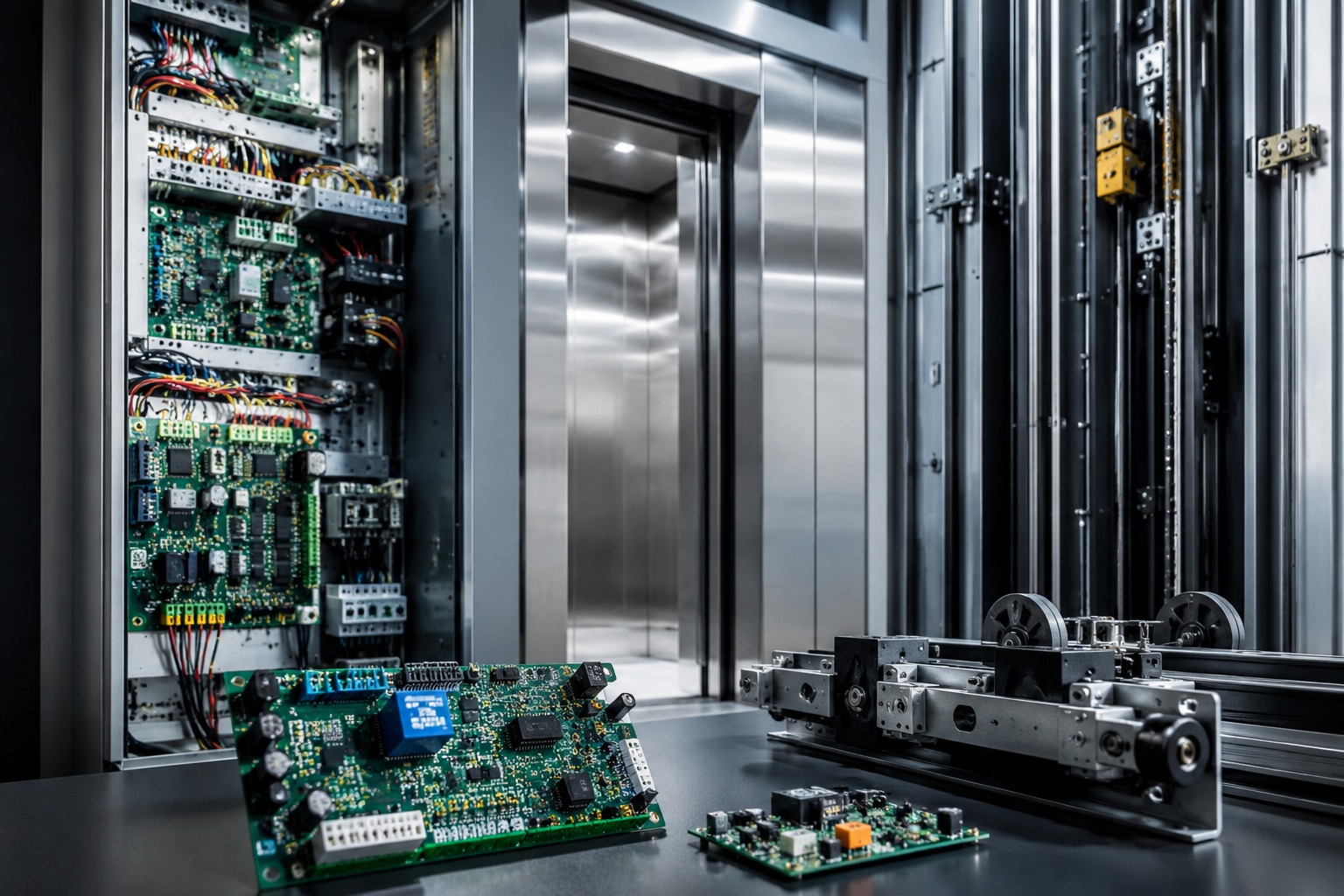
Elevator control boards are the decision-making layer inside a lift system. They process landing calls, door timing, speed references, safety chain inputs, leveling commands, and communication signals between the main controller, inverter, door operator, COP, and other subsystems. When a board begins to fail, the problem rarely looks like a single simple defect. Instead, it often appears as intermittent logic faults, nuisance shutdowns, inaccurate floor leveling, door reopening, communication loss, random resets, or unexplained service interruptions. In the Philippines, where elevators operate in coastal humidity, high-rise commercial districts, hospitals, hotels, mixed-use towers, logistics hubs, and residential developments, board condition has a direct effect on uptime and passenger confidence.
The short answer is this: when a lift shows repeating logic-related faults that cannot be traced to field wiring, sensors, door mechanics, or power quality, the control board becomes a primary suspect. Proper troubleshooting requires fault-code review, voltage checks, I/O confirmation, environmental assessment, and careful model matching before replacement. Sourcing also matters. An elevator board that is electrically similar but not firmware-compatible can create new faults instead of solving the original one. That is why many maintenance companies in Metro Manila, Cebu, Davao, Clark, and Iloilo now place greater emphasis on traceable sourcing, anti-static handling, and post-installation commissioning.
For building owners and service contractors, the biggest risk is not only board failure itself, but downtime caused by incorrect diagnosis or wrong part selection. A safe and efficient replacement program starts with identifying symptoms correctly, confirming exact part numbers, checking revision levels, and deciding whether a brand-new board, original stock board, or refurbished unit is the right fit. For readers looking for brand-specific options, products such as Hitachi elevator control boards, Toshiba elevator motherboards, and Toshiba elevator expansion boards are commonly discussed when matching older and newer installations.
In the Philippine market, this topic is especially relevant because many lifts are now beyond their early warranty years. Systems installed in office towers in Makati and Bonifacio Global City, hotels in Pasay and Parañaque, residential towers in Quezon City and Mandaluyong, industrial estates near Laguna and Batangas, and port-related facilities around Subic and Manila all face pressure to maintain availability with aging electronics. Spare board strategy is now part of modernization planning, not just emergency repair. The sections below explain the warning signs, diagnostic process, sourcing considerations for Hitachi and Toshiba platforms, testing requirements for refurbished boards, ESD packaging standards, and commissioning steps that help prevent repeat failures.
Common Control Board Failure Signs
Control board faults can be obvious, but many are subtle. A failed component on a board does not always result in a dead elevator. In many cases, the lift still runs, but reliability drops. This is why maintenance technicians must distinguish between a board fault and a field component fault. A relay issue, damaged encoder cable, unstable power supply, or door lock feedback problem can imitate controller failure. The key is to look for patterns.
Common board-related symptoms include random resets during travel, loss of floor position data, failure to register landing calls, door operator communication errors, unexplained drive inhibit signals, unstable COP or LOP response, intermittent safety chain reading, and repeated fault recurrence after temporary reset. In coastal areas such as Manila Bay zones, Cebu, and Davao, corrosion and moisture contamination can weaken connectors and solder joints. In buildings with poor power conditioning, transient voltage stress may damage sensitive logic circuits. In older machine rooms, heat buildup and dust accumulation can shorten component life.
| Failure Sign | What It Looks Like | Possible Board Involvement | Other Causes to Rule Out | Service Priority | Typical Downtime Risk |
|---|---|---|---|---|---|
| Random controller reset | Lift reboots without clear trigger | Power regulation section, CPU instability | Main power fluctuation, loose terminals | High | High |
| Intermittent door faults | Doors reopen or fail to close normally | I/O output issue, communication logic fault | Door locks, rollers, sensors, operator board | High | Medium to high |
| Missing floor calls | Landing or car calls are not accepted | Input processing or bus communication defect | Buttons, wiring, COP board, LOP board | Medium | Medium |
| Leveling inconsistency | Car stops above or below floor level | Signal processing or speed command issue | Encoder, brake response, drive tuning | High | High |
| Communication alarm | Controller loses link to inverter or expansion board | Port damage, firmware mismatch | Communication cable, grounding, EMI | High | High |
| Burn marks or odor | Visible overheating on board surface | Component failure, shorted section | External overload, wrong voltage input | Immediate | Very high |
The table above shows why symptoms should not be judged in isolation. For example, a door fault may begin with a mechanical issue, but repeated overload of the operator output stage can eventually damage a board channel. Likewise, an unstable SMPS section may mimic sensor problems because downstream signals become unreliable. A useful practical rule is that intermittent logic faults that appear across multiple functions deserve board-level investigation earlier rather than later.
Technicians in the Philippines also report seasonal effects. During hot months, boards with weakened capacitors may fail more often after prolonged operation. During rainy periods, moisture ingress in older shafts and machine rooms increases the risk of oxidation around connectors and edge contacts. Facilities near ports and coastal industrial sites face added contamination from salt-laden air. These local operating conditions should influence both troubleshooting and spare stock planning.
How Technicians Diagnose Board Faults
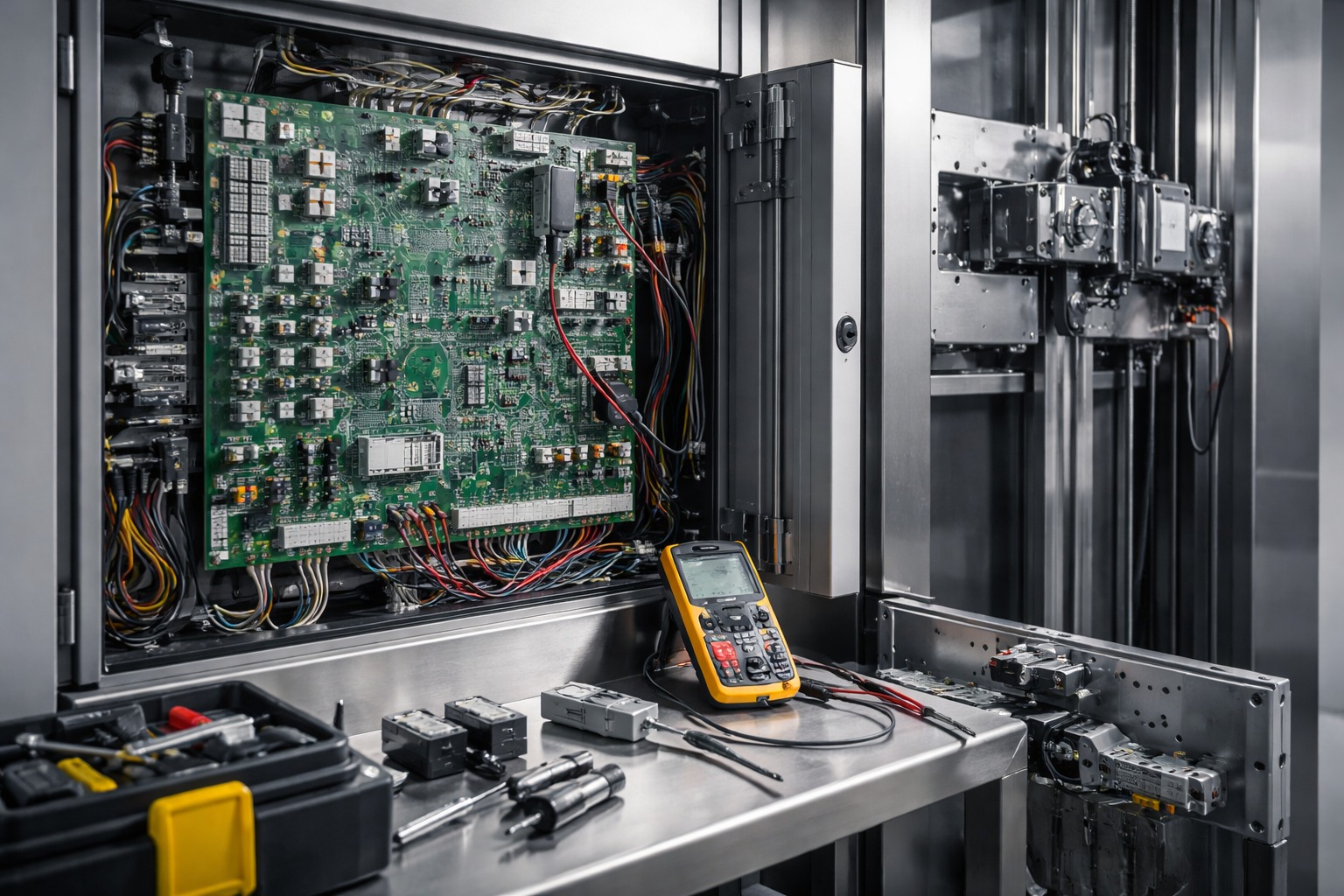
Good diagnosis is a structured process, not a guess. Replacing a board without evidence can waste time, increase cost, and create new compatibility problems. Professional technicians typically begin by collecting event history from the controller display or maintenance tool, then compare recurring fault codes with actual machine behavior. They inspect power input quality, verify grounding, check safety circuit integrity, and confirm that field inputs are reaching the board correctly.
A proper diagnosis usually follows six stages: symptom confirmation, fault log review, power and communication checks, I/O verification, visual inspection, and substitution or bench test. Symptom confirmation means reproducing the issue if possible. Fault log review reveals whether errors cluster around the same subsystem. Power and communication checks confirm whether the board is receiving stable voltage and data signals. I/O verification tests whether external devices are switching correctly at the board terminals. Visual inspection looks for swollen capacitors, discolored resistors, cracked solder joints, oxidized connectors, or contamination. Only after these steps should a replacement decision be made.
| Diagnostic Step | Purpose | Tools Commonly Used | What Confirms a Board Suspect | What May Clear the Board | Field Note |
|---|---|---|---|---|---|
| Read event history | Identify repeat fault patterns | Service tool, display logs | Same logic fault repeats across conditions | Single event linked to external issue | Save screenshots or written logs |
| Check input voltage | Confirm stable supply | Multimeter, power analyzer | Regulated output unstable on board | Incoming power issue found upstream | Useful in older buildings |
| Verify I/O status | Confirm signal processing | Meter, diagnostic LEDs, software | Correct field input but wrong board response | Input absent due to sensor or wiring fault | Do not skip terminal checks |
| Inspect communication lines | Check data integrity | Protocol analyzer, continuity test | Port dead or unstable despite good cable | Broken or noisy cable discovered | EMI can mislead diagnosis |
| Visual board inspection | Find physical damage | Magnifier, light, ESD bench | Burn marks, corrosion, cracked joints | Board appears clean and stable | Humidity damage is common |
| Controlled substitution | Validate suspected failure | Known good board | Fault disappears after correct replacement | Fault remains, pointing elsewhere | Confirm firmware and revision first |
One of the most important points in diagnosis is understanding whether the board is the root cause or a secondary casualty. For example, a short in an external sensor loop can damage an input channel. If the channel is replaced without fixing the loop, the new board may fail again. Similarly, inverter feedback issues may be caused by encoder problems, but repeated unstable signals can also confuse the main board and generate misleading controller alarms. Therefore, every replacement should include a cause review, not just a symptom review.
Technological capability plays a major role here. Experienced parts suppliers support maintenance teams by helping verify exact board model numbers, terminal layouts, revision codes, and application compatibility. This reduces the risk of ordering a board that looks similar but behaves differently in service. Strong technical sourcing support is particularly valuable when contractors are handling legacy installations, mixed portfolios, or modernization projects involving multiple brands and generations.
For building owners, it is worth asking service partners whether they perform pre-order fault confirmation and whether they can cross-check board identity from photos, nameplates, and controller data. These simple steps often save days of delay, especially when a site is in a busy service corridor such as Ortigas, Alabang, Cebu IT Park, or Davao commercial districts where uptime expectations are high.
Hitachi Control Board Sourcing Considerations
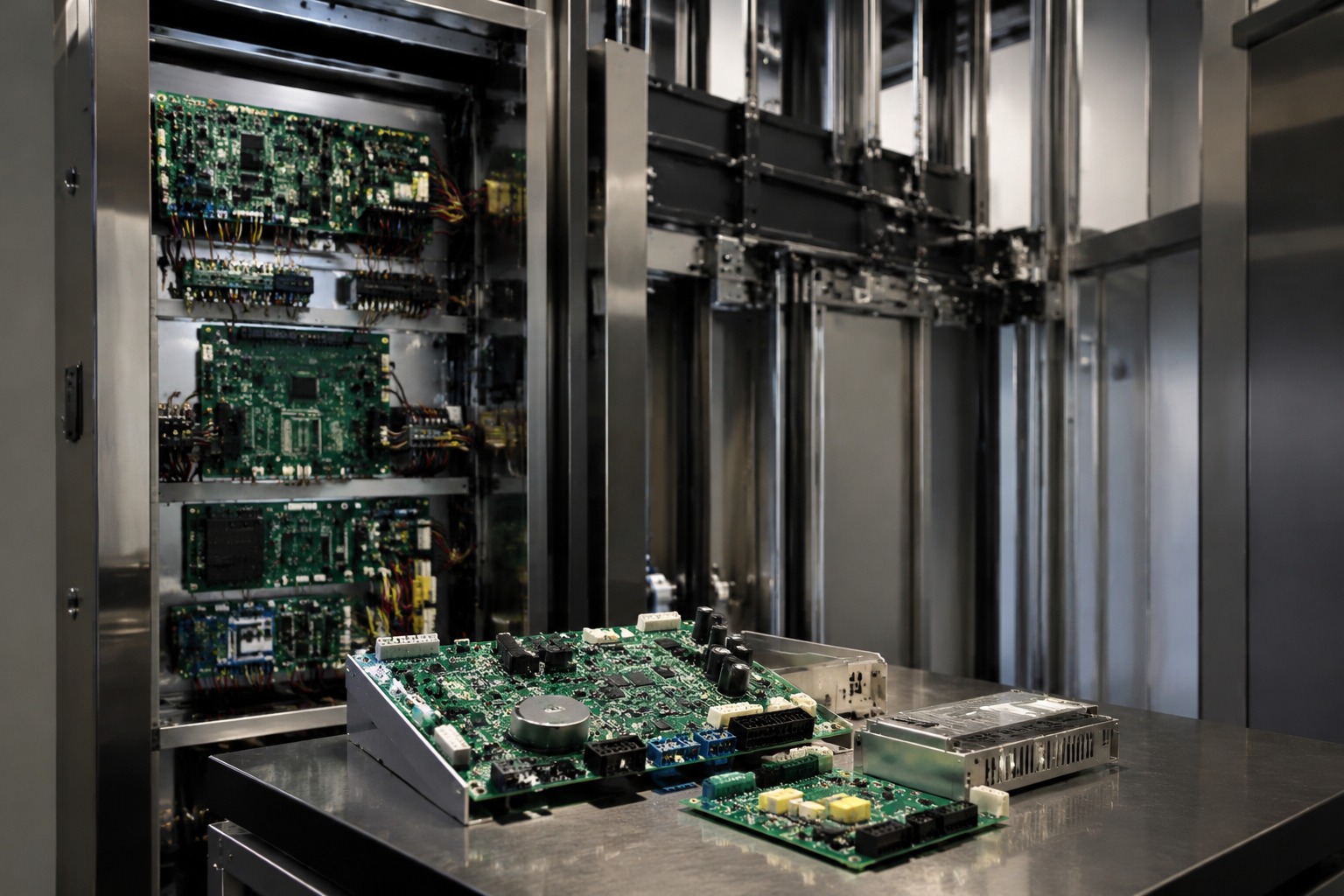
Hitachi elevator systems are widely respected for control precision, but replacement board sourcing requires close attention to platform generation, firmware compatibility, connector style, and regional configuration. A board with a matching family name may still be unsuitable if its software revision, communication protocol, or terminal mapping differs from the original application. This is why reliable sourcing is about more than finding a similar-looking PCB.
When sourcing Hitachi boards in the Philippines, buyers should confirm the complete part number, board code, controller model, elevator application, and whether the unit is a main controller board, drive interface board, expansion board, or door-related board. Photos of both the board face and the label side help verify differences in layout and component population. Some buildings in Metro Manila and Cebu run older systems with limited local documentation, so the ability to compare actual field photos with stocked references becomes valuable.
For buyers seeking a replacement option, the category page for Hitachi elevator control board parts can be useful as a starting point for model matching. However, final selection should always be based on exact identification rather than general appearance or brand family alone.
| Sourcing Checkpoint | Why It Matters | Risk If Ignored | Recommended Buyer Action | Best For | Priority Level |
|---|---|---|---|---|---|
| Exact part number | Confirms board identity | Wrong board supplied | Match full code including suffix | All projects | Critical |
| Revision level | May affect firmware or connector logic | Intermittent incompatibility | Check label and service manual | Repairs and modernization | Critical |
| Controller model | Links board to host system | Communication mismatch | Share controller data with supplier | Older installations | High |
| Application type | Main board, interface, or expansion differ | Incorrect function restored | Define board role clearly | Service teams | High |
| Condition status | Brand-new, original stock, refurbished | Unexpected performance level | Request test details | Urgent replacements | High |
| Packaging quality | Protects during shipment | ESD or transit damage | Require anti-static and shock protection | Island deliveries | High |
The Philippine supply chain also adds practical considerations. Boards may need to move from overseas inventory through Manila, Batangas, or Cebu gateways before onward delivery to provincial projects. This means buyers should ask about lead time realism, anti-static packaging, moisture protection, and whether the supplier can support fast dispatch for emergency shutdown cases. If the installation serves hospitals, BPO towers, transport facilities, or premium residences, delayed board availability can have serious operational and contractual consequences.
Manufacturing capability is another factor that separates stronger suppliers from traders with limited control. Suppliers with stable sourcing channels, quality inspection workflows, and packaging discipline are better positioned to provide consistent replacement boards, especially for high-value electronic components. Quality inspection should include label verification, connector condition review, visual PCB examination, and where applicable, controlled functional testing before shipment.
Toshiba Motherboard Replacement Notes
Toshiba elevator motherboard replacement requires the same discipline as any major control-board job, but with special attention to system architecture. In many Toshiba systems, the motherboard acts as the central processing and coordination layer, so replacement affects multiple functions at once. Before removing the original board, technicians should record parameter settings, wiring positions, dip switch states, plug orientation, and any linked expansion board references.
If a Toshiba motherboard is visibly damaged or non-responsive, replacement may be straightforward. But if the fault is intermittent, the technician should first confirm external conditions, because the motherboard may only be reacting to unstable input power, poor communication from a sub-board, or a safety-chain issue. Replacing the wrong board can create confusion during restart, especially if parameter transfer or initialization steps are overlooked.
For projects needing a direct product category reference, Toshiba elevator motherboard options and Toshiba expansion board products are often reviewed together because both may be relevant during fault isolation. Some faults that appear to be motherboard-related are actually caused by an associated expansion board, communication daughter board, or interface card.
| Replacement Item | What to Record Before Removal | Main Risk During Changeout | Best Practice | Commissioning Impact | Notes for Toshiba Systems |
|---|---|---|---|---|---|
| Main motherboard | Parameters, switches, connector positions | Loss of setup data | Photograph everything before disconnecting | Very high | Central logic board |
| Expansion board | Address settings, linked ports | Communication conflict | Match board code and addressing | High | Can affect I/O mapping |
| Drive interface board | Signal terminal layout | Drive not enabling | Confirm protocol and cable orientation | High | Check inverter handshake |
| Door-related control board | Input and output assignments | Door sequence errors | Test complete open/close cycle | Medium to high | Often confused with mechanical faults |
| Communication sub-board | Port labels and node role | No data exchange after restart | Inspect cable shielding and grounding | High | Noise-sensitive in older sites |
| Power supply board | Voltage ratings and outputs | Damage to downstream electronics | Verify output before energizing loads | Critical | Should be tested first when resets occur |
In practical field work, technicians should use a replacement checklist instead of relying on memory. This is especially important in busy service environments where shutdown windows are short. In towers around Makati CBD, BGC, Cebu business districts, and airport-linked properties in Pasay, every hour of downtime matters. A documented sequence reduces errors during removal, installation, and restart.
Another good practice is to keep removed boards for controlled analysis rather than disposing of them immediately. Even when the board is confirmed faulty, post-failure review may reveal the deeper cause, such as moisture ingress, surge exposure, contaminated connectors, or repeated stress from unstable external loads. That insight helps prevent a repeat event on the replacement board.
Why Refurbished Boards Need Careful Testing
Refurbished elevator control boards can be a practical option when original new stock is limited, lead times are long, or older systems require discontinued electronics. However, refurbished does not always mean ready for safe field use. A properly refurbished board should undergo more than a simple power-on check. It needs structured testing, component inspection, cleaning, repair validation, connector assessment, and ideally function simulation or controlled load testing.
The main risk with poorly refurbished boards is hidden instability. A unit may pass a short bench power-up but fail after thermal stress, longer operating cycles, or communication load. In elevator service, intermittent faults are especially disruptive because they consume technician hours and damage end-user trust. This is why buyers should ask what testing was done, whether key components were replaced, and whether the board was inspected for corrosion, previous rework quality, and connector wear.
Service capability becomes critical in this area. Strong suppliers do not just ship boards; they help customers confirm compatibility, explain condition status clearly, and support decisions between refurbished and brand-new options based on urgency, budget, and application criticality. For a hospital lift, premium office tower, or heavily used mixed-use development, a tested and traceable board with responsive support is usually more important than finding the lowest price.
In the Philippines, many building owners manage older assets that still perform mechanically well but rely on aging electronics. For such projects, refurbished boards may support life extension while broader modernization planning is underway. The decision should consider passenger volume, criticality of the lift, expected remaining service life, and access to future spares.
ESD Packaging and Shipping Requirements
Electrostatic discharge protection is not optional for elevator control boards. A board can be damaged before installation if handled or packed incorrectly. This risk increases when parts move through multiple logistics steps, such as warehouse transfer, domestic forwarding, and island distribution. In the Philippines, shipment routes may involve Manila, Cebu, Davao, Cagayan de Oro, or Batangas logistics hubs, making robust packaging even more important.
At minimum, a control board should be packed in an anti-static bag, cushioned against shock, protected from moisture, and boxed to prevent movement. Sensitive connectors and edge contacts should be shielded. For high-value or hard-to-source boards, double boxing and clear ESD handling labels are recommended. If the destination is a coastal or humid area, adding moisture barrier measures is wise.
| Packaging Requirement | Purpose | Minimum Standard | What Happens If Missing | Recommended for PH Logistics | Importance |
|---|---|---|---|---|---|
| Anti-static bag | Controls electrostatic exposure | Sealed ESD bag | Latent or immediate board damage | Always required | Critical |
| Shock-absorbing layer | Protects PCB and components | Foam or bubble cushioning | Cracked solder joints or connector damage | Use dense cushioning for island shipping | High |
| Moisture protection | Reduces humidity impact | Inner barrier or desiccant | Corrosion risk | Recommended for coastal destinations | High |
| Rigid outer box | Prevents crushing | Strong carton | Transit deformation | Double-wall carton preferred | High |
| Connector protection | Preserves contact quality | Cap or shield for exposed terminals | Bent pins and poor contact | Very useful for older boards | Medium to high |
| ESD warning label | Alerts handlers | Visible marking | Improper manual handling | Should be standard practice | Medium |
Buyers should also think about the handoff after delivery. Even the best packaging cannot protect a board if it is opened on-site without grounding precautions. Technicians should store the unit in its anti-static packaging until installation time and avoid placing it on unprotected surfaces. This is particularly important when emergency replacements happen in machine rooms or control spaces where work areas are not ideal.
Reliable service providers build this discipline into the process: inspection before packing, anti-static wrapping, impact protection, shipment labeling, and delivery follow-up. That combination reduces transit damage and helps maintenance teams receive boards in installation-ready condition.
Commissioning Steps After Board Replacement
Replacing a board is only half the job. Proper commissioning determines whether the elevator returns to stable and safe service. After installation, technicians should verify wiring, connector seating, switch settings, parameter restoration, communication links, and power quality before any full run test. If the board requires initialization, address configuration, or firmware-linked setup, these should be completed according to system requirements.
Commissioning usually begins with a static inspection. The technician confirms that no plugs are misaligned, no loose hardware remains, and no damaged terminals are present. Next comes controlled energization: check output voltages, verify status indicators, and confirm that alarms are consistent with the actual state of the elevator. Then proceed to subsystem tests such as door operation, car calls, landing calls, safety circuit confirmation, leveling response, and normal travel. After this, perform repeated trips under observation to ensure stability.
| Commissioning Step | Objective | What to Verify | Pass Criteria | Typical Error if Skipped | Priority |
|---|---|---|---|---|---|
| Visual recheck | Catch installation mistakes | Connectors, terminals, switches | Everything matches record | Immediate fault on power-up | Critical |
| Controlled power-on | Confirm safe energization | Voltage outputs, LEDs, alarms | Stable startup status | Overlooked supply issue | Critical |
| Parameter confirmation | Restore correct behavior | Operational settings | Settings match original system | Incorrect speed or door timing | Critical |
| Communication test | Validate data links | Drive, expansion, COP/LOP links | No communication errors | Subsystem remains offline | High |
| Functional ride test | Check actual elevator behavior | Calls, travel, leveling, doors | Normal service cycles | Hidden fault appears later | High |
| Observation run | Confirm reliability over time | Multiple repeated trips | No intermittent alarms | Early recurrence in service | High |
For high-traffic buildings, observation after restart is strongly recommended. The elevator may pass initial tests but still show instability under repeated use. A good practice is to run multiple cycles, monitor event logs again, and verify that no new communication or I/O anomalies appear. In premium developments in Makati, Taguig, or Cebu, this post-commissioning validation helps avoid callbacks within hours of reopening.
Applications vary by sector. Residential towers need smooth door timing and leveling. Hospitals need reliability and predictable dispatch. Hotels depend on quiet and consistent operation. Industrial facilities and warehouses may face dust, heat, or frequent loading cycles. Malls and transport-related properties often demand long operating hours and low tolerance for downtime. The commissioning checklist should account for these application realities, not just generic startup steps.
By 2026, commissioning practice is expected to become more data-driven. More contractors will use digital maintenance logs, photo-based replacement records, and tighter compatibility validation before installation. Sustainability will also influence decisions, with more interest in extending equipment life through tested replacement electronics where safe and practical. Policy and building management trends may also push for better maintenance documentation, especially in high-occupancy properties.
FAQ About Elevator Control Boards
What is the difference between a control board, motherboard, and expansion board?
A control board is a broad term for electronic boards that manage elevator functions. A motherboard usually refers to the central processing board. An expansion board adds inputs, outputs, or communication functions.
How do I know if a board is really faulty?
You need symptom review, fault logs, voltage checks, I/O verification, and compatibility-aware diagnosis. Never assume the board is the problem just because the elevator stopped.
Can a refurbished board be reliable?
Yes, if it has been properly inspected and tested. The quality of refurbishment and verification matters more than the label alone.
Should I keep a spare board on site?
For critical buildings such as hospitals, premium offices, major hotels, and transport facilities, keeping strategic spare electronics can reduce downtime significantly.
What should I prepare before ordering?
Prepare clear photos, full part number, board label, controller model, elevator brand, fault description, and if possible the event log. This speeds up matching and reduces ordering mistakes.
Can a wrong revision level still power on?
Sometimes yes, but it may create communication faults, unstable operation, or partial function loss. Exact revision matching is important.
Why is anti-static packaging so important?
Because electronic boards can suffer invisible damage from electrostatic discharge during handling or shipment. The damage may not appear until installation or later use.
What industries most often need replacement control boards?
Residential high-rises, office towers, hotels, hospitals, malls, industrial sites, and transport facilities all depend on board reliability, but urgency is highest where passenger traffic is continuous.
Buying Advice for the Philippines Market
When purchasing elevator control boards in the Philippines, buyers should focus on five things: exact compatibility, condition transparency, testing method, protective packaging, and response speed. Price matters, but the cost of incorrect supply is usually much higher than the savings from a cheap but uncertain board. Downtime in a busy building can affect tenants, operations, and reputation far more than the board price itself.
It is wise to evaluate the supplier in three dimensions. First, technological capabilities: can they verify part numbers, revisions, and application fit? Second, manufacturing and quality capabilities: do they inspect products carefully, manage sourcing consistently, and package electronics properly? Third, service capabilities: can they respond quickly, provide practical matching support, and coordinate urgent deliveries? These are the qualities that reduce project risk.
Case experience across the market shows that emergency board replacements are often smoother when buyers maintain a record of each installed lift: controller model, board numbers, photos, and previous fault history. In large portfolios across Manila, Cebu, and Davao, this documentation helps maintenance companies act faster and avoid repeated site visits.
Local Supply Conditions, Applications, and Case-Based Insights
The Philippine elevator parts market is shaped by both geography and building mix. Metro Manila remains the largest concentration point for commercial and residential demand, but Cebu, Davao, Clark, Iloilo, Bacolod, Cagayan de Oro, and Batangas continue to expand their installed base. This creates demand not only for new equipment but also for replacement electronics that can keep existing lifts in service while modernization plans are developed.
Applications differ across sectors. In a residential tower, a short shutdown may be inconvenient but manageable if another lift is available. In a hospital, board failure can disrupt patient movement. In a hotel, repeated breakdowns affect guest experience. In an industrial site, lift unavailability can delay goods movement or maintenance access. This is why board sourcing strategy should reflect the operating role of the elevator, not just the brand.
Consider a practical case pattern common in the market: an office tower in Makati experiences intermittent communication alarms and occasional door timing issues on an aging elevator group. Initial suspicion falls on field devices, but event history shows the alarms occur across several floors and under varying traffic conditions. The technician confirms stable wiring and power, then identifies a failing interface board with connector oxidation. A correctly matched replacement board, shipped in anti-static packaging and commissioned with repeat travel tests, restores stable service. The lesson is that recurring multi-function faults often point toward electronics, but only after careful exclusion of field causes.
Another common scenario occurs in provincial mixed-use developments. A replacement board is ordered based only on a partial brand reference, arrives with a similar layout, but the revision level is wrong. The lift powers up yet shows communication issues with an expansion board. This type of delay is expensive because it consumes freight time and technician labor. Exact model matching from the beginning prevents this outcome.
About Our Support Approach
We support elevator maintenance companies, distributors, modernization contractors, and building owners with replacement parts for control systems and related lift components. Our work covers a broad range of elevator electronics and accessories, including control boards, inverter and frequency converter parts, door operator components, door locks, light curtains, guide shoes, oil cups, sensors, encoders, power supplies, buttons, COP panels, intercom parts, and other lift accessories for major brands such as Hitachi, Toshiba, KONE, Mitsubishi, and more.
Our technological capabilities focus on accurate model matching and compatibility review. This means checking part numbers, photos, board functions, and application details to reduce the risk of mismatch. For customers managing older systems or multiple brands, this support is especially valuable when controller documentation is incomplete.
Our manufacturing and quality capabilities center on stable sourcing, careful inspection, and protective handling. Boards are reviewed with attention to identification, physical condition, connector integrity, and packaging requirements so that sensitive electronics are better protected throughout transit.
Our service capabilities are built around responsive communication and practical shipment support. Customers in Metro Manila, Cebu, Davao, Laguna, Batangas, and other regions often need quick answers on availability, compatibility, and delivery status. By combining sourcing reliability with service responsiveness, we help customers reduce downtime and keep elevator systems operating more safely and predictably.
Looking ahead to 2026, the market will likely place even greater value on documented traceability, sustainability-conscious repair strategies, and strong lifecycle support for existing installations. Building owners will continue to weigh the balance between full modernization and targeted electronic replacement. In both cases, disciplined board sourcing and replacement practice will remain essential.