
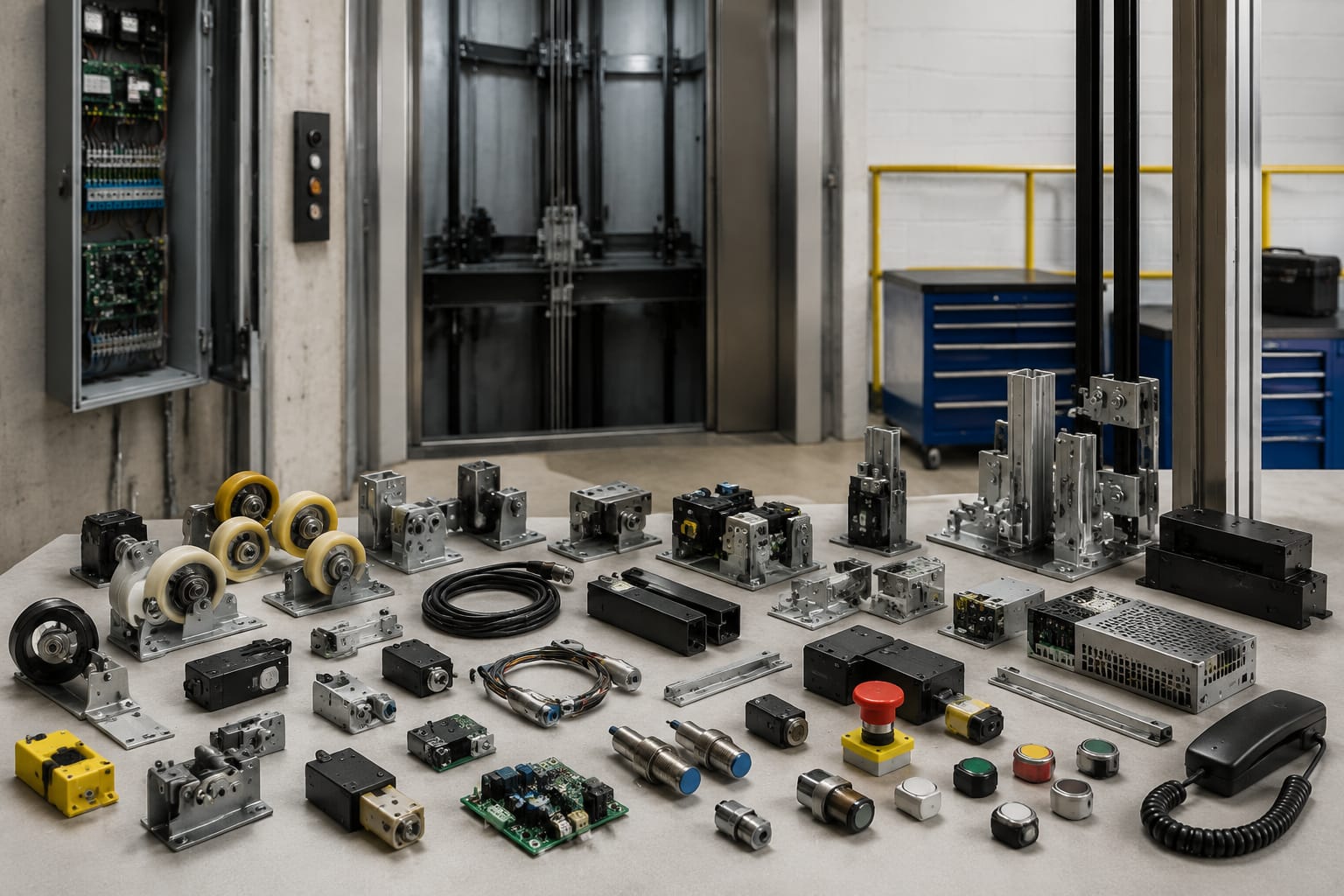
Elevator accessories are the electrical, mechanical and service parts that support an elevator's safe, reliable day-to-day operation. They range from small switches and landing buttons to door hardware, sensors, guide components and maintenance tools. Although many parts may look similar, the right choice depends on the lift model, interface, dimensions, duty rating and installation location.
For Philippine maintenance contractors, distributors and sourcing teams, the most useful approach is to classify the needed part by function first, then verify its exact technical match against the installed equipment. This reduces repeat site visits, incorrect deliveries and avoidable downtime.
What qualifies as an elevator accessory?
An elevator accessory is generally a component that supports operation, monitoring, access, passenger communication, door movement, cabin condition or servicing, but is not necessarily the main controller, traction machine or complete door operator.
The term covers both replacement parts and add-on items. A replacement accessory restores the original function of an installed lift. An add-on may improve usability, protection or monitoring, subject to the building's requirements and the lift system's compatibility.
Common categories include:
- Electrical switches, relays, sensors and interlocks
- Car operating panel buttons, landing call buttons and indicators
- Displays, alarms, intercoms and emergency communication equipment
- Door rollers, guides, contacts, locks, gibs and protective devices
- Cabin handrails, mirrors, fans, lights and protective fittings
- Guide shoes, oilers, lubricating materials and mechanical fasteners
- Inspection, adjustment and cleaning accessories for maintenance work
An accessory is not automatically universal because it performs a common function. For example, a landing button may have the same arrow symbol and voltage as another unit but still be incompatible due to its mounting cut-out, connector, communication protocol or faceplate dimensions.
Electrical switches and sensors
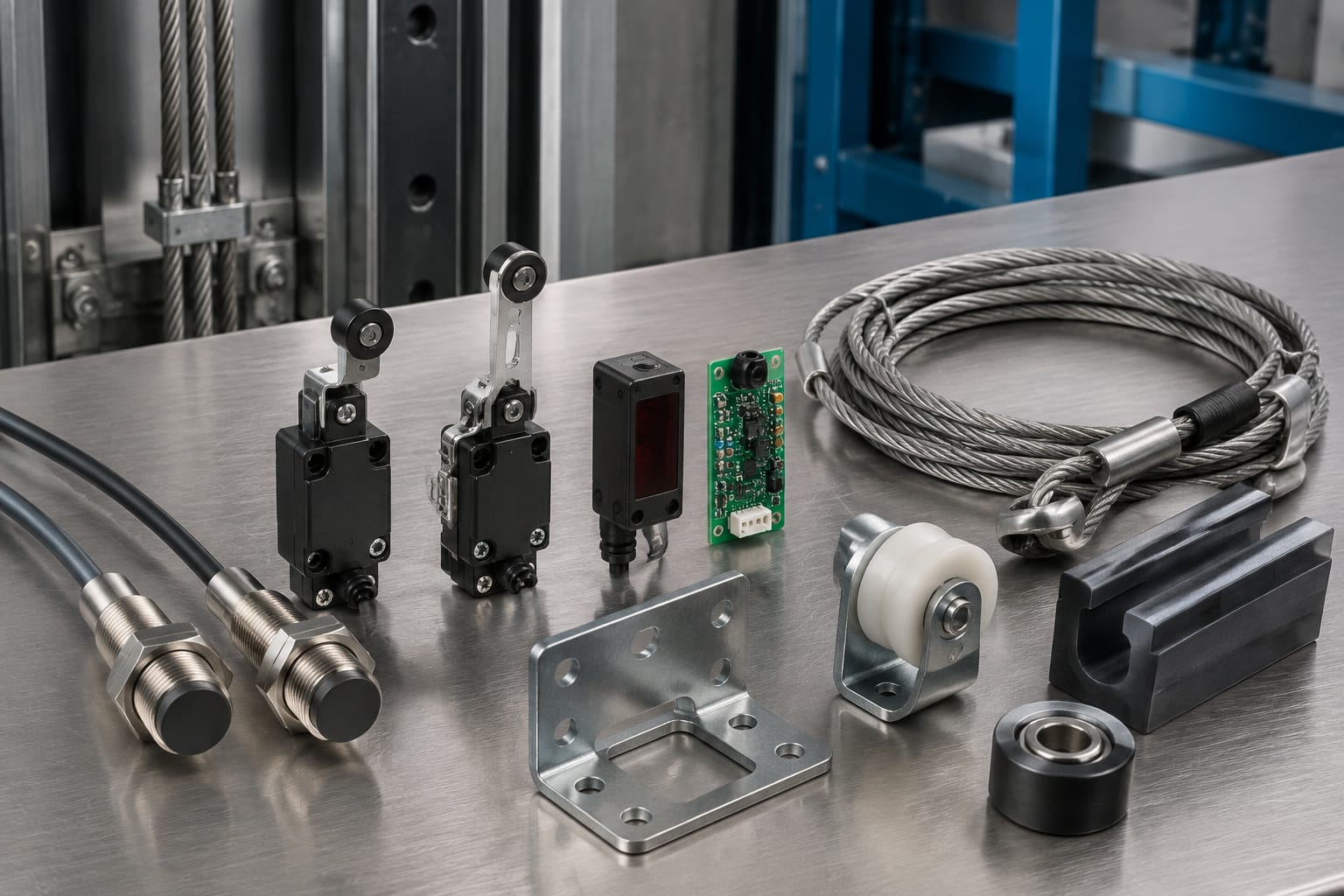
Electrical switches and sensors provide position feedback, safety monitoring and movement detection. They are small components with an outsized effect: incorrect actuation, wiring or contact configuration can prevent normal operation or cause intermittent faults.
Common switch and sensor types
| Part type | Typical role | Key checks before purchase |
|---|---|---|
| Limit switch | Detects travel or mechanism position | Actuator style, contact form, voltage/current rating, mounting |
| Leveling sensor or switch | Helps confirm car position at a landing | Original part number, sensing method, bracket position, wiring |
| Door zone sensor | Identifies the door zone for controlled door operation | Compatible magnets or vanes, sensing distance, controller interface |
| Turning or rotation detection switch | Monitors movement or rotation in relevant assemblies | Actuation method, electrical contacts, physical fitment |
| Proximity sensor | Detects a nearby target without physical contact | Sensor type, supply voltage, output type, sensing range |
| Safety switch | Supervises a guard, chain, access point or safety condition | Normally open/closed arrangement, safety circuit requirements, actuator |
A sensor must be selected as part of a complete sensing arrangement. Its operation may depend on a magnet, vane, cam, target plate, roller arm or mechanical bracket already installed on the lift. Replacing the sensor alone without checking the target alignment can leave the original fault unresolved.
For instance, a [cigarette rod leveling sensor switch for Otis elevator applications](/products/cigarette-rod-leveling-sensor-switch-otis-elevator-parts-lift-accessories-lift-accessories/) should be checked against the installed equipment reference, mounting arrangement and electrical connection before it is treated as a suitable replacement. The product name alone is not enough to establish compatibility.
Movement-related switches also require application-specific confirmation. A [Mitsubishi elevator turning detection switch](/products/elevator-turning-detection-switch-mitsubishi-lift-parts/) may be relevant where the existing assembly and reference match, but its use should be verified against the lift's original documentation and site condition.
Electrical checks that cannot be skipped
Before ordering any switch or sensor, confirm:
- Part number and revision: Record markings from the existing component, including suffixes and revision codes.
- Supply and load rating: Verify AC or DC supply, voltage, current, switching load and output configuration.
- Contact logic: Confirm normally open, normally closed, changeover or a specific electronic output type.
- Connector and cable details: Compare plug type, pin count, cable length and wire termination.
- Mechanical actuation: Check the roller, lever, rod, plunger or non-contact target arrangement.
- Environmental exposure: Consider heat, dust, moisture, vibration and oil contamination in the installation area.
- Safety circuit role: Do not substitute a safety-related device solely on the basis of physical appearance.
A multimeter reading can help diagnose continuity or supply issues, but it does not prove that a replacement is functionally suitable for a safety circuit. Commissioning should follow the lift manufacturer's procedures and be performed by suitably qualified personnel.
Buttons, displays, and communication parts
Passenger-facing elevator accessories need to be compatible technically while also matching the panel layout, accessibility requirements and expected building use. A visually similar button can differ in illumination voltage, mounting thread, connector arrangement or signal method.
Buttons and operating panels
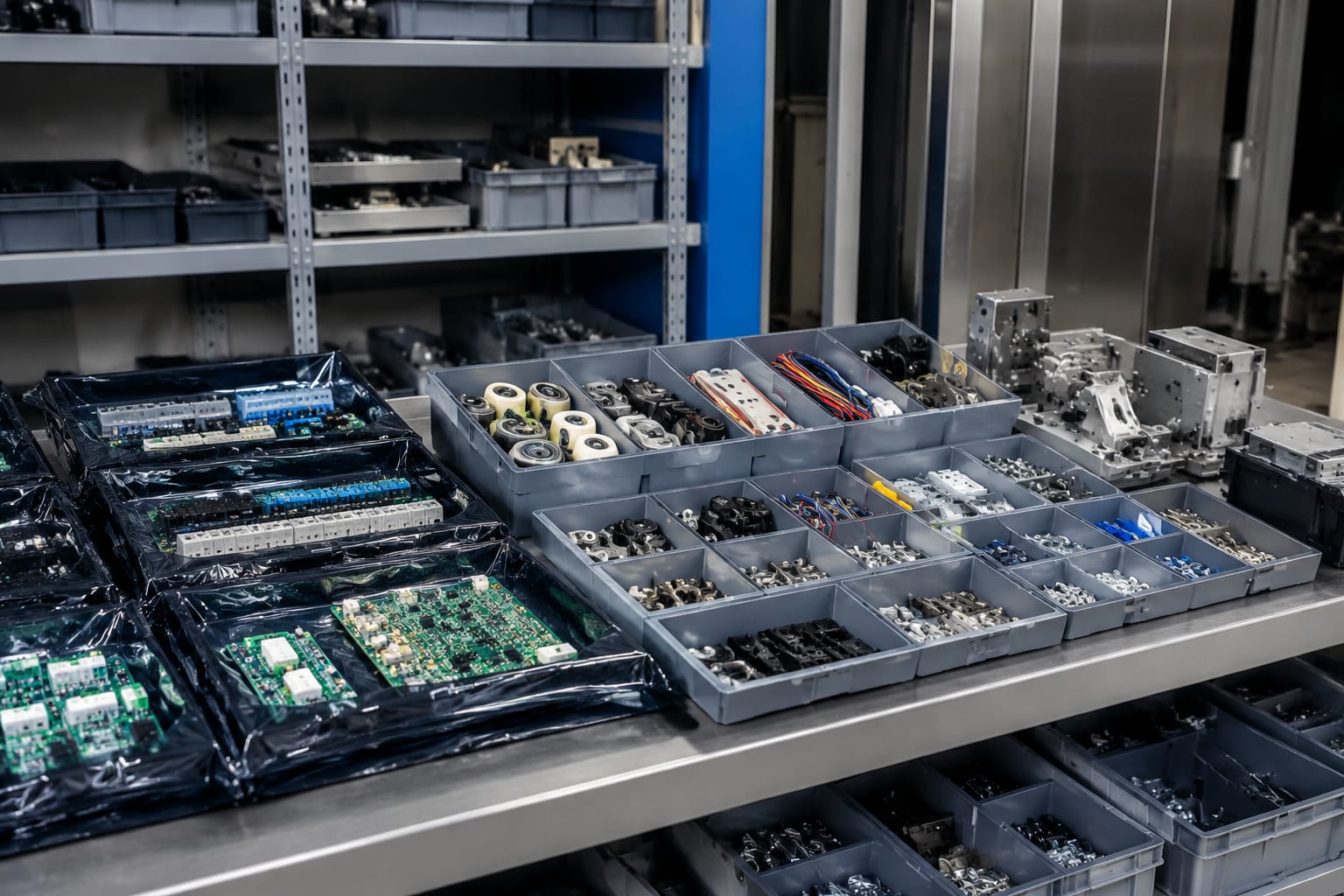
Typical button-related accessories include:
- Car operating panel push buttons
- Landing call buttons
- Door open and door close buttons
- Alarm buttons and key switches
- Fire service or special-operation switches where applicable
- Braille plates, legends, faceplates and button surrounds
- Button lamps, LED modules and retaining rings
When replacing a button, measure the panel cut-out and note the button body depth behind the panel. This is especially important when space is limited inside a car operating panel or landing fixture. Also check whether the button uses dry contacts, a specific board connection, a serial bus or a proprietary module.
For modernisation work, replacing a complete set of buttons may produce a more consistent appearance than mixing different illumination colours, tactile profiles or faceplate finishes. However, a full panel refresh can require wiring, programming or controller-interface changes beyond the scope of a simple accessory replacement.
Displays and indicators
Displays and indicators may show floor position, direction of travel, lift status or service messages. Common items include:
- Car position indicators
- Hall lanterns and direction arrows
- Landing position displays
- Dot-matrix or segment display modules
- LCD or TFT display units
- Gong units and audible arrival indicators
Compatibility checks should cover the display's power supply, communication interface, mounting frame, visible opening size and firmware or controller requirements. A display can fit the panel physically yet remain blank or show incorrect information if the controller cannot communicate with it.
Emergency communication accessories
Communication parts may include alarm bells, intercom handsets, speaker grilles, microphones, emergency call buttons and associated accessories. Their selection should account for the building's emergency communication arrangement, wiring route and test procedure.
Do not assume a replacement communication unit can simply be connected to any telephone, intercom or monitoring system. Confirm the interface type and the required operation during a power interruption where relevant to the installed system.
Door and cabin accessories
Door and cabin accessories affect passenger experience, reliability and equipment protection. Door components, in particular, move repeatedly and must match the door operator arrangement exactly.
Door accessories
Common door-related parts are:
- Door rollers and hanger rollers
- Door gibs and guide shoes
- Door vane assemblies
- Door contacts and contact assemblies
- Landing door locks and related actuators
- Door restrictors
- Light curtain or door protection sensor components
- Sills, sill guides and debris guards
- Door clutch and coupling-related pieces
Door rollers should be checked for wheel diameter, groove profile, bearing type, shaft bore, bracket shape and load arrangement. A roller that turns freely by hand may still be unsuitable if its profile does not align with the track or if its offset changes the door panel position.
Door contacts and locks belong to critical operating and safety arrangements. Confirm the complete assembly relationship, including the mating contact, lock body, actuator, mounting holes and circuit configuration. Adjustments should not be used to force a near-match part into service.
A door protection device also needs a full-system check. Verify the opening height covered, transmitter and receiver arrangement, cable routing, controller connection and any configuration required after installation. Damage to a sill or misaligned door panels can imitate a sensor fault, so inspect mechanical conditions before replacing electronics.
Cabin accessories
Cabin accessories commonly include:
- Handrails
- Mirrors
- Cabin fans and grilles
- Light fittings and diffusers
- Emergency light components
- Ceiling clips and panels
- Floor-edge trims and protective plates
- Ventilation and decorative hardware
- Car apron-related accessories where relevant to the installation
For cabin parts, match material, finish, dimensions and fastening method to the existing interior. In humid conditions or buildings with heavy daily use, corrosion resistance and ease of cleaning can matter as much as appearance. Any modification that changes cabin weight, electrical load or required clearances should be evaluated as part of the lift system, not treated as a cosmetic replacement.
Guide, lubrication, and mechanical items
Mechanical elevator accessories help control car and counterweight movement, reduce wear and support correct alignment. Their condition can affect ride quality, noise and the service life of larger components.
Guide shoes and related parts
Guide shoes, rollers, liners and inserts keep the car and counterweight aligned with the guide rails. Depending on the lift design, the arrangement may use sliding guides, roller guides or a combination of components.
Before sourcing guide-related parts, confirm:
- Car or counterweight application
- Guide rail size and profile
- Shoe body dimensions and mounting centres
- Liner material or roller dimensions
- Adjustment range and hardware arrangement
- Whether the part is supplied as a complete assembly or only an insert
A guide shoe insert should not be chosen only by its external length and width. The retaining profile, material hardness and required clearance also matter. Incorrect fit can create noise, accelerated rail wear or poor guidance.
Lubrication and mechanical service items
Lubrication-related accessories may include oilers, wicks, reservoirs, brushes, lubricating pads and fittings. These should be assessed with the approved lubricant and the condition of the rail or moving surface in mind.
More lubricant does not necessarily solve noise or rough travel. Excess oil can attract dust and contaminate nearby components, while insufficient lubrication can increase friction. Inspect rail condition, shoe adjustment and the actual delivery of lubricant before replacing an oiler or changing the lubricant type.
Other mechanical items may include springs, clips, brackets, bolts, pins, bearings and adjustment hardware. Generic hardware is appropriate only where dimensions, material grade and load requirements are known. For proprietary assemblies, the original reference and mating component remain the safer basis for selection.
Maintenance and service accessories
Maintenance accessories help technicians inspect, adjust, protect and restore lift equipment. They are not substitutes for a planned maintenance procedure, but the correct supporting items can make routine work more consistent.
Useful service accessories may include:
- Inspection-box covers, labels and replacement hardware
- Cleaning brushes and non-residue cleaning materials suited to electrical equipment
- Door sill cleaning tools and debris guards
- Lubrication applicators and replacement wicks
- Panel fasteners, locks and keys where authorised
- Cable markers and durable identification labels
- Test leads and measuring accessories appropriate for qualified technicians
- Protective covers for components during renovation or nearby construction work
Keep consumables separate from critical safety replacements in purchasing records. Brushes, cloths and standard fasteners may be managed as routine stock, while safety switches, door contacts and model-specific electronic modules need tighter traceability.
An escalator accessory should likewise be specified by its safety function and installed assembly. For example, an [Otis escalator chain break switch](/products/escalator-chain-break-switch-otis-elevator-parts-lift-accessories/) requires confirmation of the exact equipment application, mounting and circuit requirements. It should not be ordered as a generic switch.
Check model, dimensions, and ratings
A disciplined verification process is the most effective way to source elevator accessories correctly. The following order works for both one-off repairs and stock purchasing.
1. Identify the installed equipment
Record the lift manufacturer, model, controller family, door operator type and relevant assembly location. Take clear photos of the component in place, its label, connectors, bracket and surrounding interfaces.
The manufacturer name is useful, but it is only one identifier. The same brand can use different parts across model ranges, years and controller generations.
2. Capture the exact part reference
Use the full part number from the existing unit or equipment documentation. Include all suffixes, revision marks, date codes and connector labels. A missing suffix can distinguish a different voltage, firmware version, cable length or mechanical configuration.
3. Measure the physical interface
For mechanical items, measure the details that control fit:
- Overall length, width and height
- Hole spacing and thread size
- Shaft diameter and bore size
- Roller or wheel diameter
- Bracket offset and orientation
- Cable exit direction
- Panel cut-out and visible face dimensions
Photographs should include a scale reference where possible. A ruler alongside the item helps a supplier or purchasing reviewer verify dimensions without relying on estimates.
4. Verify electrical and functional requirements
For electrical accessories, confirm:
- Input voltage and frequency where applicable
- Current or power rating
- Contact arrangement or signal output
- Connector type and pin assignment
- Required controller interface
- Required operating state or sensing distance
- Any programming, setup or calibration requirement
A matching voltage alone does not establish compatibility. A 24 V device may still differ in output type, polarity, communication method or duty rating.
5. Compare the full assembly
Check the accessory against the components it connects to. A landing button must match the fixture and controller input. A sensor must match its target and bracket. A roller must match the track, shaft and door hanger. This assembly-level comparison catches many ordering errors before delivery.
Avoid compatibility and ordering mistakes
The most common procurement problem is treating an elevator accessory as a generic item because its shape or basic function appears familiar. In lift equipment, small differences can have operational consequences.
Mistakes to avoid
Ordering from a photo alone. A photo is useful evidence, but it rarely confirms electrical ratings, hidden mounting dimensions or revision details. Combine it with the label, measurements and application information.
Using only the equipment brand. “Part for [brand] elevator” is too broad for most electrical and door accessories. Provide the specific lift or component reference.
Replacing a failed part without finding the cause. A burnt switch, damaged roller or repeated sensor fault may be caused by misalignment, water ingress, door impact, cable damage or incorrect adjustment. Replacing the part without addressing the cause can lead to another failure.
Assuming an aftermarket equivalent is automatically interchangeable. An equivalent may be appropriate when its full technical and mechanical specifications have been verified. It should not be selected solely because the name, colour or connector appears similar.
Ignoring handedness and orientation. Left-hand and right-hand door items, cable exit directions and bracket orientations are frequent sources of incorrect orders. Describe the position from a clear, agreed viewing direction and provide photos.
Combining unrelated revisions without review. Mixing display modules, button boards or electronic components from different revisions may create communication faults. Confirm compatibility across the relevant controller and fixture assembly.
Failing to define the supply scope. State whether the requirement is for a complete assembly, one sensor, a cable, mounting hardware, a lamp module or a replaceable insert. This avoids receiving a partial part when a complete unit is needed.
A practical purchase request checklist
Include these details in an internal requisition or supplier enquiry:
- Equipment brand, model and application location
- Full existing part number and readable label photos
- Quantity required and whether it is for stock or an active repair
- Dimensions, mounting details and orientation
- Electrical rating, connector and contact or output type
- Photos of the installed part and mating components
- Whether an original-reference replacement or a verified equivalent is required
- Any site restrictions, such as limited panel depth or specific cable length
- Required documentation or confirmation from the supplier
For recurring parts, create an approved item record after the first successful verification. Record the part reference, equipment application, photos, dimensions and notes on installation. This makes future sourcing faster without removing the need to check revisions or site-specific changes.
The right elevator accessories are the ones that match the equipment's function, interfaces and operating conditions, not merely its brand or outward appearance. For multi-brand sourcing, Kelevator supplies elevator spare parts to B2B importers, distributors, maintenance contractors and OEM buyers. Start any requirement with the installed part reference, clear photographs and the checks in this guide so the requested item can be assessed accurately.